Ahead of midterms, federal court strikes down NH proof-of-citizenship voter registration law
May 29, 2026 | 5:00 pm ET
Description
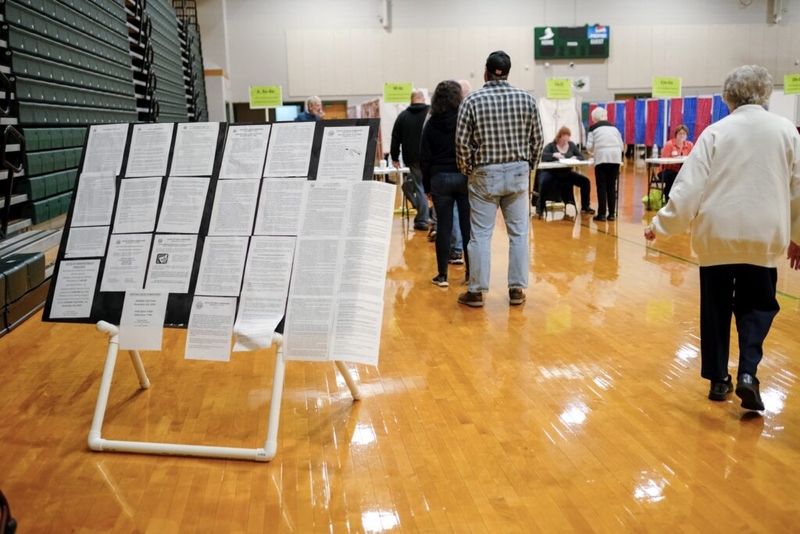
The judge ordered the state to immediately stop enforcing the new law. (Photo by Will Steinfeld/New Hampshire Bulletin)
A federal judge struck down New Hampshire’s new law requiring hard-copy proof of citizenship for voter registration Thursday, finding it unconstitutional, in a move that could stop its implementation for the midterm elections.
In a 98-page order, Judge Samantha Elliott held that the law imposed an excessive burden on the right to vote. She wrote that it would particularly affect people who might not have easy access to citizenship documents, such as college students, those without passports, those who changed their name after marriage, and those born out of state.
“A law that delays registration, even by one day or a few hours, is more likely to deprive qualified voters access to the ballot,” Elliott wrote.
Elliott ordered the state to immediately stop enforcing the new law.
Reacting to the ruling on Friday, Secretary of State Dave Scanlan confirmed his office would tell local officials to allow New Hampshire voters to register to vote without producing citizenship documents. But he said new voters will still be expected to provide documentary proof of their identity, age, and domicile when registering — issues the ruling did not address.
Plaintiffs in the lawsuit and state Democratic leaders rejoiced Friday, arguing the ruling halts a law, House Bill 1569, that would have disenfranchised voters in the September state primary and November general election.
“This decision is a victory for New Hampshire voters and for the fundamental freedom to vote,” said Liz Tentarelli, president of the League of Women Voters of New Hampshire, in a statement. “Granite Staters deserve a system that makes it possible for eligible voters to participate without unnecessary hurdles or confusion.”
The League of Women Voters was one of several plaintiffs in the lawsuit, including New Hampshire Youth Movement, the Coalition for Open Democracy, the Forward Foundation, and three individuals who said the new law would affect their ability to vote. The groups were represented by the New Hampshire and national branches of the American Civil Liberties Union, as well as the Boston-based Ropes & Gray LLP.
In a statement Friday afternoon, a spokesman for the Attorney General’s Office, which is defending the law, said “we intend to pursue an appeal in this matter.”
“We are disappointed with the court’s decision and are carefully reviewing the order at this time,” the spokesman, Michael Garrity, said. “HB 1569 represents a common-sense approach to voter registration and election administration designed to protect the integrity of our elections.”
Republicans also railed against the decision, calling Elliott, who was nominated to the court by President Joe Biden, a “progressive” judge and contending she had wrongly inserted herself into a legislative matter and misapplied the law.
“I am not surprised that an unelected judge ‘appointed’ by the autopen in 2021 would push far-left Democratic policies on the people of New Hampshire,” Rep. Ross Berry, a Weare Republican and the chairman of the House Election Law Committee, said in a statement Friday. “The vast majority of Granite Staters support common sense election integrity laws.”
Voter fraud concerns not founded
When it took effect in 2024 — a week after the presidential election — the new law imposed one of the strictest voter eligibility measures in the country.
Passed via HB 1569, the law requires a New Hampshire resident registering to vote for the first time to produce a document proving that they are a U.S. citizen, such as a birth certificate, a passport, a naturalization certificate, a federally issued certificate of citizenship, or consular report of birth abroad.
The law imposed a no-exceptions policy: It eliminated the previous option for someone without access to those documents to fill out a “qualified voter affidavit,” attest they were a U.S. citizen on penalty of voter fraud charges, and register to vote.
The law also changed the process for challenges of voters on Election Day. Previously, if an observer at a polling place challenged the eligibility of a voter, that voter could fill out a “challenged voter affidavit,” allowing them to vote and for their qualifications to be investigated later. HB 1569 prohibited those affidavits, effectively requiring a challenged voter to obtain an emergency order from a state superior court before the polls closed in order to cast a ballot.
Republican lawmakers, who championed the bill, said both measures were necessary to close loopholes in the state’s process. They said the previous law allowed people to fraudulently complete the affidavits and vote, potentially affecting close elections even if they were later found to be ineligible.
The state Attorney General’s Office used those voter fraud concerns to defend the law in court. Lawyers for the state also argued that the laws were important to maintain public confidence in New Hampshire elections, and to reduce costly post-election citizenship investigations. By keeping out everyone without clear proof from registering in the first place, the state argued, those investigations would be unnecessary and the voter rolls would be secure.
But Elliott disagreed with those arguments. She ruled that historical instances of voter fraud in the state are too low to justify a state interest in the law, noting that of the 8.3 million ballots cast in New Hampshire elections from 1998 to 2024, there were 47 documented cases of wrongful voting, only eight of which involved non-citizens.
“If wrongful voting is rare in New Hampshire, wrongful voting by noncitizens is essentially non-existent,” she wrote.
Elliott also pointed to testimony by Scanlan that 90% of New Hampshire residents had confidence in the state’s election — as well the findings of a Special Committee on Voter Confidence in 2022 — to refute the idea that a law was needed to maintain that confidence.
And she disputed the state’s argument that verifying affidavits is a financial burden, noting there has never been a statewide investigation of citizenship affidavits because of the low rate of fraud.
Republicans have used the small investigation rate to argue there may be more fraud than is known.
Potential for disenfranchisement
Instead of voter fraud, most of Elliott’s decision centered on whether the law would disrupt lawful voters’ ability to cast a ballot.
Over a nine-day bench trial in February, experts for the plaintiffs argued that requiring that documentation would be burdensome and unnecessary. Elliott frequently cited that testimony in her ruling.
For instance, Elliott relied upon an analysis by Michael Herron, a Dartmouth professor of quantitative social science, that gave a “conservative” estimate that between 5,433 and 31,291 — and as many as 59,583 — eligible voters in New Hampshire currently lack documents to prove their citizenship.
Elliott also drew upon an analysis of New Hampshire voting data by Rutgers political science professor Lorraine Minnite, author of the book “The Myth of Voter Fraud,” to conclude that fraud in the Granite State is rare.
Because the law was delayed to take effect shortly after the November 2024 presidential election, it has not been tested on a major, statewide voting day. But it has affected town meetings, municipal elections, and special elections conducted in the past 18 months.
Lawyers for plaintiffs noted that hundreds of would-be voters appear to have been turned away from the polls during those smaller elections because they lacked proof of citizenship, pointing to unofficial tallies by voting rights organizations. (The contested law does not require those documents from all voters on Election Day — only voters who are not currently on the state voting rolls and are seeking same-day registration.)
Since the documentation law took effect, Republican lawmakers have passed legislation aimed at reducing this risk. In 2025, Gov. Kelly Ayotte signed a law, House Bill 464, that sought to allow local election officials to access a statewide database to help confirm a person’s citizenship using state vital records and Division of Motor Vehicles records. Lawyers for the state used that law to argue measures had been taken to prevent disenfranchisement.
But Elliott rejected that argument, noting that 60% of New Hampshire registrants were born in another state and would thus not be in that database.
She also raised concerns over people who change their last names after getting married. People in those situations might have birth certificates that clash with the name on their voter registration form, and the state database does not include marriage records to address that confusion, Elliott noted.
“HB 1569’s elimination of the QVA to prove citizenship will have a particularly detrimental impact on young residents and married women,” Elliott wrote.
Overall, Elliott’s ruling agreed with plaintiffs that the repeal of qualified voter affidavits and challenged voter affidavits violated potential voters’ First and 14th Amendment rights. She also ruled that the removal of challenged voter affidavits — and the requirement for those challenged to appeal to superior court to vote — violated due process rights.
In ruling for the plaintiffs, Elliott applied the “Anderson-Burdick test” a legal framework named after two U.S. Supreme Court cases that allows courts to decide whether a law — particularly a voting law — adequately balances the state’s interests against the ability for voters to participate in the electoral process.
“Because New Hampshire does not offer provisional ballots or provide a ‘day after’ election day on which an eligible voter can register and still vote in that election, there is no ‘safety valve’ to allow voters who arrive at the polls without (proof of citizenship) to register to vote,” she wrote.
In an unusual move, Elliott also rebuked the state’s attorneys for what she said was an “ambush” against the plaintiffs during the court proceedings. She noted that the state presented information about the new voter registration database during the discovery period but did not correct that information before the trial when they realized it was no longer correct. She also said the state had ignored requests by the plaintiffs to provide certain information before the trial.
Those failures, Elliott concluded, meant that some of the plaintiffs’ witnesses relied on inaccurate information in their testimony, and deprived attorneys of all the facts necessary to adequately cross-examine the state’s witnesses.
“Here, the defendants offered testimony at trial regarding HB 464’s implementation that they never disclosed to the plaintiffs despite repeated requests and an order from this court,” Elliott wrote.
Elliott said the behavior warranted sanctions against the state according to federal rules of civil procedure — which would allow her to give certain testimony by the state “lesser weight” — but she added she did not need to deploy those sanctions because she was already ruling in favor of the plaintiffs.
Garrity did not respond to a request for comment about that admonishment.
Future unclear
It is not immediately clear what will happen next. If the Attorney General’s Office seeks to stay Elliott’s ruling and allow the new law to take effect over the 2026 elections, it will likely file a motion to do so with the U.S. District Court and then, if unsuccessful, appeal the request to the 1st Circuit Court of Appeals.
Garrity also did not respond to a question about whether the state will do so.
Meanwhile, plaintiffs have previously asked for the court to order the state to pay for their attorneys’ fees. In her ruling Thursday, Elliott requested the plaintiffs to submit briefs to support that request in the next 30 days.
Henry Klementowicz, an attorney for the American Civil Liberties Union of New Hampshire, which is helping represent plaintiffs, confirmed Friday that the plaintiffs would file a motion seeking the attorneys’ fees. But he noted that action could be postponed until later if the state files an appeal.
Concord, NH