Judge expects Alabama Supreme Court to get Tommy Tuberville residency case
Jun 30, 2026 | 6:01 am ET
Description
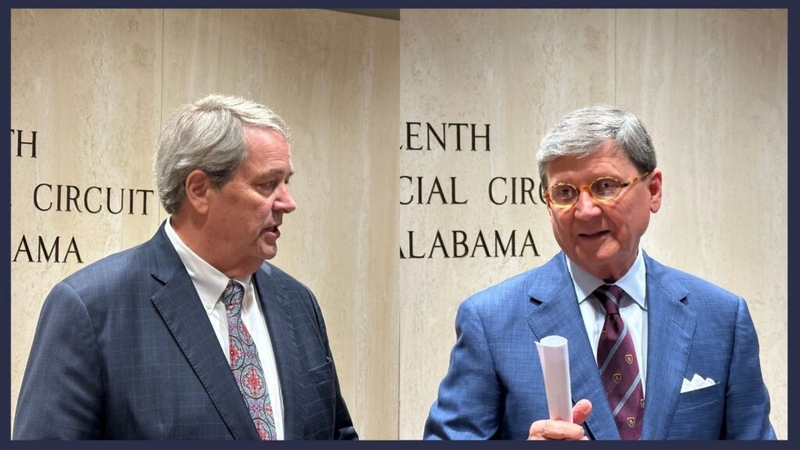
Barry Ragsdale (left) and Joe Espy (right) speaking to the media after a hearing on a motion to dismiss a lawsuit against Alabama Republican gubernatorial nominee Tommy Tuberville on June 29, 2026, in the Montgomery County Courthouse in Montgomery, Alabama. Montgomery County Circuit Judge Brooke Reid did not rule on the motion after three hours of arguments Monday afternoon. (Anna Barrett/Alabama Reflector)
Attorneys argued for nearly three hours in a Montgomery courtroom Monday about whether to allow a challenge to U.S. Sen. Tommy Tuberville’s ability to run for governor to move forward.
Montgomery County Circuit Judge Brooke Reid did not rule on a motion from Tuberville’s attorneys to dismiss a motion known as quo warranto, which challenges whether the Republican gubernatorial nominee has lived in the state long enough to meet constitutional requirements to run for governor.
“I understand the arguments on both sides, and certainly the argument that the court doesn’t have jurisdiction, and I get that argument,” she said. “It’s more helpful or instructive if there is a case directly on point that’s a bright line.”
Reid said her decision will likely not be the final word, and the Alabama Supreme Court will have final say.
Attorneys for the U.S. Senator and two plaintiffs challenging his residency cited various cases dating back to at least the 1940s to support dismissing the case or moving forward. Neither Tuberville nor the plaintiffs were present at Monday’s hearing. Reid said that there was not a single case that explicitly supported either side.
In previous cases, quo warranto has only been used against defendants who are already elected. Joe Espy, one of Tuberville’s attorneys, said the case should be dismissed because his client has not been elected as governor yet.
“Your Honor, the plaintiffs have a mountain to climb, and they’re barely at the base with nowhere to go,” Espy said.
Barry Ragsdale, an attorney for the plaintiffs, acknowledged that there has not been a recorded quo warranto case against a party nominee, but that the Alabama Supreme Court has not said it is incorrect.
“Now, I personally believe that, because in our 200-some-year history, we’ve never had an out-of-stater try to run for governor,” he said. “There’s a reason why it doesn’t come up.”
The lawsuit alleges that Tuberville has not lived in the state for seven years and does not meet the residency requirements to be Alabama’s governor. It is the fourth challenge of its kind, but the first brought from outside the Republican Party.
The Montgomery lawsuit does not challenge the results of the May primary, which Tuberville won with 85% of the votes. Ragsdale said the question of the suit is about the constitutionality of Tuberville’s candidacy.
“It violates all those cases that we cited, your honor, in which we say it is the exclusive, solemn purview of the courts to interpret the Constitution. Their position, when it’s boiled down to its essence, judge, is that only the Republican Party gets to say what the Constitution means,” Ragsdale said.
Espy said it is the Alabama Republican Party’s job to determine a candidate’s eligibility. The party in mid-June heard a challenge to Tuberville’s win and his residency brought by his former opponent Ken McFeeters, but rejected it due to insufficient evidence.
McFeeters also sued Tuberville in Covington County, but the judge dismissed his case on a lack of standing the day before the primary election.
“It is not a court’s decision, it’s the party’s decision, and that’s what they said, that’s what the law said,” Espy said. “It’s not my burden, it’s their burden. Give me a case.”
Tuberville has faced questions about his residency for years. He moved to Florida in 2017 but says he has maintained residency in Auburn since 2018. The suit alleges that Tuberville held a Florida driver’s license until 2023, which Mobile-based newspaper Lagniappe reported in May. It also alleges that he and his wife voted in Florida in 2018, after he moved to Auburn.
Tuberville lived in the state while he was the head football coach at Auburn University from 1999 to 2008, and told Alabama Daily News last year that time should count towards the residency requirement.
Should Tuberville win the November election and his qualifications be challenged again, it would be up to the Legislature. Espy said that would still be “up to the people” because the Legislature is an elected body.
“You have to accept the people’s voice. They don’t want to accept the voice of the people. We do. We want to accept the voice of the people, and want to follow the Constitution of Alabama,” Espy said after the hearing.
Republicans control the Legislature with a supermajority. In the 2026 elections, one-third of elections for the House of Representatives and fewer than half of the elections for the state Senate are contested.
Ragsdale said after the hearing that courts and not political parties decide how the Alabama Constitution is applied.
“In this instance, one of the requirements that’s in that constitution is that you have lived here for seven years before the election, that should matter, because frankly, somebody who wants to be governor ought to have to live here, ought to have to be in a situation where they interact with Alabama voters and Alabama citizens on a daily basis,” Ragsdale said. “He’s not running into a lot of Alabamians down in his gated community on the Gulf of Mexico.”
Reid said she would try to make a decision quickly.
Montgomery