After years of pleas to address water crisis, Morrisey begins two-day Southern WV listening tour
Aug 04, 2026 | 8:47 pm ET
Description
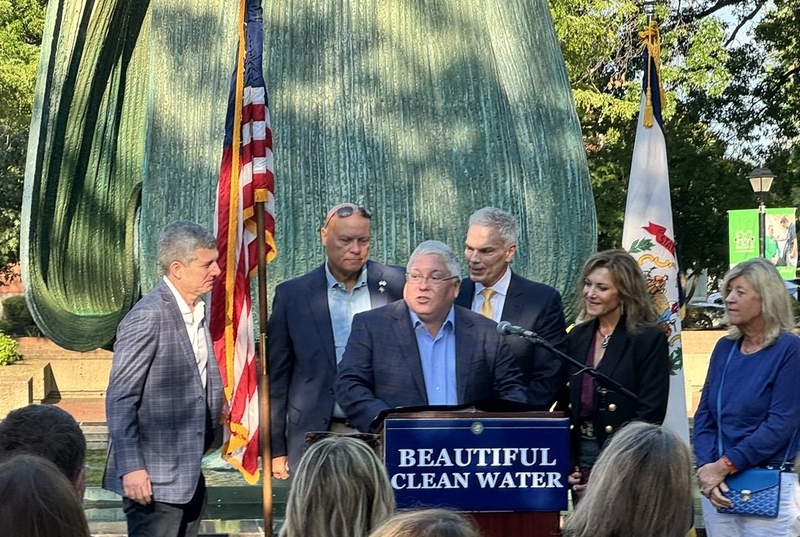
Gov. Patrick Morrisey announces his two day water listening tour at a stop in Huntington, West Virginia on Tuesday, Aug. 4, 2026. The governor is joined by Marshall University President Brad Smith (third from right). (Photo courtesy of Gov. Patrick Morrisey’s X account)
Gov. Patrick Morrisey announced Tuesday that he will be taking a brief listening tour around the state’s southern coalfields to hear about the persistent water issues residents in the region face.
The listening tour started on Tuesday and will go through Wednesday. Morrisey said during a news conference Tuesday morning that he will be stopping in four counties — Wayne, Mingo, Wyoming and McDowell — to meet with local officials and water operators and learn more about the challenges related to aging water infrastructure, poor water quality and struggling local utilities.
“We will be listening. We need to listen to learn about all the challenges that families are facing, and we know one of the big challenges that they’re facing deals with clean water,” Morrisey said. “… This isn’t about making speeches. This is about listening to what’s going on.”
The tour comes after residents in the coalfields have spent years — and, for some, decades — sounding the alarm on the crises unfolding in their backyards. Residents and advocates have shown up at the state capitol year over year begging for state-level attention on the issues, including increased funding to alleviate the challenges and a focus on correcting the root cause of some of them, like disturbances from nearby coal mining activities.
Morrisey said part of the struggle for the state in addressing these concerns has come down to red tape: different agencies working on the same projects in different capacities, competition for funds and potentially overpaying contractors for work to correct problems. The governor did not provide specific examples of these situations.
The governor also touted the state’s recent investments in water and wastewater infrastructure. In the last 18 months, Morrisey said, the state has put more than $550 million toward those projects, with about $174 million of that coming from state grants.
But that money is less than a drop in the proverbial bucket that’s needed to correct the southern coalfield’s ongoing water woes.
According to the Infrastructure and Jobs Development Council’s 2023 statewide needs assessment survey — the most recent published — it’s estimated that nearly $18 billion is needed to upkeep and rehabilitate the state’s existing water and sewage infrastructure as well as to expand water and sewage service to all structures in the state.
As of that report, about 64,000 West Virginians are not connected to a centralized water service, while almost 254,000 residents go without sewage service. Of those who are served, thousands more live with inadequate service — leaky lines that lead to high water loss rates, persistent service outages, long-term boil water notices, contaminants that could impact health and more.
Water infrastructure is expensive to fix for even well-funded utilities under the state’s current funding structures. A majority of the money available comes from long-term loan funds, which can be difficult to pay off for small, already cash-strapped utilities. The cost of those loans is often directly passed on to ratepayers, as bills paid by customers are the only source of income for most of the state’s public water and wastewater utilities. That means residents are left to pay higher rates for services that are still inadequate.
As of Tuesday, there were more than 380 open boil water advisories active in the state. About 10% of those notices are for systems within the coalfield counties (generally recognized as Boone, Lincoln, Logan, Mercer, Mingo, McDowell, Wayne and Wyoming counties). Data for Boone County was not available on the state’s public boil water notice dashboard.
Some residents have relied on public water utilities that have been under boil water advisories — due to a lack of certified operators, consistently leaking pipes and persistent contamination, among other reasons — for years.
And while the problem has centered on the southern coalfields — due to a combination of cash-strapped local governments as well as long term disinvestment from the state and private companies that, in previous generations, kept up the public services — water issues persist statewide.
In 2024, according to an analysis from the Charleston Gazette-Mail, more than 79% of the state’s public drinking water systems were found to have violations of the federal Safe Drinking Water Act. Nearly 30% of systems — the highest rate in the nation — had health-based violations.
Residents from affected areas have, for years now, shared photos and videos far and wide of what the water coming out of their faucets looks like. They’ve brought bottles to the state Capitol and hearings of the Public Service Commission, urging officials to take a drink if they don’t believe the issue is serious enough to warrant immediate response. Often that water is brown or yellow and murky. Sometimes it’s tinged with red, black or grey. The water stains clothes in the laundry, ruins expensive household appliances and, residents say, leaves some to develop skin rashes if used to bathe.
On Tuesday, Morrisey said he wants to hear directly from those who live with these challenges every day before moving the state forward with any sort of solution to the decades-old problem.
“The people closest to these challenges, they’re often the people with the best ideas for solving them, and that’s why we’re here … We want to hear directly from the people who know these issues the best,” Morrisey said. “We’re going to learn, and then we’re going to act and we’re going to do the right thing.”
Charleston, WV