Iowa sets new transmission standards for noise, guy wires, field strength
Aug 04, 2026 | 6:36 pm ET
Description
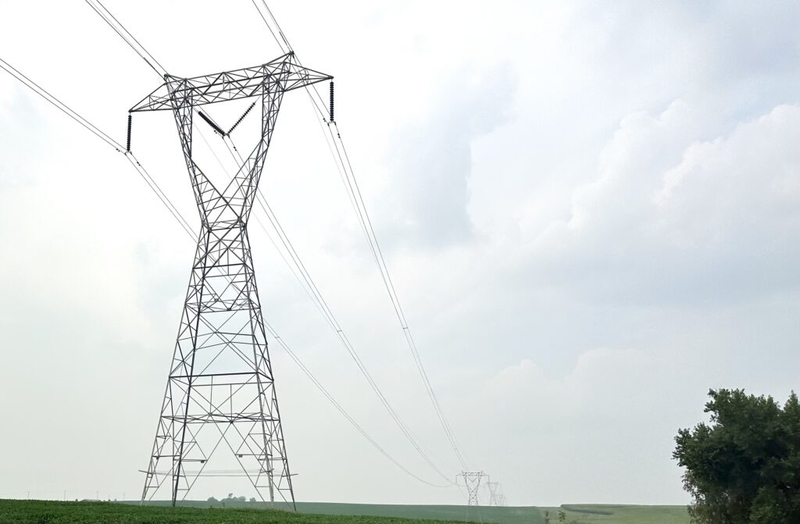
Transmission lines in farmland along U.S. 30. (Photo by Cami Koons/Iowa Capital Dispatch)
Newly adopted rules from the Iowa Utilities Commission aim to “mitigate potential impacts” of proposed large-scale transmission projects.
IUC asked the grid operators for the region to consider the rules, which it said address safety and technical issues, when evaluating transmission projects.
Under the new rules, transmission structures cannot be constructed on pasture and cropland with guy wires – wires that come off of the structure and into the ground to help stabilize – unless the landowner specifically allows these types of structures.
Large-scale transmission projects must also operate within a noise limit of 55 decibels for the majority of a one-hour measurement period and have an electric field strength of no more than 6,000 volts per meter when measured one meter above the ground within the right-of-way.
In a letter to Midcontinent Independent System Operator, known as MISO, which serves as the grid operator for the majority of Iowa, IUC said the new regulations were developed with engagement from transmission developers, industry stakeholders, farmers and advocates for the environment and consumers.
“We believe it is imperative for large-scale transmission projects to be designed in a manner that will help mitigate impacts on landowners and surrounding areas, thereby reducing the number of requests by companies to use eminent domain,” IUC said in the letter.
MISO’s long-range transmission planning phase known as Tranche 2.1 was a “catalyst” for the rulemaking, according to a news release from IUC.
Tranche 2.1 develops a 3,631-mile transmission “backbone” with a 765 kilovolt line to carry more electricity and reduce energy losses across the Midwest MISO region, according to MISO.
In its letter to the regional transmission organizer, IUC said the 765 kV lines proposed in Iowa will be the “largest scale of transmission infrastructure ever built” in the state. IUC said there are roughly 700 miles of 765 and 345 kV transmission projects proposed in Iowa.
The new rules apply to transmission lines operating with a maximum voltage of 170,000 volts or more and to project petitions filed after the start of calendar year 2027.
Iowa Farm Bureau Federation was supportive of the rule change through the adoption process and said in a filed comment that the rules “strike an appropriate balance between providing additional safety for landowners and cost when addressing some of the longstanding concerns with electric transmission lines going through agricultural land.”
Iowa Farm Bureau was especially supportive of the rule to require landowner permission for guy wired structures, which the bureau said are “difficult to work around with farm equipment and impose an increased safety risk on farms.”
Farm Bureau said the noise standard, at a maximum of 55 decibels, did not address “nuisance conditions, especially in the quiet rural areas where high voltage transmission lines are most likely to be placed.” According to Yale University, 55 decibels is about the sound of a household refrigerator.
The farm group also said the electric field strength limit of 6,000 volts could still “impact the behavior and productivity of cows and pigs.” The IUC’s letter to MISO said the limit was “shown to improve safety with respect to the size and scale of equipment used for row crop production and reduce impacts to livestock in pastures or barns.”
The letter asks MISO to “evaluate proposals and their project designs with consideration of these rules.”
A spokesperson for MISO said in a statement that the regional transmission organization’s processes “respect state and federal laws and regulations.”
The new rules follow a recently enacted law to require transmission line owners to repair agriculture land after transmission construction, including fixing tile drainage, tilling impacted soil and reseeding cover crops or conservation practices in the easement area. Iowa Farm Bureau was also supportive of this measure at the State House.
Des Moines, IA