Underly says it’s urgent to fix the school funding formula but timing will depend on the election
Sep 25, 2026 | 4:30 am ET
Description
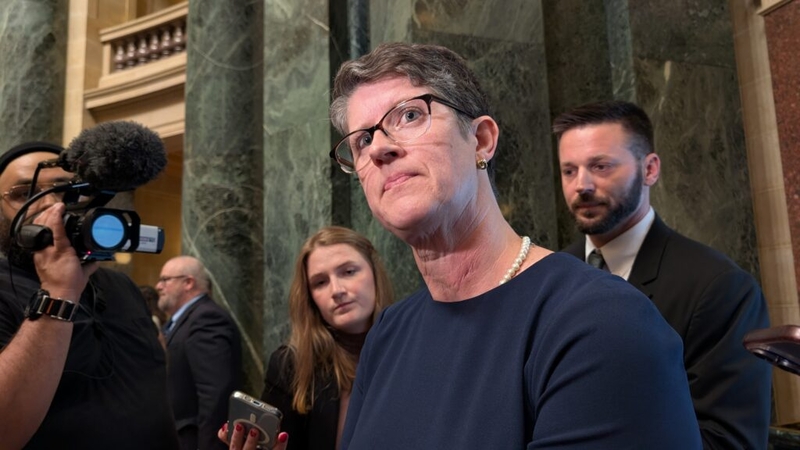
“The formula used for funding our schools, for years, has failed our children, schools and entire communities,” Underly said during her address. Underly speaks to reporters after delivering her sixth State of Education address. (Photo by Baylor Spears/Wisconsin Examiner)
Wisconsin State Superintendent Jill Underly called for the state to overhaul the school funding formula in her sixth State of Education address Thursday, saying that the state “simply cannot afford to wait any longer.”
Underly delivered the address less than six weeks before the November election, when Wisconsin voters will decide who she will be working with in the governor’s office and in the state Legislature on the next state budget. She will need their support to get the funding for the budget proposals she has begun to formulate.
The Department of Public Instruction so far has only submitted the first part of its budget request, which covered funding for libraries, support for children who are deaf and blind, public libraries, cybersecurity, technology modernization and the investigation of alleged educator misconduct. The agency said last week that it would release the second part of its request, for “categorical aid programs and other critical supports” for Wisconsin’s public schools, in November. The election is scheduled for Nov. 3.
“The formula used for funding our schools, for years, has failed our children, schools and entire communities,” Underly said during her address. “The reasons are varied and complex, but you don’t need to be familiar with every detail of the funding formula to know that it’s simply not working. The evidence is all around us.”
More than 75 school referendum requests carrying a total cost of $1.5 billion will go before voters in November. It’s just the latest round in a now-familiar ritual as school districts across the state seek approval to raise property taxes to make up for a shrinking pool of state aid. School districts that can’t pass a referendum have had to cut costs including by eliminating programs, staff and in some cases closing or consolidating schools. Districts on a streak of failed referendum requests have faced dissolution.
Underly noted that the classrooms of the Hustisford School District “sat empty” on the first day of school this year. The district started the dissolution process after its referendum failed in April.
“Every kid felt the impact,” Underly said. “Kindergarteners, who should have been walking through the doors of the school their family chose when they made this beautiful community home, instead traveled to a neighboring town. Meanwhile, seniors who spent the past 12 years as Hustisford Falcons started their last year of school in an unfamiliar building,” Underly continued. “This is what happens when we turn our back on our schools. And when schools close, the impact doesn’t stop with students. It ripples through entire communities.”
Underly said the state funding formula “places value on the wrong things,” including enrollment, district spending and property value, instead of on student needs.
“It fails to ask the most essential question: How much does it actually cost to educate the students who live in a district so that they have an equal opportunity to succeed? A student’s opportunity for success should not depend on their zip code,” she said.
School funding will depend on who’s in office. Republican candidate Tom Tiffany and Democratic candidate David Crowley are running to be governor and control of the state Senate and Assembly are up for grabs.
Some lawmakers have argued that rather than increase funding for schools the state needs to explore more school consolidation given declining enrollment. Asked about when school closure is the appropriate answer to declining enrollment, Underly told reporters she thinks “it deserves some study and conversation to figure out what’s best for kids.”
Underly pointed to the 2019 bipartisan Blue Ribbon Commission while speaking to reporters. The commission, which was created by Assembly Speaker Robin Vos and then-Senate Majority Leader Scott Fitzgerald in 2017, developed a report offering ideas to address school funding issues, as a guiding document for what the state should be doing. She said that the reports showed that there are kids who need additional support including those in poverty and who have special needs. She said money also needs to be invested in career and technical education, mental health supports and speech and language pathology.
“All these things have been in my past budget requests, and that’s what we will be able to expect in the next one, too,” Underly said. The agency’s 2024 state budget request totaled over $4 billion.
Urgent, but possibly not very fast
While Underly delivered her message with urgency, the timeline for changes could look vastly different depending on who wins in November.
Senate Minority Leader Dianne Hesselbein (D-Middleton), who could become the Senate Majority leader depending on the results of the November elections, has said Democrats will increase school funding in the next state budget, but changing the state’s school funding formula could be a “multi-year” process.
“We’re also looking at a long-term goal of seeing what other states are doing and how they are funding their public schools, but that’s going to take probably a multi-year task to try to figure that all out and talking to our friends in Minnesota, Michigan, Illinois,” Hesselbein said.
Crowley has been supportive of increasing school funding, including moving the state toward reimbursing districts for 90% of the cost of special education, instead of the current rate of 38% , but he has also suggested throughout his campaign for governor that there may need to be another Blue Ribbon Commission to study tax issues including school and local government funding. The last Blue Ribbon Commission on school funding took two years to complete.
Tiffany has said he wants some increases to school funding, but also promises to freeze property taxes if elected. He hasn’t provided clarity on how much he would invest or how he would balance the two issues. Tiffany has focused on issues of accountability and ensuring “high standards” as opposed to school funding when discussing education issues.
Underly has had a strained relationship with Republicans on the Joint Finance Committee, who have declined to invite her to testify in front of the committee, and it’s unclear whether a working relationship between her and Tiffany would be an improvement. Tiffany recently described the state superintendent’s position as a constitutional office as a “problem” at a Moms For Liberty Town Hall in Richfield. He said he would use the state budget, which determines the state’s spending for a two-year period, to try to steer the superintendent to make the decisions he wants her to make.
Underly said responding to the comments that independence is positive.
“When you think about my office, my office is nonpartisan. It’s independent. It is not at the whim of any governor and I think that actually strengthens public education,” Underly said. “I think his comments stand on their own.”
In her speech, Underly called for people to look at the candidates’ records on school issues, not their talking points, when making their decisions at the ballot box this November.
“We have people running for office who have spent a decade or more in government, in positions to make school funding decisions — or who have left state government for another level and now want to return — whose records include repeatedly voting against investments in Wisconsin’s children,” Underly said, apparently referring to Tiffany, who as a state lawmaker served on the budget committee before he was elected to Congress. “Past actions are the best evidence we have of what someone will do when given power again. Wisconsin does not need more people who tell us they support children while their votes tell a different story. We need people in positions of decision-making power who are pro-public school, pro-child and pro-Wisconsin.”
Madison, WI