Racial disparities ground challenge to Colorado Springs off-cycle elections
Sep 25, 2026 | 6:00 am ET
Description
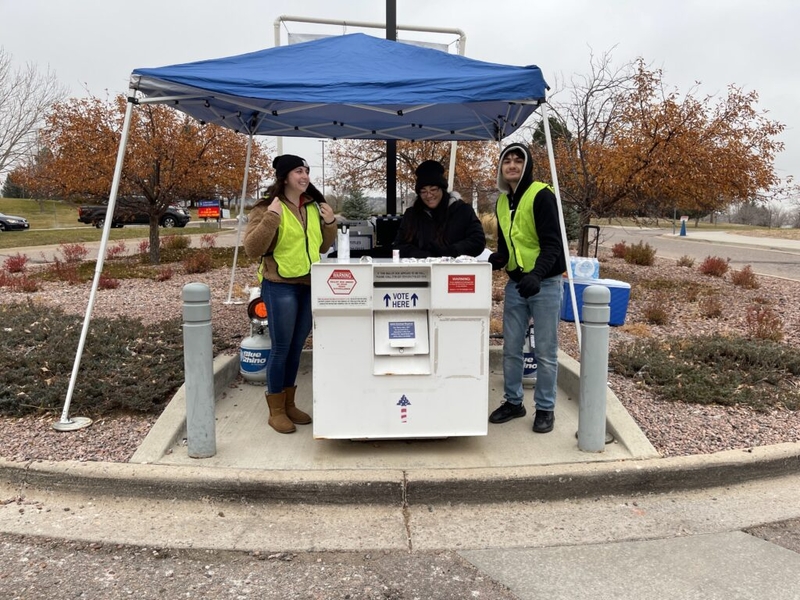
People hand out "I voted" stickers at the ballot drop off box outside the El Paso County Clerk's Office in Colorado Springs on Nov. 2, 2021. (Photo by Julia Fennell/Colorado Newsline)
Voting rights groups unsuccessfully sued Colorado Springs in 2022, arguing the timing of the city’s municipal elections led to a racial disparity in voter turnout. They’re trying again now that a new Colorado law creates a local enforcement mechanism.
The League of Women Voters of the Pikes Peak Region, Citizens Project and Common Cause Colorado — three organizations that advocate for civic engagement and voting rights — filed a lawsuit against Colorado Springs in June. Angela Peña De Niz, a Colorado Springs voter who has not been able to vote in the city’s spring elections, is also a plaintiff.
Plaintiffs want a court order that declares Colorado Springs’ off-cycle elections, which don’t occur in November alongside state and federal elections, amount to unlawful voter suppression under the Colorado Voting Rights Act, or COVRA.
COVRA, signed into law last year, prohibits election practices that limit the participation of people of color and other protected groups.
Colorado Springs, in its August motion to dismiss the lawsuit, argues it does not have to change the timing of its elections because the Colorado constitution grants the city the right to set the date of its own elections as a home-rule municipality. The city’s 1909 charter says its municipal elections will be held on the first Tuesday of April every second year.
The city also argues the 14th Amendment to the U.S. Constitution prohibits the use of race in setting election rules — citing a recent U.S. Supreme Court ruling that weakened the federal Voting Rights Act.
Plaintiffs, in their response to the city’s motion to dismiss the case, cite voter and census data that shows fewer Black and Hispanic voters participate in Colorado Springs’ April municipal elections. From 2017 to 2025, they participated in the city’s April elections at just over half the rate of white voters. But in November, Black and Hispanic voter turnout is nearly the same as that of white voters, the response says.
This actually is a really important notice to every other municipality that off-cycle elections in some contexts do create a racial vote turnout gap.
Many Colorado municipalities hold off-cycle local elections, including Denver. Denver and Colorado Springs both have municipal elections in April. But the plaintiffs challenged Colorado Springs’ practice because of the disproportionate turnout data, Aly Belknap, executive director of Common Cause Colorado, said. The city doesn’t dispute the numbers, she added.
More municipalities around the state should look at their turnout data and consider how aligning their election timelines would improve voter participation, Belknap said.
“This actually is a really important notice to every other municipality that off-cycle elections in some contexts do create a racial vote turnout gap,” Belknap said. “Turnout is really low in these off-cycle elections in … truly every single community where they’re held.”
‘It’s all about political power’
Shelly Roehrs, president of the League of Women Voters of the Pikes Peak Region, said her organization and other advocates approached the Colorado Springs City Council as early as 2014 with the idea of moving the municipal elections, and she said “there wasn’t a whole lot of interest.” The City Council could on its own change the timing of the city’s elections, or send a referendum to voters to make the change.
The League of the Pikes Peak Region joined a 2022 lawsuit that sought to move the elections under the federal Voting Rights Act, but a judge dismissed the case due to a lack of standing.
The League and other plaintiffs in the new lawsuit sent the city a notice of their intention to file a lawsuit, asking if city officials would be open to discuss options to amend the election timeline without going to court, Roehrs said. They had limited engagement from City Council members.
“They didn’t want to put any of their political chips into this basket because it wasn’t worth it,” Roehrs said. “It is so not about the voter. It’s all about political power, and once they’re in, they don’t care about voter(s).”
Voters get confused by elections happening in the spring since they are used to general elections happening in the fall, Roehrs said. She’s had voters tell her they didn’t believe her when she told them there was an upcoming election not long after a presidential election.
Julie Ott, also with the League of Women Voters of the Pikes Peak Region, said it also doesn’t help that the spring election sometimes falls on April Fools’ Day.
Colorado Springs has run ballot questions on November ballots, Ott said, and the turnout on those questions has been much higher than during spring elections. In the mayoral runoff election in 2023, Roehrs said, 135,000 voters participated, while over 235,000 people voted on city ballot measures on the November 2024 ballot.
The city clerk coordinates with the El Paso County clerk to run a municipal question on a general election ballot, ensuring only residents within the city have the question on their ballot. That’s, in theory, how aligning the municipal and general election timelines would work for the city if it makes the change, Roehrs said. It would also save the city money.
Plaintiffs filed a response Sept. 18 to oppose the city’s motion to dismiss. No trial in the case is scheduled yet.
Denver, CO