Advocates push repeal of gas pipeline program they say benefits utilities, not ratepayers
Mar 11, 2026 | 3:19 am ET
Description
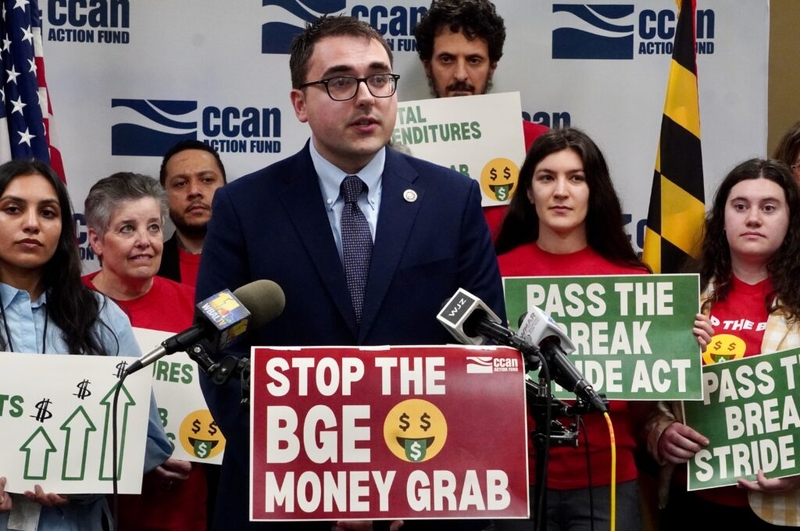
Del. Dylan Behler (D-Anne Arundel) speaks during a rally on March 10, 2026 in support of his bill that would repeal Maryland's STRIDE law, in an effort to slow utilities' spending on natural gas pipelines, which he argues has been excessive and raised customers' bills unnecessarily. (Photo by Christine Condon/ Maryland Matters)
Last year, the General Assembly tried to restrain STRIDE, the program that encourages utilities to upgrade aging natural gas pipelines.
This year, advocates are pushing for the program to be repealed altogether.
House Bill 1253, the “Break STRIDE Act,” would repeal a 2013 law that encouraged utilities to update aging and unsafe natural gas infrastructure by letting them recover the costs of their projects in advance — rather than after the fact.
But consumer advocates argue that STRIDE, which stands for Strategic Infrastructure Development and Enhancement, has incentivized utilities to spend excessively on infrastructure on the customers’ dime. In 2010, for instance, Baltimore Gas & Electric charged 26 cents per therm for gas delivery; as of February 2026, that figure had almost quadrupled, to 97 cents per therm, according to data from the Maryland Office of People’s Counsel.
“What we’re seeing across the state is a tremendous money grab by our corporate utilities,” said bill sponsor Del. Dylan Behler (D-Anne Arundel), during a news conference Tuesday.
During a hearing on the bill Tuesday before the House Environment and Transportation Committee, however, officials from BGE and from Washington Gas defended the program, arguing that it has led to proactive replacement of outdated infrastructure such as corroding cast-iron pipes that might have otherwise gone undone.
“Being proactive and targeting that specific type of material to do the replacement — it is more cost-effective than relying on chasing the leak and being reactive,” said Brittany Jones, vice president of governmental and external affairs at BGE.
She said that proactive replacement adds an average of $10 a month to a customer’s bill, while making repairs after leaks occur could end up costing customers $20 per month.
Del. Marc Korman (D-Montgomery), chair of the House Environment and Transportation Committee, took issue with that line of reasoning during the hearing.
“Prior to 2013, you’re telling me that the BGE did no proactive work whatsoever?” Korman said.
“That’s not what I think we’re saying here,” said John Frain, vice president of strategy and regulatory affairs at BGE.
“Well, that is what I and many members of the committee are hearing,” Korman said. “So, let’s try again.”
Frain then said that BGE would still complete proactive gas pipe replacements but “on a more limited scale.”
Gas companies could still choose to complete proactive infrastructure repairs, said Emily Scarr, a senior adviser for Maryland PIRG, even without preapproval from the Maryland Public Service Commission. They would build the projects first and then ask the commission for approval to recover the costs through rates.
“There’s a natural disincentive to spend wastefully if you don’t know you’re going to get that money back until you show the receipts later,” Scarr said. “But with forecasting, it sort of exacerbates this incentive to overspend.”
Officials from Washington Gas argued that the program has been a success, reducing gas leaks 41% since 2019, said Kevin Murphy, vice president of asset management, engineering and supply at the gas company.
“This level of progress simply would not have been possible without the support of the STRIDE legislation,” Murphy said.
STRIDE was updated last year by the Next Generation Energy Act, which required utilities to show that they analyzed the cost effectiveness of gas line replacements, among other updates. But David Lapp, the Maryland Pe0ple’s Counsel, argues that last year’s bill didn’t do enough to meaningfully slow down utility spending on gas. He believes the legislature should halt forecasted ratemaking altogether.
“We can try and nibble at the edges of things to reduce rates, or to provide customer relief,” Lapp said in an interview. “But we’re really just putting a Band-Aid on a scratch, while we’re still hemorrhaging.”
In filings before the Public Service Commission, utilities such as Washington Gas and BGE, have pointed out what they perceive as loopholes in the Next Generation bill.
BGE argued that it is not currently operating under a STRIDE plan, but rather baking its future gas infrastructure spending into its multiyear rate cases, so the changes made by the General Assembly “have no impact.”
Washington Gas argued that the law change couldn’t be applied to its 2026 project list, because their STRIDE plan was already approved by the PSC before the law took effect.
Behler’s bill would also require tha gas utilities notify customers two years in advance of gas line replacement work, a provision that drew some industry concern on Tuesday.
The idea is that, by giving homeowners ample notice of pipeline replacement, customers might consider electrifying equipment in their homes. If enough homeowners decided to electrify, some of the workload could be reduced.
But in practice, the two-year notice would be “completely unworkable,” said Brian Quinn, a lobbyist for Chesapeake Utilities, which provides gas service on the Eastern Shore.
“Suppose a hospital, nursing home or a residential customer with critical medical equipment at home wants to install a backup gas generator. Under this bill, that hospital or customer would have to wait two years,” Quinn said.
Often, gas companies do not know two years in advance that they plan to replace a particular pipeline, Quinn added.
The PSC, which regulates utilities, recently determined that 180 days worth of notice to customers was appropriate for gas line replacements, said Benjamin Baker, a senior commission adviser.
“We decided that 180 days was an appropriate amount of time to balance between giving customers an opportunity to consider if they would like to transition, and do electrification instead of continuing to use the gas system, without unduly burdening the utilities,” Baker said. “But obviously, we’ll work with whatever policies that you give us.”

Annapolis, MD