Advocates, elected officials urge hospitals to resume gender-affirming care for youth
May 22, 2026 | 4:00 am ET
Description
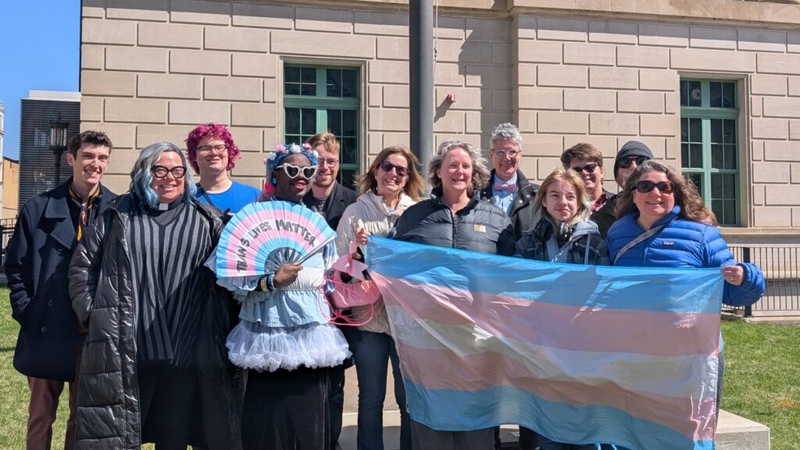
Madison Mayor Satya Rhodes-Conway and Wisconsinites take part in a city celebration for Transgender Day of Visibility on March 31, 2025. Rhodes-Conway is one of more than 90 elected officials who have urged Wisconsin hospitals to resume providing gender-affirming care that they stopped under a threat from the Trump administration. (Photo by Baylor Spears/Wisconsin Examiner)
A group of more than 60 nonprofits, advocacy organizations and businesses wrote to two Wisconsin health systems Thursday, urging them to resume gender-affirming care for minors that they halted five months ago.
The hospital organizations — UW Health in Madison and Children’s Wisconsin in Wauwatosa — stopped providing hormone medication and puberty-blocking medication to minors with gender dysphoria following Trump administration actions targeting such healthcare.
Thursday’s letter, led by the LGBTQ+ rights groups Fair Wisconsin and GSAFE, cites a federal judge’s ruling in April that threw out the administration’s order blocking gender-affirming care.
“Gender-affirming care is legal in Wisconsin, but it is increasingly more and more difficult to access due to decisions made to pause the provision of this care at your institutions,” states the letter. “These decisions must be reversed and care restarted immediately.”
Thursday’s letter was the second this week to UW Health and Children’s Wisconsin. On Tuesday, more than 90 elected officials from around the state released a letter urging both hospitals to restore the suspended services, “reaffirm [their] commitment to evidence-based care, and rebuild trust with the transgender and gender diverse community.”
“The most important thing for people to understand is that the support for this care is so much broader and deeper than people realize,” Abigail Swetz, executive director of Fair Wisconsin, told the Wisconsin Examiner Thursday. “I hope the leadership of these hospitals are seeing that in this letter and the others that are coming through.”
She said local groups, Madison TRAC and Reproductive Justice Action Milwaukee, are organizing petitions in their communities as well for the general public to sign.
Both hospitals released statements Thursday that acknowledged the concerns of families and their children seeking gender-affirming healthcare, but cited legal risks of providing such care.
“We know this issue matters deeply to many in our community, especially the patients and families we serve,” Children’s Wisconsin said.
“Due to ongoing legal and regulatory uncertainty affecting organizations and providers across the country, we are not currently providing gender-affirming pharmacologic care,” it said. “We recognize the impact this has on patients and families.”
Children’s said it continued to provide related mental and behavioral healthcare.
UW Health said it paused gender-affirming medication therapy for minors “due to ongoing federal actions that threaten health systems that provide this care.”
“While we continue to believe this is evidence-based care, threats from those federal actions are not fully resolved,” UW Health said. “Therefore, the current risk is too great to resume this care. We recognize the challenges faced by impacted patients and families and remain committed to providing patient-centered care and supporting their health and well-being throughout this critical time.”
Gender-affirming care is a response to gender dysphoria, which the American Psychiatric Association has defined as “psychological distress that results from an incongruence between one’s sex assigned at birth and one’s gender identity.”
Based on survey data collected by the federal Centers for Disease Control and Prevention between 2021 and 2023, the Williams Institute at the University of California at Los Angeles Law School estimated in an August 2025 report that 3% of adolescents ages 13 to 17 and 1% of adults 18 or older identify as transgender or nonbinary.
Swetz said that when health professionals provide gender-affirming healthcare, they do so because it is medically necessary.
“I think it is sometimes seen as something that is not essential, but it absolutely is medically necessary, because we know that when gender dysphoria is treated then the mental health of our trans youth just drastically improves,” she said.
Gender-affirming care is also provided based on what is appropriate for the person’s age, “and always, with the full consent of parents and guardians,” Swetz said.
For a child who hasn’t yet reached puberty, it entails counseling and other forms of behavioral therapy — not medication, she said. At the start of puberty, medication may be used to pause that process, along with hormone treatment, but it’s also “highly individualized,” she added.
“We’re talking about high quality care that is respectful and meets a trans youth exactly where they’re at, in the age appropriateness of the kind of care that will help move them forward in their lives and make it possible for them to live in a body that really feels like home,” Swetz said.
The two hospitals paused their use of gender-affirming care medication after a Dec. 18, 2025 declaration from Health and Human Services Secretary Robert F. Kennedy Jr. that threatened to withhold federal health dollars, such as Medicaid reimbursement, from providers offering gender-affirming healthcare for minors.
Wisconsin was one of 21 states and the District of Columbia that sued to block the federal rule. In late March, a federal judge in Oregon ruled for the states on summary judgment, and in April issued a written order that vacated Kennedy’s declaration.
The judge ruled that the declaration violated the Administrative Procedures Act; that Kennedy and HHS officials lacked the authority to override professional standards for gender-affirming care; and lacked the authority to exclude providers from federal programs for providing gender-affirming care that meets professional standards.
The order also includes an injunction forbidding “any materially similar policy which supersedes or purports to supersede the professionally recognized standards of care for gender-affirming care that exist” in the 21 states and D.C. that filed the lawsuit.
“They’re trying to make sure that the federal government can’t go around and just, like, do something in another name,” Swetz said. “And I think it’s important for people to know that Wisconsin specifically is one of the states.”
This report was updated to correct the organizers of local petitions in Madison and Milwaukee.
Madison, WI