Of 5K Utah voters needing to prove citizenship under new law, fewer than 2K have responded
Oct 15, 2026 | 3:16 pm ET
Description
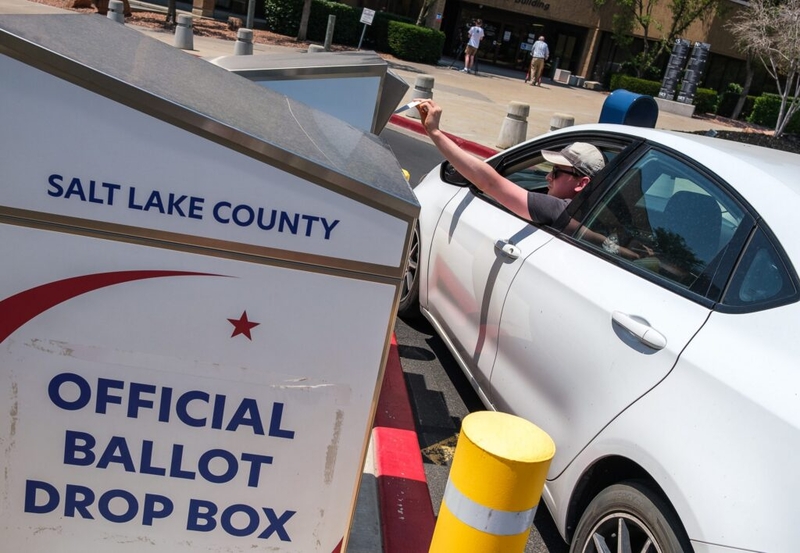
A voter drops off a ballot on primary Election Day at the Salt Lake County Government Center on Tuesday, June 23, 2026. (Photo by Marco Lozzi for Utah News Dispatch)
Of about 5,000 Utah voters who state election officials notified earlier this year needed to provide proof of their U.S. citizenship before this year’s November election, only 1,827 have responded and confirmed their citizenship, according to Utah’s lieutenant governor’s office.
Those voters received a ballot with state and federal races — but those who didn’t respond, 4,307, were sent a ballot in the mail this week with only federal congressional races printed on them.
A fraction — 57 — requested to be removed from Utah’s voter rolls because “either they could not confirm citizenship or otherwise asked to be removed,” the lieutenant governor’s office told Utah News Dispatch in a statement Wednesday.
More than 5,000 Utah voters need to provide proof of citizenship under new state law
“Voter rolls are always changing and we are continually working with county clerks to keep them updated — including verifying citizenship,” the office said.
The new proof of citizenship requirements were enacted earlier this year after the Republican-controlled Utah Legislature passed a new state law, HB209. It requires voters to provide “documentary proof” of their U.S. citizenship before the Nov. 3 election — or else they would be provided a federal-only ballot with no state or local elections.
Under that new law, Lt. Gov. Deidre Henderson’s office earlier this spring sent letters to 5,007 Utahns who had a citizenship status that her office was unable to confirm using existing documentation on file. The letters notified those voters of the state’s new proof of citizenship requirements.
Many of those were “legacy” voters, or registered to vote years before driver license or Social Security numbers were required to register under state law, Henderson said at the time.
With HB209, Utah lawmakers created a “bifurcated ballot system” for elections starting in November 2026. Federal law does not require proof of citizenship to vote for members of Congress or the president, though it maintains that only U.S. citizens can legally cast a ballot.
‘Not a widespread problem’: Lt. gov. releases early findings from voter citizenship review
“Federal law says that you only have to say you’re a citizen and attest to being a citizen under penalty of perjury,” Henderson said in May, when she issued a report on a state review that found 27 “noncitizen” registered voters in the state, a tiny fraction of the state’s 2 million.
“Our state law used to mirror that. And now this year it changed, so we can’t just tell (people who don’t provide proof of citizenship) they can’t vote. We would get sued and it would be unconstitutional,” Hendersaid said at the time. “So they would get a federal only ballot because now our state law has changed.”
Critics of the new law argued it would create unnecessary barriers for Utah voters and potentially disenfranchise them even if they’re eligible — especially elderly voters who have stayed on Utah’s voter rolls for decades but now may not have the documentation on hand to continue voting in all elections. They have also argued it would pile greater administrative burdens on election officials, while federal law already prohibits noncitizens from voting.
Proponents, including the law’s sponsor, Rep. Cory Maloy, R-Lehi, have argued it’s an added layer of security to ensure no one who isn’t a U.S. citizen casts a vote — and that if even a few noncitizens were on Utah’s voter rolls, “that’s a few too many.”
During a news conference on that report at the time it was issued, Henderson told reporters she’s “always concerned” about the potential for unintentional eligible voter disenfranchisement.
“It keeps me up at night,” she said in May. “Honestly, I’ve had a lot of angst about this.”
However, she also said that HB209 “serves a really valuable purpose.”
“I think it’s good to have a place to kind of sequester folks who don’t have that documentation in a way that doesn’t completely disenfranchise them,” she said. “I think the way we’ve done it is responsible and tries to balance the idea of preserving rights for people while also making sure that, you know, ineligible people aren’t registering (to vote).”
For those roughly 4,300 Utah voters who were only given by-mail ballots with the option to vote in their district’s congressional race and not any state legislative or local races, it isn’t too late.
“Voters can still provide proof of citizenship and receive a full ballot,” Henderson’s office said Wednesday. “The last day to mail ballots is Oct. 28, but voters are also able to show proof of citizenship to their county clerk on Election Day.”
Salt Lake City, UT