What the story of a pawn shop camera can teach us about human creativity — and the need to foster it
Nov 29, 2026 | 4:33 am ET
Description
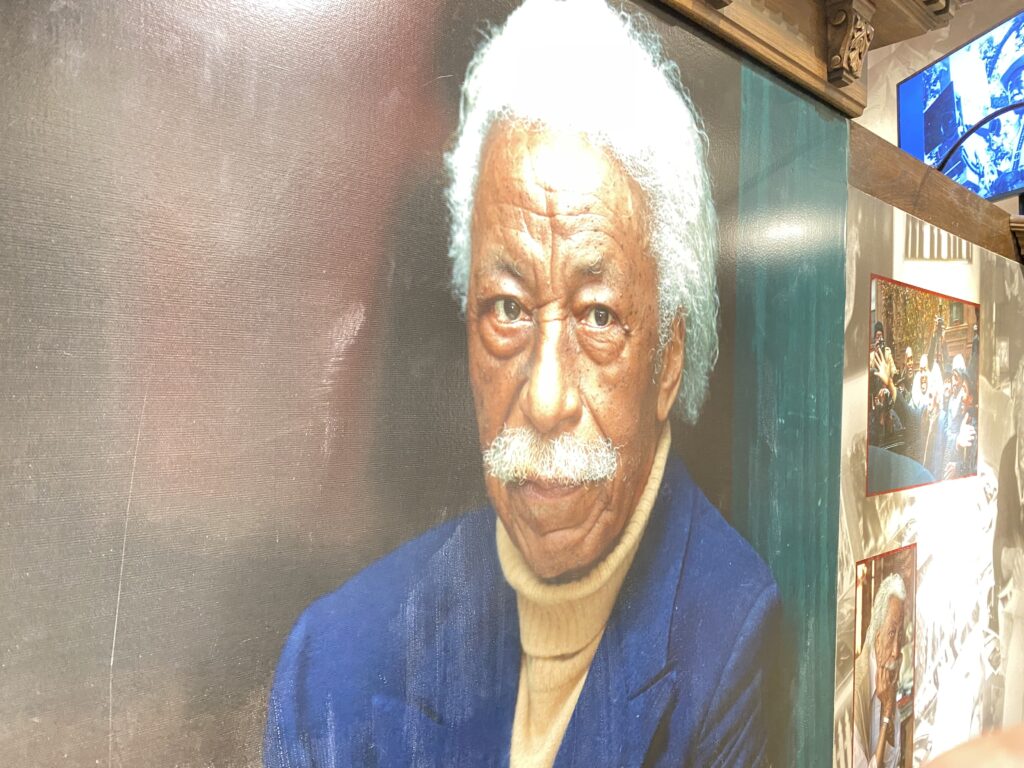
A portrait of photographer, filmmaker and author Gordon Parks watches over the museum dedicated to his works in Fort Scott. (Photo by Frank Barthell for Kansas Reflector)
When Gordon Parks bought a used camera for $12.50 at Abe Cohen’s pawn shop in downtown Seattle in 1939, it was the first in a series of choices that still reverberate in American culture today.
The camera was a Voigtlander Brilliant, a boxy German model that took square photos using 120 roll film. It wasn’t the expensive professional camera that Parks, a 24-year-old dining car waiter on the Northern Pacific Line, wanted, but it was the one he could afford.
He had $17 in his pocket, enough for the camera and three rolls of film.
This story of how Parks, a young Black man from Fort Scott, overcame poverty, violence and racism is told in his 1966 autobiography, “A Choice of Weapons.” Instead of a knife or a gun, Parks chose a camera. He eventually became a staff photographer for Life magazine and also directed films, including the autobiographical “The Learning Tree,” in 1969, and “Shaft” in 1971. Parks, who had played piano in a brothel in his youth, composed his own original movie scores, although he did not know how to read or write music.
When I was a university professor not so long ago, I frequently used the Parks autobiography in my classes as an example of how photojournalism can help change society for the better. He used photo essays to bring the human truth of racism to readers of one of the most widely read magazines in America.
Lately I have been pondering the camera that Parks purchased for $12.50, which is about $300 in today’s money, reckoning for inflation. The story has always resonated with me, because the first “real” camera I had was a 35mm Yashica rangefinder, purchased by my father at Ben Milgram’s pawn shop in Joplin, Missouri. I must have been 15 or 16 years old. I eventually concentrated on words instead of images, although I still have a love for the power of photography and an appreciation of its history.
But the reason I’ve been thinking about the Voigtlander Brilliant that Parks bought is because there’s been so much talk about innovation and creativity in regard to artificial intelligence. But we are confusing innovation with creativity.
A technical advancement — a camera, for instance — is not in itself creative. It’s a tool meant to solve a problem.
Advances in shutters speeds and stop-action photography by Eadweard Muybridge in the 1870s were innovative. The eccentric Muybridge, whose head injury in a stagecoach accident seems to have freed him from social inhibitions, provided the creativity.
Rebecca Solnit, in her biography of Muybridge, “River of Shadows,” describes Muybridge’s “splitting of the second” as dramatic and consequential as the splitting of the atom. It was the technical point that allowed for photojournalism, scientific photography, and motion pictures.
Each technological innovation, from the telegraph to television, has remade society in ways that would have been difficult to imagine before their arrival. In 2026, we are as remote from the rise of television in the 1950s as we were then from the invention of the light bulb. But I think there have been only two innovations of existential consequence in all human history. The first was the manufacture, and use, of the atomic bomb.
“When men broke open the miraculous power of the atom,” as poet Joseph Fasano puts it in his poem posted to Instagram, and quoted here without line breaks, “the first thing they did with it was deliver it into the hands of the schoolchildren of Hiroshima.”
The second is the development of AI.
For the past century, we’ve been celebrating American technological innovation as the single most powerful driver of the economy. We’ve made heroes of the inventors, praised the efficiency managers, and rewarded the public relations and advertising professionals who have sold the myth to us.
Perhaps nothing conveys this hero-worship of innovators better than Apple’s 1997 “Here’s to the Crazy Ones” television commercial, which showed clips of Albert Einstein and Bob Dylan, among others. By association, and with an inspiring narration, it suggested that you, too, could change the world. Doing it with an Apple computer was implied.
But again, possessing technology isn’t the same as being creative.
If it were, there would be no frustrated writers banging away on their pricey MacBooks Pros (and I’m picking on Apple because, well, that’s what I’m using to compose this). There would be no unsung guitarists, at least not if they could afford an American Strat or a Gibson Les Paul, and no disappointed photographers who had the means to buy a Leica.
Those tools are luxuries. Let’s dig down to the nut of the problem.
If innovation were truly the motor of the economy and progress the primary factor in our quality of life, no American would go hungry or suffer homelessness. None would be lack health care, and each would have the opportunity, if not the promise, to achieve personal self-actualization. Racism and other forms of inequality would be bad dreams from the past. But we all know none of this is true, although as a nation we have had the means, but not the will, for decades to make much of it a reality.
There is no reason to think AI will make things better for most Americans.
It’s likely to make things much worse, and right quick.
AI is not a specific advancement, such as vaccines or antibiotics, light bulbs or the personal computer. It’s a machine to make all the next advances, not for the benefit of humanity, but for profit of an elite few.
We should all tremble.
I have no doubt that AI might discover a cure for cancer, just as it appears to have proven the Riemann hypothesis, a problem that had stumped human mathematicians for 167 years. Riemann was cracked by Claude, Anthropic’s AI agent, on Nov. 20. Levent Alpöge, the mathematician who guided the process, gave much of the credit to his machine partner. “Claude flew, and danced, and sparkled near that finish line,” he said.
The news has disrupted the field of mathematics, just as the prospect of AI replacing professionals in other disciplines is growing. The humanities seem particularly vulnerable. Why go to the trouble and pain of writing a novel when all that is required is coming up with prompt?
AI is already eroding trust in traditional photojournalism because it’s so damned difficult to tell a real photograph from an altered one — or one that’s been wholly generated from a prompt.
There are plenty of reasons why you would want to write a novel, or a poem, paint a landscape or make a photograph. Authentic self-expression remains the measure of human existence. Even if machines have the power to create art without a prompt — and I believe AI may have such capability now — the product is, in every way, alien.
It is a discussion that we’ve had for a couple of hundred years in science fiction, but which we are just now having to confront in real life. From Mary Shelley’s “Frankenstein,” published in 1818, to Ridley Scott’s “Blade Runner,” a 1982 film based on a novel by Philip K. Dick, a dominant question in speculative fiction has always been: “What is human?” The monster made of dead humans or the bio-engineered androids produced by the Tyrell corporation have more in common with us than Claude currently does.
That’s because Frankenstein’s monster and replicant Roy Batty suffer.
Life is suffering, and it propels us toward art, religion, and the desire to ease the suffering of others. Suffering is the beginning of empathy, and a recognition of the value of our flickering, wretched and wonderful human lives.
Claude may scheme, but there’s no evidence it feels.
Beyond the philosophical question of what separates us from our creations, there’s the issue that Claude and its AI siblings have been developed in a toxic capitalist hothouse. The goal is money, and Anthropic has been pursuing the biggest Wall Street payday of all time. The results, so far, have been mixed.
If Anthropic fails, it might drag the rest of the economy down with it.
If there were any doubt that we are now in the grip of an authoritarian techno-state, that doubt should have been dispelled by last week’s intervention by the president of the United States to pressure chip maker Nvidia to return to power its disgraced CEO, Jensen Huang.
You may recall that Huang had an affair with a suspected Chinese spy, possibly jeopardizing our national security. Huang resigned as a result. But that Huang was restored to his position at Nvidia at the urging of President Donald Trump is a trifecta of impropriety. It is a clear conflict of interest because Trump has stock in Nvidia, it represents an intervention that overturns the principle of a free market, and it exposes the lie that we are in a desperate global race for AI superiority. The administration is abetting the flow of chips, and presumably information, to China.
None of this bodes well.
“Americans have been talking and writing about creativity and its nearest synonym, ‘innovation,’ since World War II,” writes Thomas Frank in his new book, “The Creativity Con.” In it, Frank makes the case that in the American economy, creativity is measured in human advancement.
“The power to create, to make something where before there was nothing — that is what supposedly distinguishes humans from other animals. It is the highest of virtues, the most fulfilling of activities, the quality we most admire in our leaders, our artists, our business tycoons,” he writes.
But, Frank asks, is it true?
Not if you measure productivity growth or GDP. Those numbers have fallen by half since World War II.
“Meanwhile, truly creative occupations like music, writing, and liberal-arts scholarship have been in economic free-fall for decades,” Frank writes. “No one denies this; the facts just sit there next to all our rhetoric about how much our society values creativity and how creativity now rules the world.”
And it’s not just the fault of conservatives or big business, Frank argues. For decades, liberals have embraced the idea of innovation as the key to solving all of our economic woes as well.
While I don’t agree with everything Frank has to say — and he needs to make a clearer distinction between innovation and true creativity — he reveals some unpleasant truths, just as he did in his 2004 book, “What’s the Matter with Kansas?” He rightly says it was a mistake for America to abandon its manufacturing base to China and elsewhere.
I’m a sucker for an underdog story, so for most of my life I’ve believed all the myths told about innovators such as Thomas Edison. But a lot of his ideas were inferior to those of his onetime employee Nikola Tesla.
Innovation is not so much a stroke of genius as a result of luck, collaboration, competition and outright theft. Need more evidence? Look into the history of the telegraph and the relationship between Samuel F.B. Morse and Alfred Vail. Or the story of RCA and the inventor of television, Philo Farnsworth.
AI is a paradigm-shifting technology, but its development and deployment are subject to the same human foibles that have kept us fighting over wealth and influence forever.
While true creativity is a solitary pursuit, there are things that can encourage it.
Gordon Parks, after he bought that second-hand camera and had some initial success as a fashion photographer, was hired by Roy Stryker at the Farm Security Administration at Washington, D.C. The FSA was a New Deal federal project to document rural poverty, and Stryker was a legendary editor who fostered some of the influential photojournalists of the last century. Stryker took a chance on Parks, giving him the support and training he likely wouldn’t have gotten elsewhere.
Parks’ career was not settled the moment he bought that pawn shop camera. But it was encouraged when he received the support of a government program aimed at improving the lives of millions of rural Americans through farm loans, a pioneering health care program and a documentary unit.
We need a program like the FSA now to help Americans through a turbulent and uncertain economic time. The FSA and its more famous New Deal sibling, the Works Progress Administration, helped millions survive economic calamity. AI may cause the biggest loss of jobs since the Great Depression, and the new Congress should be ready with a plan. That plan should be aimed at not only providing an economic lifeline, but one that also encourages authentic human creativity, in all its forms.
We need a government that works on behalf of all the people, and not just the tech oligarchs who are plotting a bloodless future.
Max McCoy is an award-winning author and journalist. Through its opinion section, the Kansas Reflector works to amplify the voices of people who are affected by public policies or excluded from public debate. Find information, including how to submit your own commentary, here.

Topeka, KS