Living in the little communities
Nov 26, 2026 | 1:00 pm ET
Description
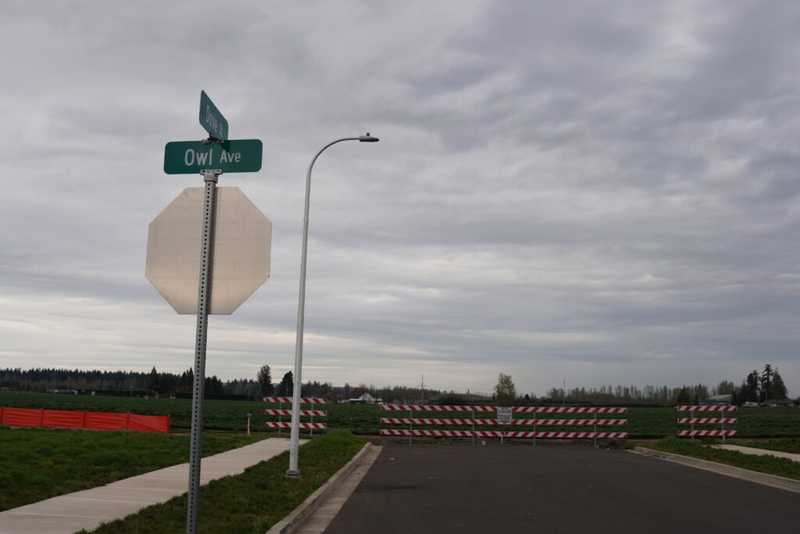
A street ends at an empty field at the edge of Woodburn's urban growth boundary. This empty field is now the potential site of a new housing development, a possibility with House Bill 4035. (Photo by Robin Linares/Oregon Capital Chronicle)
Public talk about unaffordable housing often seems to carry a presumption that costs are more or less equally bad everywhere.
That’s not true. Housing is extremely unaffordable — for people who are not wealthy or who already own a home of enough value — in many places, but that’s less true in others. You can find areas in Oregon, when residential property does come up for sale, where it’s actually still quite affordable.
In Oregon, many of those less costly places fall into the category of “unincorporated communities,” and in not all, but many, housing is relatively affordable. Look up real estate listings of houses for sale in these locations — such as at Medical Springs, Christmas Valley, Chemult or Eddyville and scores more — and you can find what would look like strikingly good deals in a more urban area.
A proposed state rule change by the Land Conservation and Development Commission, aimed at improving affordable housing stock in the state and planned for action in February, focuses on these areas. But it could have the unintended effect of making more residences in those places more unaffordable.
The rule change is on the agenda for the Dec. 3 LCDC meeting.
These unincorporated communities (meaning they are not cities) are numerous, though the exact number varies with the study and report and with the criteria and definitions they use. An incomplete LCDC list in the current rules documents doesn’t include Baker, Curry, Gilliam, Grant, Lake, Linn, Malheur, Morrow, Union, Washington, Wheeler, or Yamhill counties, which do not lack for UCs. A 1997 list from the Department of Land Conservation and Development, which includes some places outside the formal OC definitions, finds such communities in all counties, including seven in Multnomah and 117 in Malheur, though some are much changed since then (such as Sunriver in Deschutes County).
The communities are widely different. Some, as far flung as Cloverdale, Bly, Rhododendron and Grand Ronde, have the feel of small cities. The LCDC actually recognizes four kinds of UCs: resort communities, rural communities, rural service centers (which include commercial or industrial activity) and urban unincorporated communities, which are “larger developed areas with at least 150 residential units and a combination of other land uses that are supported by public facilities and services.” Any firm description of Oregon’s UCs inevitably will match some but not all.
Most are small collections of residences, many housing not much more than 200 people. Many have grown slightly if at all in recent decades, or generations. Operating outside city rules, governed by counties which often treat them much the same as open rural land, regulation and government services both are light.
Many are relatively remote from employment opportunities and services, which goes a long way to explaining why they haven’t been growing: They’re geographically inconvenient for most people. Not for all, since people do live there, many of them for many years, many would not want to move, and many do make a living in their remote areas. But newcomers often would find life there challenging.
The argument for the proposed state rules is the need to develop more housing there.
The agency said, “Existing rules allow counties to plan and zone for any level of residential density in an unincorporated community. Therefore, while additional tools like model codes, grants, or case studies could be helpful to assist counties promote infill and redevelopment, new rule provisions allowing additional housing production within existing unincorporated community boundaries are unnecessary. Instead, these draft rules focus on clarifying and where appropriate, extending opportunities to expand unincorporated community boundaries.”
Raising the question: How much new construction would simple expansion of those boundaries actually encourage in what is today a limited buying market?
Regardless, the presumptive purpose would be to expand housing development in these areas. And serious questions arise from what would happen if it does.
The 1000 Friends of Oregon group has raised questions about exactly this.
It warns that the rules take too little account of the needs of people living in these areas, but “instead, they are focused on outside people and businesses who want to build second homes and vacation rentals and develop commercial uses that take advantage of access to nearby water or energy, but could overrun the rural area like data centers.”
The small cities in these regions often are stressed by costs for infrastructure and services, and Friends warned the changes “would also create competition between unincorporated communities and nearby rural towns and cities for scarce public funding for infrastructure.” And remember that these small communities lack government organizations or officials to speak specifically for them.,
These concerns also raise the question of what happens if commercial and investor money moves into these unincorporated (and lightly regulated and serviced) areas. Not a lot of investment would be enough for newcomers to swamp the interests of people who have lived in these communities for many years.
More than that, it could heavily distort the property value picture. Financial pressures lead home builders to construct more rather than less expensive houses, meaning that most would probably not be in an affordable range. But when more expensive houses come on the market in a given area, values for other houses also rise. That may benefit existing homeowners, but it likely won’t improve the availability of housing for first time buyers.
Some of those could be cured if developers were required to sell the new houses (and presumably other properties) at low prices. But that would be hard to accomplish under state laws.
As it is, incentivizing new from-outside developments in unincorporated communities may have some unintended effects, to the extent they work.
Salem, OR