Blue wins and bipartisanship in red Alaska
Nov 24, 2026 | 8:00 pm ET
Description
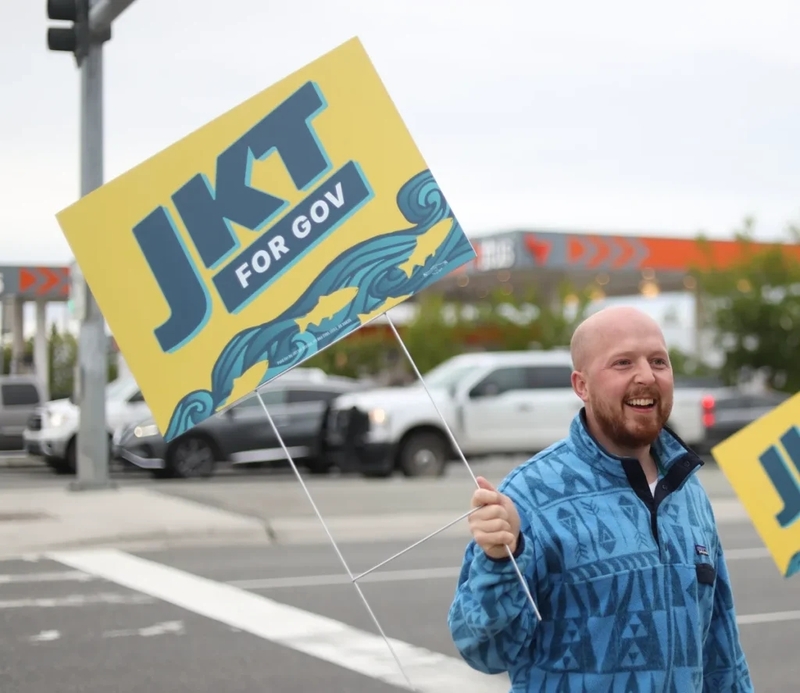
Jonathan Kreiss-Tomkins, a Democratic former state House member, won the state's gubernatorial primary last month. (Nathaniel Herz/Anchorage Press)
A year ago, most Alaskans would be hard pressed to believe our next governor would be a Democrat and the youngest to hold that office in any state. Or that an Alaskan would be the last of 56 Democrats to flip the U.S. Senate.
We’d be more likely to witness the return of glacial ice lost to climate change.
After all, two thirds of Alaska’s three-member congressional delegation had all but relinquished its power to the President — along with a Republican majority Congress — diminishing any hope of them opposing the dismantling of democracy, dehumanization of immigrants and destruction of public lands.
Since we moved to the capital in the early 1990s, Juneau’s been a blue pocket of this red state. Back then the Legislative Speaker of the House was a steely Republican woman named Ramona Barnes. Then there was the Democratic Representative who voted Republican. Richard Foster spent House floor sessions leaning back in his chair with his feet on the desk, thumbing through gun magazines.
But here we are, awash with hope by a blue tsunami. An Alaska Native woman from Bethel is replacing an establishment Republican incumbent from Fairbanks. An Alaska Native fisherman might have kept the Republican incumbent from retaining the lone House seat, had he received the votes that went to a perennial sham candidate and convicted felon.
Since statehood the majority of Alaskans voted Republican. Only 11.6%of last frontier voters are registered Democrats. So how did we get here?
The short answer is more of us are just as fed up with the rising cost of living as the rest of America. But there is more to it.
Alaskans know that divisive politics hinder progress. And with about 737,000 people inhabiting 665,384 square miles, or a population density of just over one resident per square mile, we must team up to survive.
Alaska legislators routinely band together in a bipartisan caucus. It’s how they passed much needed funding for education, only to be repeatedly vetoed by outgoing Republican Governor Mike Dunleavy.
In her first interview as senator-elect with the Anchorage Daily News, Mary Peltola said, “Those who want to engage in partisan rhetoric and stagnate while we’re just engaged in partisan mudslinging — those folks have been sidelined, and I would love to see that happen on a federal level.” The headline: Peltola calls for bipartisanship after winning U.S. Senate race: ‘Alaska has so much to teach the rest of the nation.’
Governor-elect Jonathan Kreiss-Tomkins, aka JKT, is one of 30 Democratic governors elected nationwide. Crossing the aisle to get things done was his M.O. during the decade he spent as a state legislator in his 20s and 30s. “Republican, Democrat or Independent; majority caucus or minority caucus; rural or urban; we will work with anyone and everyone who wants to solve problems and move Alaska forward,” he said in a victory statement earlier this month. He’s also seeking solutions from fellow Alaskans. His transition team consists of a Democrat, a Republican and an Independent.
Kreiss-Tomkins’ proclivity for bipartisan cooperation earned an endorsement from Republican Senator Lisa Murkowski, who as a moderate in a divided Congress could equally tick off both Republicans and Democrats.
But that’s Alaska. Just ask Mary Peltola. As a member of the House of Representatives in 2023 Peltola was one of only two Democrats who voted to defund a White House Office of Gun Violence Prevention.
Years ago the Permanent Fund replaced oil as the main source of revenue for the state of Alaska. To this day few Alaska lawmakers oppose drilling in the Arctic National Wildlife Refuge. Peltola’s a defender of the oil and gas industry and in favor of expanding fossil fuel development in the Arctic.
On Nov. 3 a record number of women were elected to public office, and will now represent just over a third of Congress. Alaska is now one of a handful of states with both Senate seats held by women. A Democrat and a Republican. Peltola expects them to “work hand in hand together.”
But bipartisanship requires compromise, which requires trade-offs. The term can be used as a cover for regressive legislation. Case in point: the troublesome Bipartisan Affordability and Jobs Act aka BAAJA, en route to the House after passing the Senate by just one vote. It would fast track energy and infrastructure projects, including data centers, while cutting environmental and historical protections and ignoring laws for public and tribal input. Compromised is a healthy planet and climate for the next generations.
The longer answer to how the blue wave hit Alaska is a sweeping generational turnover in American politics, led by young leaders like the mayor of New York and the new mayor of Los Angeles. A record number of millennials were just elected to Congress. Two-thirds of college educated Alaskan voters aged 30-45 went with Peltola.
The President of the United States is exhibit A for aging boomer politicians hellbent on ruining things for everyone but themselves.
I do some substitute teaching at the elementary school down the street. Each morning, we recite class promises reinforcing that kindness, respect, compassion, listening and honesty are required to work with and get along with each other.
How a bully who would have been expelled the first day of school conned enough voters to win the presidency twice is beyond me.
On Dec. 7 a positive young guy willing to work with lawmakers regardless of party becomes our new Governor.
Alaska and the rest of the country just might be growing up.
Juneau