Remembering Mark Massa, and all my teachers, with gratitude
Nov 23, 2026 | 5:57 am ET
Description
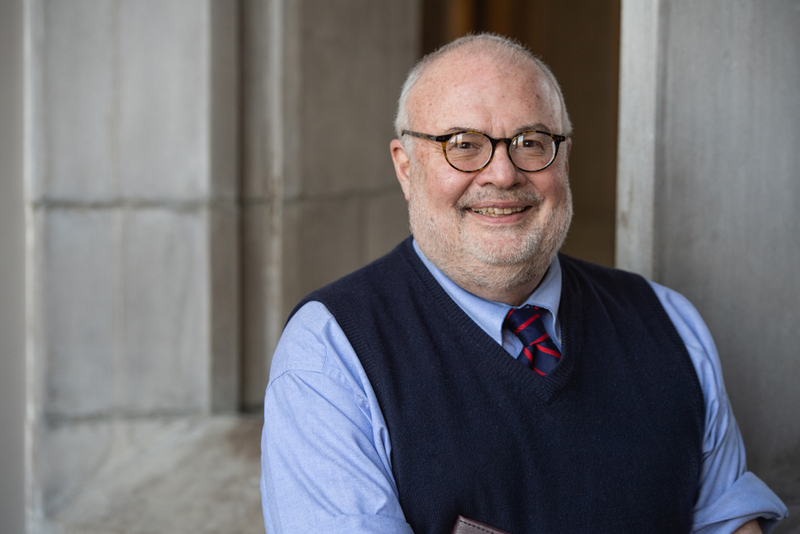
Rev. Mark Massa, S.J. is seen in a 2019 photo. (Courtesy Fordham University)
I hope you had a teacher like Mark Massa.
Whenever he gave a lecture at Fordham University, he would prowl around the front of the classroom. In his round glasses and clerical collar or business-casual wardrobe (the preferred habit of Fordham’s Jesuit community), he would gesture with his hands or lean over to drive a point home.
Massa used the Socratic method. He often opened a class by asking a randomly chosen student about that day’s assigned readings. It was a powerful incentive to show up prepared. Because the questions were coming, and you might end up being the one expected to provide the answers.
Punctuality was the other red line. A student who arrived after class began could count on a sarcastic “Good morning! How are we today?” as they rushed to their desk. One of my fellow undergraduates told me that she saw Massa ask his class for a quarter, which he took to a pay phone outside the classroom to call a student who had overslept. (That student came running in, breathless, before class ended.)
But within those boundaries, you got to experience an exceptionally gifted professor. Massa’s field of study was American Catholicism, but as befits a priest, he had a deep understanding of theology and church teachings. Nor was he afraid to share his disagreements with them. I once heard him take apart “Humanae Vitae,” the 1968 encyclical that forbade Catholics from taking birth control, saying that the pope’s argument that it interfered with a natural process was also an argument against taking Tylenol to treat a fever.
Heady stuff for a kid from a conservative Catholic household. Like the best instructors, Massa had presence. He could provoke, but never in an insulting way. He could crack funny jokes that also reflected the points he made. Massa cared about what he taught and got us to care, too.
But his most effective motivational tool was treating us like peers. Massa wanted us to do the work because he seemed eager to hear our thoughts about the texts. He treated our opinions, no matter how far off they might have been, with respect and encouragement. You liked interacting with him. You liked watching other students bounce ideas off of him. And his classes often became free-flowing, stimulating discussions. Exactly what you want a course to be.
Nearly all of us who took one of his classes wanted to reciprocate this funny and often sly priest’s interest in our intellectual efforts. Massa in turn could be very generous. When I asked him for one of his prized recommendation letters, he wrote a flattering piece set at a Fordham honors ceremony. When he gave me a copy, I thanked him but also pointed out I hadn’t actually been at the ceremony. “Well, we know that, but they don’t,” he replied.
Massa formed relationships with many of my fellow undergraduates that lasted decades. When he unexpectedly passed away on Nov. 15, there was an outpouring of grief from his colleagues at Fordham and Boston College, and from his former students. It’s hard to lose a great mind; it’s even harder when that mind works with a generous soul.
Teaching is a profession. The ability to teach is a gift. I count myself lucky that in my nearly two decades in school, most of my instructors – even those who taught subjects I struggled to master – were engaged and engaging people.
And it’s hard for me to fully convey my gratitude. Sometimes you see what they’ve done instantly; other times it takes years. For those of us outside the profession, it can be hard to appreciate the challenges a teacher faces. There’s the physical strain of standing and projecting your voice to hold the attention of sometimes disconnected students. There’s the intellectual and often emotional battle to reach a child dealing with issues that impede their education.
That many succeed is a mark of skill and professionalism that needs to be celebrated.
Alabama’s teachers may soon face more struggles. Pay raises don’t appear likely next year, and healthcare costs may go up. We have an incoming governor who has expressed overt hostility toward public school teachers and wants to expand the CHOOSE Act, the state voucher program, that would further reduce what limited resources are available to them.
So this Thanksgiving week, let me say thank you to the teachers who navigate the micro and macro challenges of their jobs every day for my children and yours, quietly making this world better, in the present and the future.
I last saw Mark Massa at a reunion in 2009. As we caught up, he gradually turned the conversation toward Alabama political history. I was many years removed from being a student. But he showed the same interest in my thinking as he had when I was an undergraduate. Like the best teachers, Massa found something worthwhile in each of his students. And I hope he understood we saw something priceless in him.
Montgomery