The night the lights went out on my MBTA train home to Providence
Nov 23, 2026 | 5:00 am ET
Description
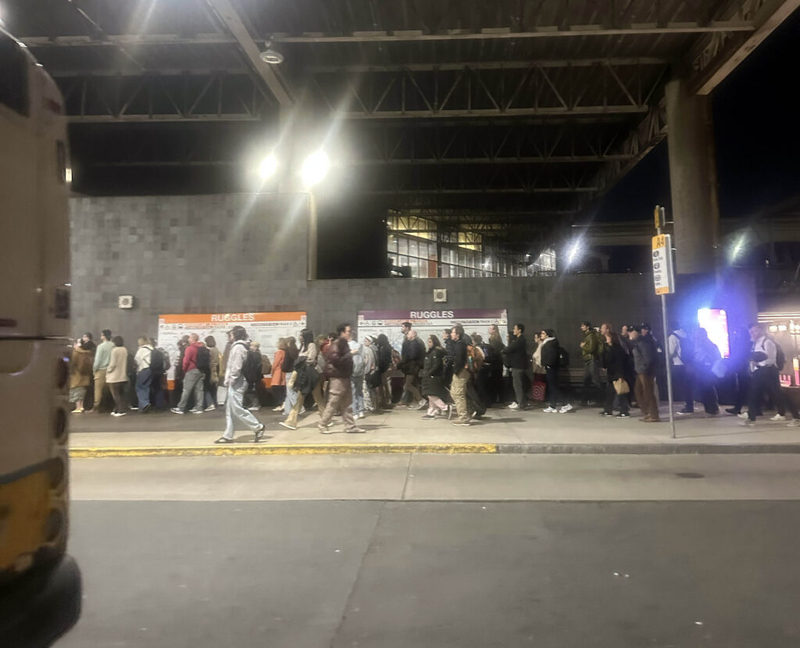
Passengers from MBTA train 6023 wait to enter Ruggles Station at 6:33 p.m. after departing the replacement train. (Photo by Dorree Ndooki Hosokawa for Rhode Island Current)
An outbound MBTA commuter rail train heading toward Wickford Junction suddenly stopped inside a dark tunnel in Roxbury, just outside Jackson Square. Moments later, the power went out, plunging hundreds of passengers into complete darkness. No lights and no ventilation prompted a collective gasp, followed by silence. As the seconds became minutes, passengers tried to stay calm. Fifteen minutes later, parents were scrambling to arrange emergency childcare. The minutes turned into hours.
I was one on the train. I live in Providence, and since returning to grad school in September, I travel to Boston twice a week. I’ve grown accustomed to the frequent delays that come with commuting on the MBTA. The afternoon of Oct. 27, I was eager to take the express train home, leaving Back Bay at 3:52 p.m. Instead, my standard 90-minute commute became a five-hour ordeal.
At 4:06 p.m., the train came to a halt just past Ruggles, the next train station after Back Bay. It wasn’t until nearly two hours later, at 6:04 p.m., that passengers were directed to evacuate onto the tracks and make their way to a replacement train to bring them back to Ruggles.
That meant passengers had to descend 4 to 5 feet onto the track, and then climb industrial stairs to reach the next train parked alongside it. Without ramps or accessible paths, riders with mobility challenges relied on conductors and fellow riders for help.
One older woman seated next to me told me she was recovering from back surgery. She said MBTA staff almost dropped her as she attempted to board the replacement train.
Confusion persisted back at Ruggles station, making it feel as though the entire ordeal was starting all over again. A massive crowd overflowed the platform around the station’s stairwell and spilled past the ticketing machines. Meanwhile, electronic departure screens consistently displayed optimistic arrival estimates. Yet no trains appeared.
I finally made it home at 9:06 p.m. thanks to a shared ride with another passenger who lived in Providence I had never met before, arriving to find home-cooked dinner waiting from thoughtful friends. But my routine commute should never have to depend on luck and the kindness of others to get home safely.
The next day, I contacted Keolis Commuter Services, the company responsible for operating the MBTA’s commuter rail service, seeking an explanation. I heard back on Oct. 29 from the company’s media relations manager Jack O’Neill, who identified “slippery rail” as the cause of the disruption.
During autumn, fallen leaves get crushed beneath train wheels, leaving an oily residue that reduces traction and affects braking, O’Neill said. The MBTA uses laser systems and high-pressure washing equipment to address this seasonal hazard.
My routine commute should never have to depend on luck and the kindness of others to get home safely.
But explaining why a train stopped is not the same as explaining why hundreds of passengers were not supported when it happened. And ironically, the MBTA’s new fall/winter schedule had taken effect just the day before the incident. Demonstrating that officials were organized enough to account for seasonal weather changes on paper, yet somehow remained entirely unprepared for the actual impact of autumn weather on the rails.
Why were passengers required to navigate such a physically demanding evacuation with no accessible options provided?
Keolis has operated MBTA’s commuter rail system since July 2014 under a multibillion-dollar contract. The agreement expires on June 30, 2027, giving Massachusetts an opportunity to reconsider how its commuter rail system should be operated.
An email I received Nov. 3 from Keolis customer service stated:
“During this event, train crews and other staff members were present to help guide passengers and facilitate the transfer to alternate equipment as safely as possible. We recognize that such situations can be especially challenging for elderly passengers and those with disabilities, and we regret any difficulties experienced during the transfer.”
Although the company acknowledged the challenges, its statement failed to clarify what specific accommodations were provided, if any, or whether emergency protocols would be improved to avoid similar situations.
The MBTA has shortlisted three companies for the next contract: incumbent Keolis in partnership with British consulting and engineering firm Amey Ltd.; Mass Regional Rail; and a partnership between Transdev and Transport UK. The MBTA’s board of directors is expected to recommend which finalist should get the contract when it meets in December.
No matter who wins the contract, however, there remain concerns about the regulators who oversee it.
A March 2025 performance audit by the Massachusetts Office of the State Auditor examining the MBTA’s administration of its Keolis contract between June 2020 and December 2023 identified significant problems. Among its findings, approximately $3.32 million in performance-based penalties that should have been assessed were not. The audit also identified incorrectly assessed penalties, errors involving performance incentive payments and weaknesses in reporting and documentation.
The MBTA must also ensure that contractual standards are frequently monitored and enforced.
We all deserve safe and reliable rail service, especially during emergencies.
Providence, RI