More state money is reaching NC childcare centers, but families are still struggling
Description
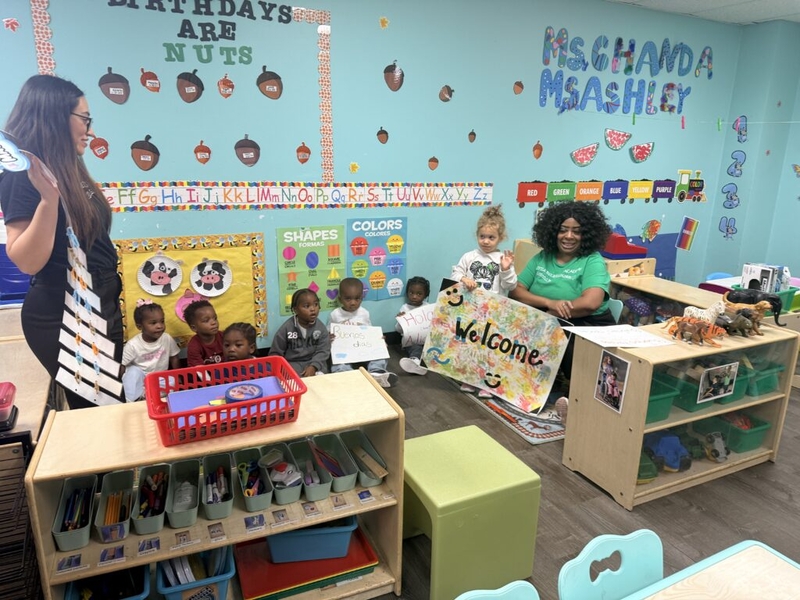
Preschoolers learn Spanish in a classroom at Little Believer's Academy in Raleigh, N.C. (Photo by Tre Spencer/NC Newsline)
For Cassandra Brooks, the owner of Little Believer’s Academy in Raleigh, the state’s new, higher childcare subsidies have meant more money to invest in her classrooms, hire staff and give longtime workers raises.
Like many states, North Carolina pays childcare centers a set amount of money for each child of a low-income family who qualifies for subsidies. The subsidy helps offset the cost to make childcare more affordable for those families.
But even with the additional state support, Brooks said many families are still struggling to afford childcare, while providers face staffing shortages and rising costs.
“It’s one step forward with this, and I’m thankful for that, but we still have a ways to go,” Brooks said during a visit Thursday.
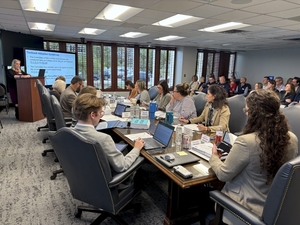
She was joined by Lt. Gov. Rachel Hunt, D-NC, and Sen. Jim Burgin, R-Harnett, co-chairs of the state’s Task Force on Child Care and Early Education. The panel was created by Democratic Gov. Josh Stein to find ways to expand access to affordable childcare across the state.
Stein announced Thursday that he had signed an executive order extending the bipartisan task force through Dec. 2027.
“With costs climbing, affordable childcare helps families start a family and stay in the workforce,” Stein said. “I look forward to the task force’s continued work to lower costs and help parents raise their children.”
The extension gives the task force another year to develop recommendations as state lawmakers prepare for future budget talks.
The task force’s visit highlighted the implementation of a new statewide floor for childcare subsidy reimbursements, a recommendation the task force first made in June 2025.
NC budget offers rural childcare businesses financial help they’ve sought for years
The state budget included an additional $160 million to raise subsidy payments and to set a statewide minimum rate. The governor’s office said North Carolina is the first state in the country to set one.
Beginning Oct. 1, providers in counties with subsidy reimbursement rates lower than the new statewide minimum got a raise. For Brooks, whose Little Believer’s Academy operates two locations, the additional funding is already making a difference.
At the Raleigh location, Brooks estimated that between 85% and 90% of enrolled children receive childcare subsidies. At the academy’s Clayton location, she said the share is closer to 50%.
The additional revenue has helped the center purchase new classroom supplies and toys, bring in additional staff and provide raises to employees who have worked at the center for years.
But the funding has not eliminated the financial challenges facing families. Brooks said even with subsidies, some parents still face monthly copayments of $300 to $400, depending on their circumstances.
She described one family whose child had to leave the program after the mother was injured at work and could no longer afford a $300 monthly copayment. The mother was receiving workers’ compensation and was homeless.
“We have multiple stories just like that,” Brooks said.

Staffing is still another challenge for the center. The academy spent thousands of dollars advertising open positions, but struggled to find and retain employees.
The center offers medical, dental, and vision insurance and pays licensed teachers hourly wages ranging from $14 to $24. Despite those efforts, employee retention at the location is still only around 60%.
To address the shortage, Brooks obtained approval to hire nine workers through the federal H-2B visa program. The workers arrived in October and will stay through May.
Brooks called the additional workers a “saving grace,” saying they have helped provide more consistent staffing and given employees more support in managing classroom needs.
Burgin said staffing shortages are affecting centers across the country, and the task force plans to keep finding ways to recruit workers.
“We say childcare begins at conception,” he said. “I think it’s something we all need to focus on. There’s a lot more work to do.”
Beyond raising the subsidy rates, Brooks said she hopes future state investments will make subsidies available to more families, provide more benefits for childcare workers, and make additional resources available to children with special needs.
Raleigh, NC