Fewer students, rising expenses and AI: UNC leaders focus on growing headwinds
Description
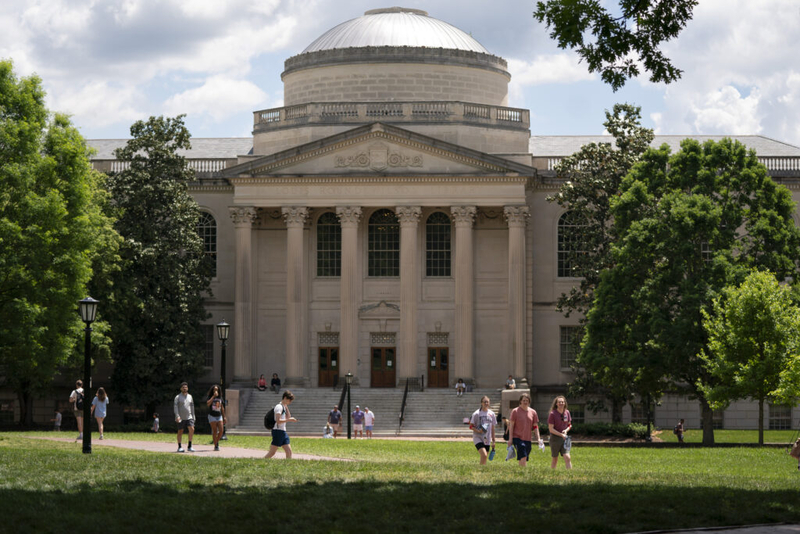
Students walk to class on the University of North Carolina Chapel Hill campus. The UNC Board of Governors discussed this week that the pipeline of incoming college students may remain flat through 2041. (Photo by Sean Rayford/Getty Images)
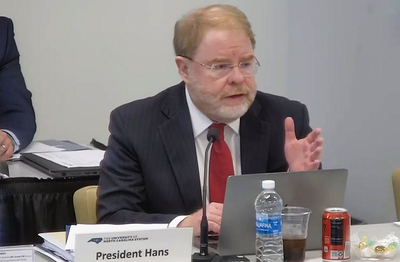
UNC System President Peter Hans says the University of North Carolina system needs to operate more like Amazon and less like Sears.
“At its peak in the 1970s, Sears accounted for 1% of the entire American economy with 3,400 stores,” Hans said. “Today, there are five stores nationwide.”
Hans offered the retail history lesson at Thursday’s UNC Board of Governors meeting. He told board members higher education exists in a competitive marketplace and unlike Sears, the system cannot afford to become complacent or lose focus.
Hans said one bright spot for the system in recent months was a new strategic partnership between UNC-Chapel Hill and the University of North Carolina School of the Arts in Winston-Salem.
“This is about two universities sitting down together and asking a simple question, ‘What could be better done together than either of us can do alone?'” Hans said.
Hans said the 17 schools that make up the UNC system all have their unique identities, but to honor their missions, they need to find ways to operate more efficiently.
“There are multiple small, similar opportunities within our system where visionary leaders can vault their schools forward by forging closer ties,” said Hans. “That is my subtle hint to the chancellors. Hopefully they’re listening.”
Attracting new students, containing costs
Hans’ remarks came one day after a lengthy presentation by Dr. Mark Becker, the former president of the Association of Public and Land-Grant Universities and the president emeritus for Georgia State University. Becker, a nationally recognized leader in higher education, told UNC board members that “tectonic forces” are reshaping higher ed.
Becker said North Carolina faces a flat pipeline of incoming high school graduates through 2041. Nationwide, higher education is facing a demographic challenge caused by falling birth rates in the United States. Research funding and international enrollment have both fallen since 2025.
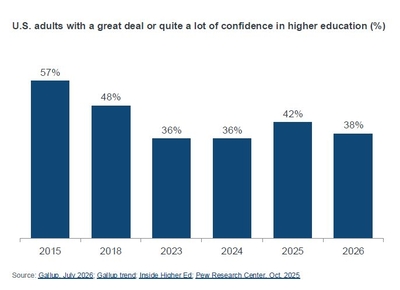
Universities are also finding that public confidence in higher education has stalled, Becker said. Thirty percent of adults who expressed low confidence cited the cost, and 31% cited politics as a reason, according to a recent Lumina Foundation-Gallup survey.
Becker said while degree-holders earn more over their lifetime, 42% of recent graduates are underemployed in fields that don’t require a degree. For the millions of Americans who began college but left before ever earning a degree, they never saw the payoff, Becker said. And nearly half of borrowers (49%) who did not finish their degree owed more than they borrowed after seven years.
Entry-level job postings are down about 35% since 2023. But Becker said there are opportunities to offset that loss with experiential learning, internships and other types of work-based learning.
Becker told members of the board’s Committee on Strategic Initiatives that three-year degrees could help lower costs, speed entry into the workforce, and regain public trust in higher education.
New year, new budget pressures
The changing landscape comes as the board of governors is beginning to look at its budget priorities for 2027. During a presentation of the funding committee, board member Kirk Bradley noted that utility costs have risen 11% over the last three years and will be rising again after another rate increase.
“I think the key thing here is just efficiency, efficiency, efficiency, and all of our campuses are going to have to be looking at this,” Kirk said. “There’s a lot of headwinds facing us.”
UNC Board of Governors poised to increase tuition despite pushback from prominent conservative
Sonja Phillips Nichols, a board member representing Charlotte, said after hearing a presentation on UNC’s various funding models, it was clear that the UNC system needs to adopt a “both and” strategy.
“There’s going to have to be some cost-cutting measures on the campuses,” Nichols acknowledged. “At the same time, we as a board will have to support our campuses in their request for more money.”
After nine years of holding tuition flat, the UNC Board of Governors allowed most system universities to increase tuition up to 3% last year. N.C. State, UNC-Chapel Hill, and East Carolina University are among schools in the system requesting an additional 3% increase in undergraduate tuition next year to cover growing campus expenses. The UNC Board of Governors is expected to review tuition and student fee increases for the upcoming academic year at its February 2027 meeting.
Hans said the system must continue to improve not only course offerings, but how it handles admissions, financial aid, and the transferring of credits to keep pace with a rapidly changing world.
“Students aren’t going to pick the higher education equivalent of Sears. They won’t indulge in unresponsive bureaucracies,” said Hans. “They’ll just move on quickly. It’s among the reasons I consistently emphasize the word simplify, simplify, simplify.”
Raleigh, NC