Auburn University Board of Trustees approves new post-tenure review policy
Nov 20, 2026 | 2:34 pm ET
Description
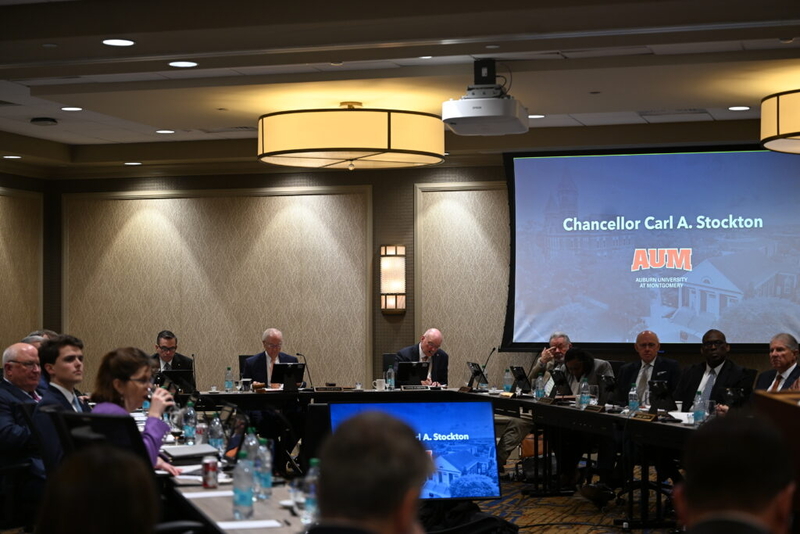
Members of the Auburn University Board of Trustees as seen during its meeting on November 20, 2026. The board approved a new policy for post-tenure review, drawing criticism from faculty organizations. (Andrea Tinker/Alabama Reflector)
The Auburn University Board of Trustees Friday voted to approve a new policy for post-tenure review that drew sharp criticism from faculty organizations.
The change was authorized by HB 580, sponsored by Rep. Troy Stubbs, R-Wetumpka, and signed by Gov. Kay Ivey in April. The law also allowed boards of trustees to disband faculty senates and drew protests at Auburn.
The university will use a four-category scale for post-tenure reviews. The four categories are “exceeds expectations,” “meets expectations,” “does not meet expectations” and “unsatisfactory.” Under the policy, post-tenure review would occur at least once every six years. No faculty member can be reviewed more than once a year.
Previously, the University Senate conducted the post-tenure review process and included an “exemplary” rating category which was removed from the policy approved by the board on Friday.
Virginia Davis, the faculty advisor to the board, criticized the new system during the board’s meeting.
“Removing the exemplary rating from evaluations seems contradictory to the desire for excellence,” Davis said. “It undercuts the ability of faculty to continue to be recognized for the level of commitment that is distinctly offered.”
The policy states after the review is complete, the dean of the college will make a recommendation to the provost who can “seek advice from an appropriate faculty advisory body or other peer review body before making a final performance rating determination.”
After the provost assigns a performance rating, the university president “shall exercise such review, approval, or oversight of post-tenure review determinations as provided by university procedures.”
Davis said “faculty are not afraid of evaluation.”
“We already have rigorous annual evaluations. Every proposal we write, every event we lead, every course we teach, every paper we publish is subject to review,” Davis said. “Any post-tenure review must carefully balance new requirements against real faculty and administrative time burdens.”
Heidi Hausse, a history professor at Auburn, said in an interview after the meeting the board’s passage of the post-tenure review policy “undermines protections of tenure, tenure safeguards and academic freedom.”
“My immediate reaction to the passage of this policy is deep concern for the future of Auburn University as a place of independent thought, as a place where students can trust they’re not going to have a censored education, as a place where cutting-edge research can be explored as a place where controversial ideas can be talked about and debated,” she said.
A petition started by United Campus Workers of Alabama, an organization that works to improve benefits, wages and working conditions for higher education employees, exceeded its goal of 500 signatures to maintain the current post-tenure review process. As of Friday afternoon, the petition had over 700 signatures.
Hausse, a member of UCW-AL, said the petition was emailed to all members of the board, except Ivey, Auburn Provost Vini Nathan and Board of Trustees Secretary Jon Waggoner at 4:30 p.m. on Thursday. The UCW-AL did not receive any response, according to Hausse.
Under the proposed policy change, professors who receive a rating of “does not meet expectations” will be referred to the provost to determine if a “Performance Improvement Plan” will be appropriate. Tenured professors who receive a rating of “unsatisfactory” could be dismissed without having a Performance Improvement Plan.
Tenured faculty members can be dismissed on performance-based, conduct and institutional grounds. Performance-based dismissal includes professional incompetence, failure to complete institutional evaluations and “serious or substantial neglect of professional or academic responsibilities,” among others.
Conduct-based dismissals include “conduct or unprofessional behavior that adversely affects the university or the faculty member’s performance of duties or fulfillment of professional responsibilities;” repeated or significant violation of the Auburn University policies, rules or regulations; and research misconduct, among others.
Institutional dismissals include institutional exigency, “discontinuance, reduction, reorganization, consolidation, or elimination of an academic program, department, unit, function, or position,” and other circumstances that are grounds for dismissal under board policy, university policy, or under applicable law.
“In describing the purpose of the post-tenure review in that policy they just passed, it includes one of its reasons to ensure that faculty work is in continued alignment with the university, and that is very concerning because it suggests the guiding question,” Hausse said. “One of the guiding questions of the post-tenure review isn’t: Are you doing well at your job? Are you doing well in the classroom? Are you doing well in your research? Are you doing well in service? One of the guiding questions in the wording of what they just passed is: Are you in alignment? And what that does is potentially turn faculty research into a tool for the interests of powerful people.”
HB 580 led Auburn and Jacksonville State University to abolish their faculty senates over protests from instructors at the schools. The University of Alabama and Troy University voted to maintain theirs.
The policy is effective immediately.
Montgomery