New University of Alaska tuition structure raises some costs and cuts others for Alaskan students
Nov 19, 2026 | 5:12 pm ET

Description
New students at the University of Alaska Southeast attend a campus tour as part of orientation ahead of the fall semester at the Juneau campus on Aug. 21, 2026. (Photo by Corinne Smith/Alaska Beacon)
Following the move to eliminate out-of-state tuition rates earlier this year, University of Alaska Board of Regents unanimously approved a new tuition structure based on degree programs that includes some changes in tuition rates for Alaskans.
Officials said the new tuition structure will streamline rates and simplify students’ billing. The new structure, called “program-based tuition” will apply to all Alaska resident, out-of-state and international students equally.

“The goal is a program-based tuition model that allows students to predict and pre-plan costs as they move into each semester, and improves the student experience by increasing transparency around their bill,” said Luke Fulp, the university’s chief financial officer, ahead of the vote at a Nov. 6 board meeting.
Under the new system, all students will pay tuition rates based on degree program, which varies somewhat across degree level and the University of Alaska Anchorage, University of Fairbanks and University of Alaska Southeast campuses. Previously, the base cost of a credit did not vary by program, but by course level, degree sought and student residence within each institution.
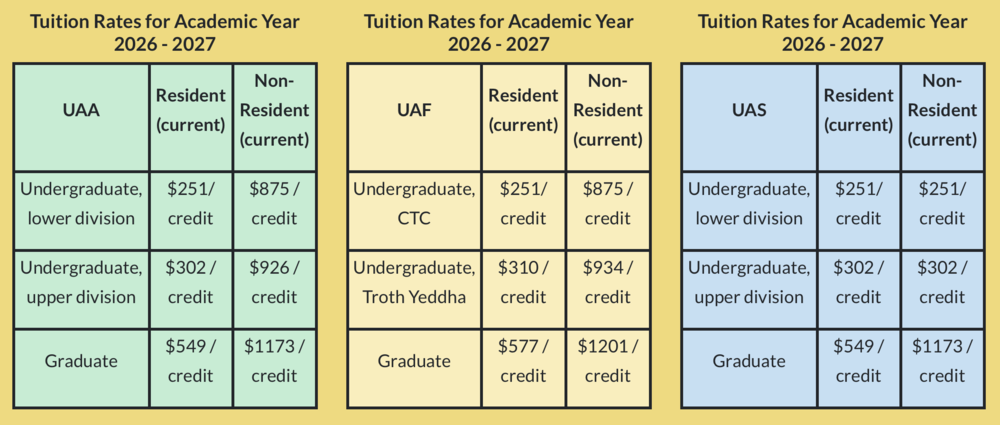

(Click to enlarge)
The new tuition structure also folds course surcharges into the tuition rates so that more of the total cost can be covered by financial aid, Fulp said. Course surcharges are added fees to more certain courses like engineering, business and aviation.
“As we roll that surcharge into a tuition rate — the surcharge behaves as a fee right now — and as we roll that into tuition, more scholarships and grants can go directly towards those costs for students,” he said.
The regents approved the change at the November board meeting, which will take effect in the fall of 2027.
The board of regents last raised tuition rates by 4% in 2025 for this academic year, following a raise of 3% for in-state students and 5% for out-of-state students the year before.
Roughly 85% of the university’s nearly 20,000 student population is from Alaska, nearly 14% from out-of-state and 1% of students are international. Full-time students make up about 47% of the student body this year, with the remaining half made up of part-time or non-degree seeking students.
The university reports it has boosted financial aid to students in recent years, totalling $124 million last year in scholarships, loans, grants and tuition waivers — distributed to roughly 62% of UA students.
While federal financial aid and tuition waivers decreased last year, UA scholarship awards increased by 12%, or $6.7 million, grants increased by 7.5%, or $2.2 million, and private scholarships increased by 14.8% or $1.3 million.
New tuition structure for Alaskans
For Alaskans, the new tuition structure will levy some increases on tuition rates depending on the degree program and campus. But some students will see decreases over time as they advance in their degrees, university officials said. Some course costs will remain the same.
Tuition rates for some courses at UAA and UAF will increase for Alaska students by 7% and up to 20% per credit, particularly for business, public policy, engineering and mining programs. Officials said those courses are generally more expensive to offer, due to equipment, lab materials or staffing.
However, Jonathon Taylor, UA director of public affairs, said with the elimination of surcharges and adding those costs into program tuition, students are expected to see similar or even a small reduction in overall costs of their degree.
At UAS, undergraduate lower division course costs will increase by 8% per credit. Upper division undergraduate course costs will decrease by 10% and graduate level courses will remain the same.

UAS Chancellor Aparna Palmer said that as Alaska undergraduate students matriculate into higher division courses over a four-year undergraduate degree the overall cost of the degree will decrease by an estimated 2%.
“Over the term of a four-year degree, students actually should be saving money relative to the previous tuition structure,” Palmer said in an interview Wednesday.
Under the current system, students pay different tuition rates based on course level and campus as well as some additional course surcharge fees. Currently, resident Alaskans pay lower rates than non-residents — but only through next August.
This fall, the board of regents approved eliminating out-of-state tuition rates, which amounted to non-residents paying double to quadruple the amount of in-state tuition depending on degree type. Officials said they estimated the change will amount to a $1.4 million loss in tuition revenue, but they hope to recover that with a boost in enrollment and drawing more students to Alaska.
Taylor said the cost to administer the different tuition rates for resident and non-resident students was difficult and bureaucratic — about 12,000 hours per year of staff time — and the university has worked to expand financial aid, including scholarships, loans and grants, to all students.
Taylor said the Alaska Performance Scholarship, up to $7,000 per year, and the UA Scholars Award, up to $15,000 over six years, can largely cover the cost of a four-year undergraduate degree for Alaskans who are eligible. Eligible students can also use the funds for graduate programs.
The new tuition structure also eliminates different tuition rates for lower and upper division undergraduate courses, and creates a standard rate for most programs, which varies somewhat by university.
Taylor said that change helps alleviate some cost increases undergraduate students were seeing around sophomore year as they move into higher division classes. “In some cases students have had to drop a class because they either couldn’t afford that additional cost, or they had to rearrange their schedule in order to accommodate it, which can cause problems sometimes as they’re trying to complete degrees,” he said.
Taylor said over the course of a four-year undergraduate degree program, tuition costs in total should not change more than 2% from what they are now.
“These changes, they’re complicated in some sense,” Taylor said. “But the impact is that it’ll give students simpler bills and a cost of attendance that is much more predictable and easier to understand, and that is an absolute win for our students and prospective students and the university as a whole.”
Monitoring the rollout
Abigail Schiffmiller is a doctoral student at UAF and spokesperson for the Alaska Graduate Workers Association, a union that represents over 400 graduate workers across the university system that is currently in negotiations for a new contract with the university.
She said the union will be monitoring the tuition changes and impacts for students, particularly the tuition waivers offered to graduate student workers who are employed by the university.
“In general, we’re concerned about any situations where costs are getting passed on to students,” she said.

“As far as the costs of getting a graduate degree, if this changes the cost structure in a way that a greater proportion of the costs can be covered by various scholarships or grants or fellowships or other things like that, that sounds like it would be helpful,” she said. “It’s just very difficult to know how that will actually be implemented and how it will actually interact with the types of scholarships and things available.”
University officials emphasized that they will be monitoring the rollout next year with students, academic advising offices, faculty and colleges and gathering any concerns and feedback.
“Whenever we make a change, it’s really important to go back and see how it is being received,” Palmer said. “And so, it’s important for me that as we go into this new tuition model, that we check back in with our students and just see what their challenges are, what their concerns are and how they are seeing this change. So we will always be constantly evaluating it.”
UA President Matt Cooper, who began his term in August, echoed that sentiment at the board of regents’ meeting ahead of the vote, and said the university administration will monitor the effects of the system on students and revenues next year.
“I set an expectation with my team that if we’re going to do this, we have to do this right, and that we have to be on top of it. And that’s what we’re planning on doing,” he said.
Juneau