BGE says new payment program is a benefit to customers. Advocates disagree.
Nov 19, 2026 | 5:32 pm ET
Description
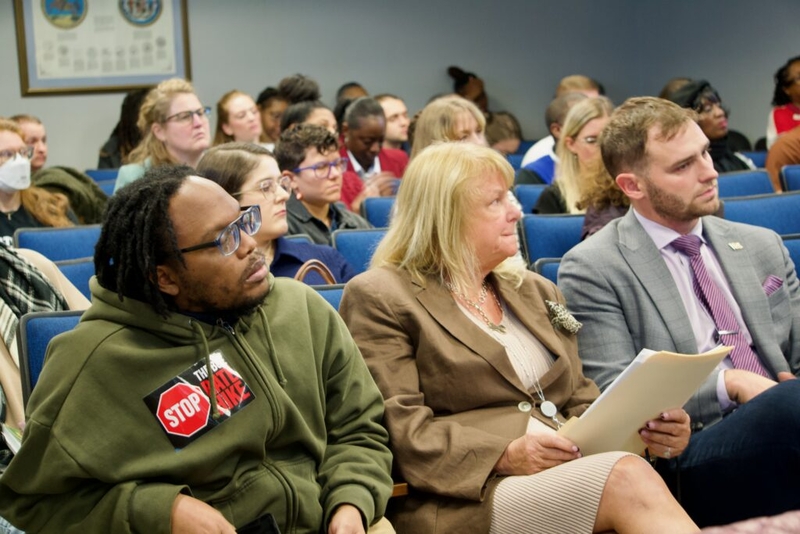
Attendees, some wearing "Stop the BGE Rate Hike" stickers, watched a hearing Nov. 18, 2026 about the utility company's rate increase request, which sits before the Maryland Public Service Commission. (Photo by Christine Condon/Maryland Matters)
The proposed Baltimore Gas and Electric rate hike drew most of the attention — and anger — at Wednesday’s meeting of the Maryland Public Service Commission, but speakers also targeted a new payment plan proposed by the utility.
Called FlexPay, the voluntary program would allow customers to prepay for their utility service by depositing funds into an account, similar to Maryland’s EZ Pass toll payment system.
BGE officials say the program would help customers better manage their accounts, and more easily pay down any debts.
But consumer advocacy groups argue that FlexPay comes with an insidious side effect: By signing up, customers would waive certain termination protections, meaning their gas and electricity service could be disconnected much more quickly if their account falls into the red.
The program could be a “Trojan horse,” said Elliott Kurtz of the advocacy group Baltimore Public Power, distracting needy customers from programs that actually lower the cost of their bills, while bringing dangerous potential consequences.
The idea currently sits before Maryland’s five-member Public Service Commission, which regulates utilities operating in Maryland. The commission is considering the idea at the same time as it considers a request from the utility to increase rates, which would cost residential customers, on average, an extra $8 per month. A decision on both matters is expected early next year.
Because of how rapidly termination can take place after an account falls to zero, low balance notifications will cause persistent stress, said Laurel Peltier, chair of the Maryland Energy Advocates Coalition, which focuses on assisting low income families with their utility bills.
“Imagine being broke, and having your mobile phone remind you all the time that your family’s power is in peril — your phone pinging when it’s 15 degrees outside and your 40-year-old gas furnace is blazing away,” Peltier said.
An analysis from the Maryland Office of People’s Counsel found that other similar prepaid programs have been disproportionately used by lower-income and minority customers.
Although participation is voluntary, “BGE proposes to offer powerful, unrelated incentives that will make it difficult for certain vulnerable customers not to enroll,” according to a news release from the office, which represents ratepayers.
In an interview, Valencia McClure, Exelon’s senior vice president for governmental and regulatory affairs in the region, said a small 2019 pilot program showed that FlexPay customers would be able to restore service more quickly than regular customers.
If a FlexPay customer’s service were terminated, the customer could restore service by bringing the account balance to just $15, said BGE spokesperson Nick Alexopulos in a statement. Their service could be restored in as little as 30 minutes, the company says.
The pilot showed other benefits, McClure said.
“We saw really 98% of the customers were satisfied with this program. We saw customers saying that they did have more awareness of their energy usage,” she said.
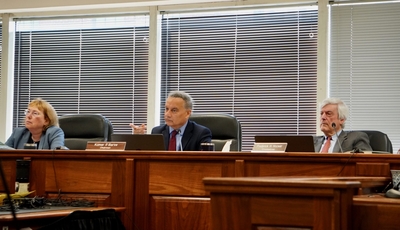
Alexopulos argues that the program also helps customers stay on top of their bills, in part because they can set automatic replenishments for their account.
“For someone who is really worried about getting behind on their bill, FlexPay is the perfect program for them,” Alexopulos said. “They can pre-pay for their energy use. You can set it so that you automatically replenish it, like EZPass.”
Customers begin with a $40 prepayment to the program, which has no security deposit, late fees or reconnection fees, Alexopulos said. Households relying on medical or life-sustaining equipment are not eligible to participate, he added. Extreme-weather disconnection protections remain in place, and disconnections do not occur outside regular business hours, Alexopulos said.
In addition to the concerns about an increase in potentially dangerous utility shut-offs, the People’s Counsel is also concerned that some participants might actually pay more for service, because of repeated transaction fees. The program could also distract needy customers from the state’s programs designed to reduce lower bills for those in need.
“BGE plans to market this program as an affordability program to people struggling to pay their bills. This advertising would distract from the bill assistance programs that are already available,” read a news release from the People’s Counsel.
Kurtz of Baltimore Public Power, called the FlexPay program, “an intentionally confusing program that makes customers vulnerable to utility shut-offs, but disguises itself as a cost-saving program.”
“BGE does not exist to distribute electricity to customers. They exist to distribute wealth to shareholders,” Kurtz said.
Annapolis, MD