After years of advocacy in SC, FCC poised to allow cellphone jamming in state prisons
Nov 18, 2026 | 5:41 pm ET
Description
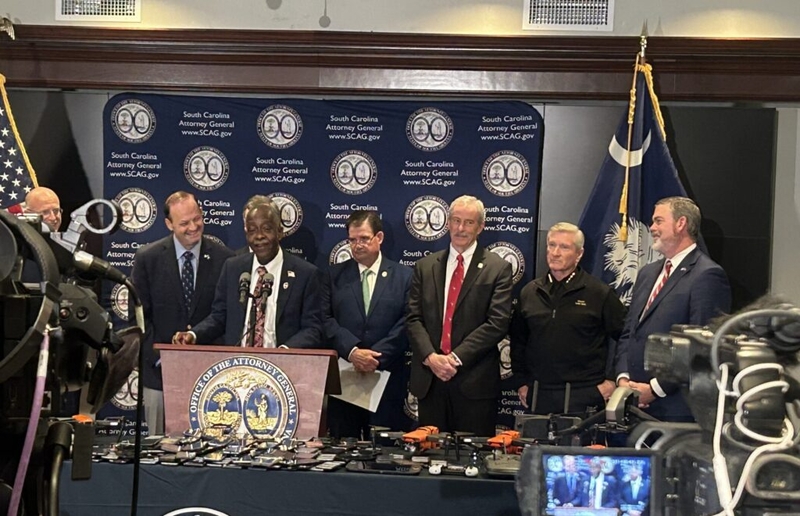
Capt. Robert Johnson, a retired corrections officer who had a hit on him in 2010, speaks to reporters at the attorney general's office in Columbia, S.C., on Wednesday, Nov. 18, 2026. (Photo by Skylar Laird/SC Daily Gazette)
COLUMBIA — After more than a decade of advocacy from South Carolina leaders, a federal commission is expected to allow state prisons to jam cellphone signals, federal and state officials said Wednesday.
The Federal Communications Commission will vote Thursday on a change in regulation that would allow state prisons and local jails to join federal prisons in blocking cellphone signals.
FCC Chair Brendan Carr said there’s “no doubt” the three-member commission will approve the change, which is meant to keep inmates from continuing to commit crimes while in prison.
In a preemptive vote last year, the commission agreed unanimously to advance the regulation. Thursday’s vote will finalize it, allowing the regulation to move to the Federal Register in the coming weeks, Carr said.
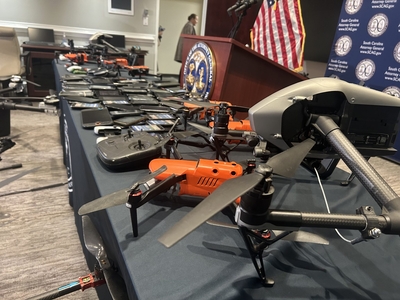
He credited South Carolina’s prison directors with building the momentum necessary to get the regulation passed.
Former prison directors Jon Ozmint and Bryan Stirling, two longtime advocates for cellphone jamming, joined Carr on Wednesday. As did current director Joel Anderson and retired Capt. Robert Johnson, who was shot after an inmate ordered a hit on him using a contraband cellphone.
“Your officials here in South Carolina pushed this forward when no one else would,” said Carr, who came to Columbia for Wednesday’s news conference ahead of the vote in Washington, D.C. “Not at the state level, not the federal level.”
Once the rule is officially added to the nation’s list of regulations, a process that takes between several days and several weeks, states can start applying to use the technology, Carr said.
South Carolina will submit its application right away, Anderson said.
The Department of Corrections will install the technology in one prison at a time, ensuring a methodical rollout with time to catch any issues that arise, Anderson said.
The agency will start with the Broad River Road complex in Columbia, which includes five prisons.
South Carolina is ready to start jamming cellphones as soon as officials get the OK.
Over the past two years, legislators spent $18.5 million on technology that tracks cellphones in prisons, allowing officials to report illegal phones and get them turned off. The same technology can also block cellphone signals, Stirling, the state’s U.S. attorney, said previously.
Once a jammer is switched on, contraband cellphones become useless.
“Pretty soon, the only thing those cellphones can be used for is for (inmates) to hit each other,” Johnson said. “They won’t be able to use them at all.”
Crimes behind prison walls
In March 2010, a gunman entered Johnson’s house in Sumter and shot him six times at close range in the chest and abdomen. The gunman left Johnson for dead.
Investigators later discovered inmates ordered a hit on Johnson using illicit cellphones because they were angry he stopped contraband, including more phones, from entering Lee Correctional Institution in rural Bishopville, where he worked.
One man was promised $6,000 to kill Johnson.
“Myself, I thought I was worth 10,” Johnson joked Wednesday.
In the 16 years since, Johnson has undergone 32 surgeries, he said.
He experiences constant pain because of the injuries from the shooting. For years, his wife, who watched him get shot, spent years afraid people were coming to attack him again, he said.
“No one should have to go through what I went through,” he said.
Technology has improved and become more accessible in the years since Johnson was attacked, allowing prisoners to hatch more sophisticated plans using cellphones, he said.
“I call these cellphones weapons of mass destruction, because an inmate can do things with one cellphone that he can’t do from the prison with the government phones,” Johnson said. “It’s unreal what these guys were able to do when I was there, and what they’re doing now — it just blows my mind.”
FCC set to vote on cellphone jamming in prisons after yearslong push from SC
For the past 15 years, Johnson has traveled the country to advocate for cellphone jamming in state prisons. After the shooting, he felt his calling was to make sure the same sort of situation never happened to anyone else, he said.
He felt the Lord knew he and his wife would be able to handle the struggles and in turn do something good for the world, he said.
“They didn’t know that they started something,” Johnson said of the inmates involved. “I told my wife, ‘I’m going to finish it. I’m not going to let this rest.’”
For years, Johnson has been the face of the worst that can happen when an inmate misuses a contraband cellphone. He’s testified before Congress asking for a way to get cellphones out of the hands of inmates.
His story was instrumental in getting the regulation passed, Carr said.
“I think, more than anybody else, he has put this issue on his back,” Carr said. “He is the reason why we’re here today getting this across the finish line.”
Prisoners use cellphones to commit any number of crimes, said Attorney General Alan Wilson, who in January will be sworn in as governor. Contraband phones have been tied to cases involving drug trafficking, dogfighting, fraud, extortion and killings outside prison walls.
The largest organized crime ring in state history ran using contraband cellphones. Inmates ordered murders, kidnappings, and sales of guns and drugs in the country and internationally.
Tired of hearing cases stemming from contraband cellphones inside prisons, the state’s two grand juries called last year for the change in federal regulation in a rare pair of reports.
Along with threatening communities, cellphones make prisons less safe, Stirling said.
Decades ago, prison officials could move an inmate to another prison if violence broke out. These days, inmates can use a network of cellphones to order hits on one another from across the state, he said.
“They go to prison, and they’re supposed to be behind bars, they’re supposed to rehabilitate, they’re supposed to be safe for society,” Stirling said. “That’s no longer the case with these cellphones.”
Getting federal change
Opponents of allowing cellphone jamming, primarily cellphone companies, have long argued the technology could cause more problems than solutions. Over the years, lobbyists have raised concerns that jammers might affect communication outside prisons, prevent corrections officers from calling for emergency services, or further isolate inmates from their friends and family.
None of that is true, Wilson said.
Tests in South Carolina prisons and in other states have shown the technology can be extremely precise, Anderson said. Jammers can block signals in a single room or building without interfering with technology outside the radius, he said.
Jammers always allow calls to 911, so anyone can contact the outside in case of an emergency, according to prison officials. And inmates can call their families on the monitored phones offered inside the prisons, Wilson said.
SC officials hopeful FCC will allow cellphone blocking in prison: ‘Jamming is the answer’
Contraband cellphones are expensive and get inmates in serious trouble if they’re caught, he said.
“Why do people go to this much trouble and spend this much money?” Wilson said. “It’s not because they want to talk to their mommas.”
Having a cellphone in a South Carolina prison is illegal, but officers need to be able to find them for inmates to face charges. Cellphone jamming is already allowed in federal prisons.
In recent years, as jamming technology improved and the problems involving inmate cellphones worsened, opposition has waned, Carr said.
Cellphone companies asked states to try various other methods of combatting contraband, such as South Carolina’s method of shutting down phones one by one. That proved to be a tedious process state officials compared to a game of Whac-A-Mole, since new signals popped up even as cellphone companies shut existing ones down.
No other methods proved as effective as jamming, Carr said.
“I think a lot of people realize that, yeah, this isn’t a horrible solution now, given the steps that have been taken,”
Columbia