Attorney General won’t defend anti-dark money ballot initiative in court
Nov 17, 2026 | 5:30 pm ET
Description
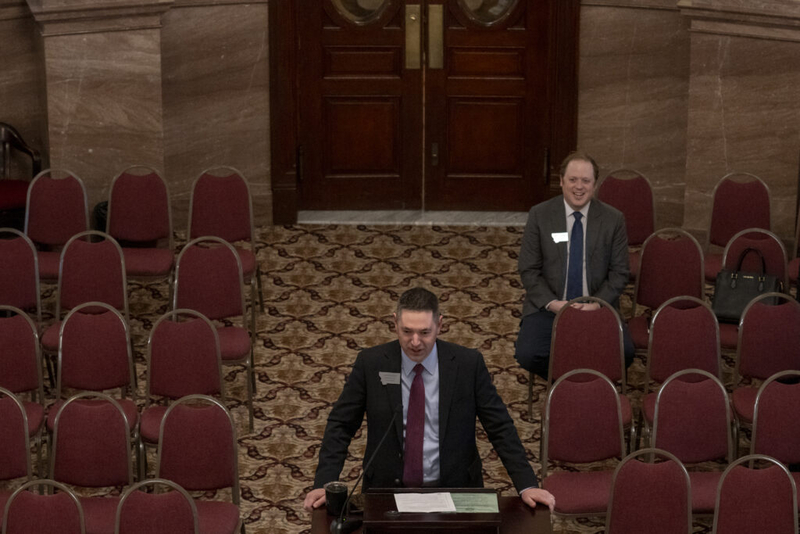
Montana Attorney General Austin Knudsen testifies before the Montana Senate Judiciary Committee on Wednesday, Feb. 13, 2025. (Nathaniel Bailey for the Daily Montanan)
Montana Attorney General Austin Knudsen will not defend a recently passed citizen ballot initiative that he believes is unconstitutional.
Barely 24 hours after voters approved Ballot Initiative 194, known as the Montana Plan, by a nearly 2-1 margin, a coalition of conservative organizations filed suit in federal court to overturn the law. The suit was filed against Secretary of State Christi Jacobsen and Knudsen in their official capacities.
Friday, Knudsen filed a notice to the court that the initiative violates the First Amendment of the U.S. Constitution, and his office will not defend it. It sought to ban “artificial entities,” such as corporations and nonprofits, from directly spending money in elections.
“This is consistent with the Attorney General’s prior legal position when evaluating similar proposals that restrict the political speech for entities with corporate charters,” the filing states.
The lawsuit — filed by the Frontier Institute, the Montana Family Foundation and the Montana Republican State Central Committee — has been consolidated with another case, filed by the Montana Chamber of Commerce, before federal Judge Brian Morris in Great Falls.
On Tuesday, the Transparent Election Initiative, the organization behind the Montana Plan, filed to intervene in the lawsuit as a defendant, as it has “a significant protectable interest in defending the initiative, one that is not adequately protected by existing defendants,” according to court filings.
“Two-thirds of Montanans voted to end corporate and dark money spending in our elections. But the Attorney General has decided that the will of the people — the voices of real Montanans — simply doesn’t matter. We won’t stand for it,” said Jeff Mangan, founder of the initiative, in a statement. “We will continue fighting to make sure Montanans’ voices are heard, and we will step in to defend their law.”
The Montana Plan adds a new chapter to Montana’s laws regarding powers given to “artificial persons” — which include corporations, nonprofits, limited liability corporations, unincorporated associations and foreign entities — and limits their “political spending power” by not including candidates, political parties or ballot measures.
The new law would not apply to political committees or political action committees, or PACs, which are subject to federal disclosure laws.
The new law is considered a direct challenge to the federal Citizens United ruling — not for the first time — wherein the U.S. Supreme Court said that the power to spend money in elections is tantamount to free speech.
Mangan, a former Montana Commissioner of Political Practice, has said the Montana Plan is a nonpartisan effort to start getting money out of the political system, and the more than 300,000 Montanans who voted for the measure — more votes than any political candidate received in the election — shows the broad support.
It’s not the first time Mangan and the Transparent Election Initiative have been in court over the issue.
In January, the Montana Supreme Court struck down an early version of the ballot initiative for being overly broad and making too many changes to state law at one time, violating Montana’s’s one-subject rule for new legislation.
After Knudsen approved a new version of the initiative as legally sufficient and Jacobsen cleared it for gathering signatures, another coalition of business associations filed a lawsuit arguing the initiative was unconstitutional.
But the state Supreme Court dismissed that suit, saying it was not inclined to provide “advisory opinions” for an issue that hadn’t qualified for the ballot and hadn’t been approved by voters.
In the current suit, the Frontier Institute and the Montana Family Foundation argue the new law is overly broad and vague and could limit the organizations’ ability to communicate about, support or oppose ballot initiatives, policies or legislative activity.
They are seeking an injunction to prevent enforcement of the new law. Knudsen has said he will enforce it until a court rules.
Helena, MT