Bipartisanship touted as slew of new Democrats join Indiana Legislature still run by Republicans
Nov 17, 2026 | 5:34 pm ET
Description
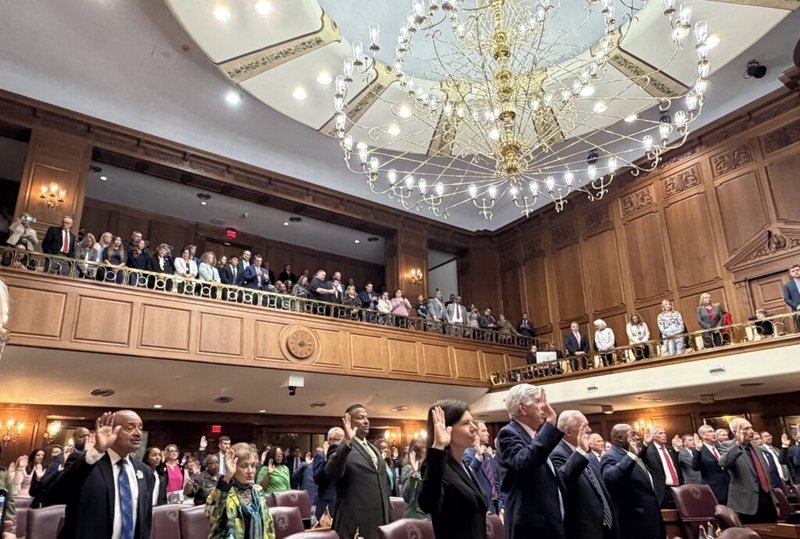
Indiana House members take their oaths of office during the Legislature's Organization Day on Tuesday, Nov. 17, 2026. (Photo by Tom Davies/Indiana Capital Chronicle)
Republican legislative leaders expressed a willingness for more bipartisanship on the day that more Democrats sat as members of the Indiana General Assembly than any time since 2010.
The Statehouse hallways and galleries were filled Tuesday with family members and friends of 37 freshman members joining the ranks of 150 total senators and representatives taking their oaths of office during the Legislature’s Organization Day.
Republican Ben Smaltz of Auburn was elected without opposition as the new House speaker — a promotion to the top leadership post following the unexpected election defeat of former Speaker Todd Huston.
Democrats gained 16 House seats in this fall’s election, narrowing the Republican House majority to 54-46.
Smaltz acknowledged that shift in a speech to the House after being sworn in as speaker, telling Democrats that they have “a greater opportunity to help shape the direction of this chamber and I encourage you to bring your ideas forward.”
“To my Republican colleagues, we still hold the majority, but the dynamics have changed,” Smaltz said. “I encourage you to listen, engage, and look for opportunities to work with our Democrat colleagues without abandoning our principles. The makeup of this chamber may be different, but our responsibility remains the same — to represent Hoosiers, to find common ground, and to deliver results.”
Top Senate Democrat urges “common ground”
Republican and Democratic leaders in the Senate also emphasized the importance of bipartisan cooperation in a chamber that will include 13 new senators among the 50 members. That includes five more Democratic senators that cut the Republican majority 35-15.
New Republican Senate President Pro Tem Chris Garten said he would seek to preserve civil debate.
“We can be firm in our convictions without being disrespectful,” Garten said in a speech to the Senate. “We can debate with passion without sacrificing professionalism, and we can disagree on policy without questioning one another’s character.”
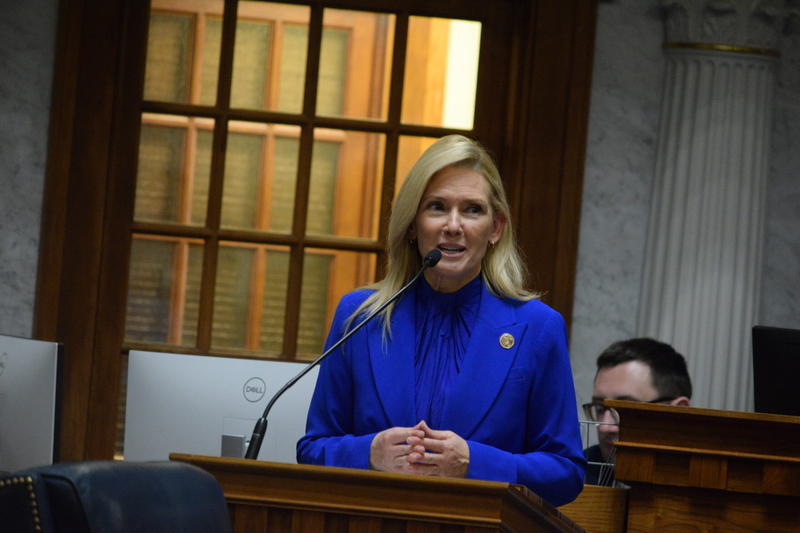
Senate Democratic leader Shelli Yoder of Bloomington urged lawmakers to consider whether the state’s economic policies are actually improving residents’ lives as they prepare to write a new two-year budget during the 2027 session that starts in January.
Yoder said she welcomed Garten’s emphasis on cooperation and believed that was possible on affordability, public schools and government transparency.
“That’s what we’re going to be finding common ground on and working very hard to the very end to make sure Hoosiers know that we are a chamber and a body that works for them,” she said.
House Republicans turn down rules changes
That spirit of bipartisanship, however, only went so far Tuesday as Republicans voted along party lines to reject proposed House rules changes that Democrats argued would make legislative action more transparent and allow more public input.
One proposal would have prohibited the House from considering bills that include provisions adopted by joint House-Senate conference committees that were not approved by at least one chamber. Such conference committees often negotiate in private the final agreements on bills in the final days of a legislative session.
Rep. Matt Pierce, D-Bloomington, cited language that was added to the state budget bill in the final hours of the 2025 session that eliminated the election of some Indiana University Board of Trustees members by IU alumni.
“I’ve seen over and over again this process favor the insiders, favor the people who have influence, and we have an opportunity today to say we can do better,” Pierce said during debate before the proposed rule change was voted down.
Another proposal from Democrats would have allowed so-called “blast motions” under which a bill that hasn’t been acted upon by a committee could be advanced to the full House with the support of at least 51 members.
Republican Rep. Alex Zimmerman, the new chair of the House Rules Committee, argued such a change would undermine the process of properly considering legislation.
“This blast motion takes away the voice of the people that we are elected to serve,” said Zimmerman, R-North Vernon. “When they show up to a committee meeting, we let them testify on every bill that is heard in committee.”
Apparent deal on House committee splits
A point of contention between Republican and Democratic leaders since the election has been the partisan makeup of House committees, through which all bills that come up for consideration must clear.
Under the previous Republican supermajorities of the past 14 years, most House committees have been made up of nine Republicans and four Democrats.
The much tighter House membership had Democrats arguing for 7-6 committee splits.
A pending agreement would expand most committees to 14 members, with eight Republicans and six Democrats.
Smaltz told reporters that such a split was “a reasonable assumption” and that he anticipated a list of committee assignments would be completed within about 10 days.
House Democratic leader Phil GiaQuinta of Fort Wayne said his caucus was never going to accept a suggested 8-5 Republican control of committees.
“The majority is going to want you know to have their two-person spread,” GiaQuinta said of the 8-6 committees. “It is a reflection of where we’ve been in the past. Good number to land on.”

Indianapolis, IN