After election gains, NC Democrats and advocates push for voting rights, redistricting reforms
Nov 17, 2026 | 5:02 pm ET
Description
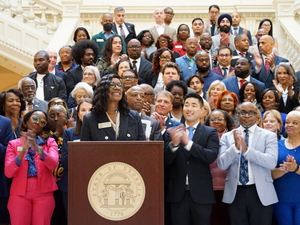
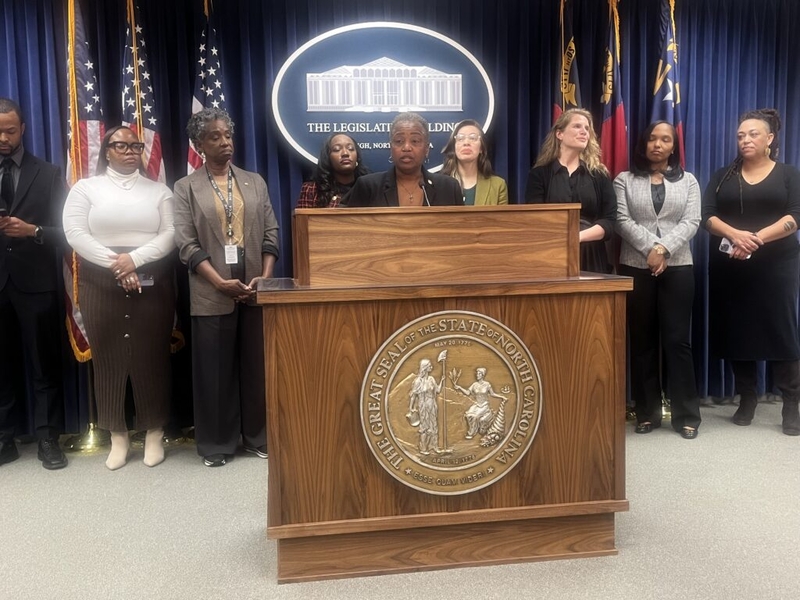
Sen. Kandie Smith speaks during a press conference at the North Carolina Legislative Building in Raleigh on Nov. 17, 2026. (Photo by Ahmed Jallow)
For the first time since 2010, Democrats will control one chamber of the North Carolina General Assembly, and voting rights advocates are already pressing the incoming legislature to pass a state Voting Rights Act and establish an independent commission to draw voting districts.
On Tuesday, Democratic senators and representatives of several advocacy groups gathered at the legislature in Raleigh to outline the changes they want lawmakers to pursue when the new General Assembly convenes in January.
Speakers cast the proposals as a response to voters’ demands after the election, but many of their ideas will likely face an uphill battle in the Senate, where Republicans maintain a one-vote majority.
Voting rights
Forward Justice Executive Director Caitlin Swain called on North Carolina to lead the South by adopting a state Voting Rights Act, saying the measure is necessary to protect voters’ rights.
“We believe that this is not only possible — that it is structurally necessary to preserve the rights of our people,” said Caitlin Swain, executive director of Forward Justice. “We don’t think that it needs to be a partisan issue.”
More specifically, advocates are calling for automatic voter registration, and changes to how state and county election boards are appointed and funded. They said the legislation could also change how election directors are hired and paid and increase pay for poll workers.
Asked about that idea, outgoing House Speaker Destin Hall, R-Caldwell, said he doesn’t think it’s necessary.
“It looked to me like most of their voters didn’t have a tough time voting this time around,” Hall quipped to reporters Tuesday, but added, “You can always improve things, of course, and so, you know, we can listen to that.”
Redistricting
Tyler Daye, program manager for Common Cause North Carolina, called for an independent commission to draw legislative and congressional districts, criticizing both parties for using redistricting to their advantage when in power.
“The only path forward for redistricting in this state is an independent commission, taking the power out of the hands of politicians and putting it back with the people,” Daye said.
Daye said the commission should include equal numbers of Republicans, Democrats and unaffiliated voters. The commission should also be required to keep communities together and prohibited from using partisan data to draw districts.
Daye noted that outgoing Republican Senate Leader Phil Berger supported independent redistricting when Republicans were in the minority in the state legislature before 2011. But in late 2025, Berger was the chief proponent of redrawing the state’s congressional map to give Republicans an 11-3 advantage.
“The party that is out of power wants reform. The party that is in power thinks the system is fine,” Daye said.
That 2025 redistricting backfired earlier this month, and Democrats won 11 seats to Republicans’ three, flipping the delegation. But speaking to reporters on Tuesday, Berger, R-Rockingham, defended the redraw, blaming the flip on the national blue wave.
“Reality is, we didn’t redraw the map in South Carolina. We saw similar situations in South Carolina,” Berger said. “We saw just a wave election. Those things happen from time to time.”
Affordability
Affordability was one of the top issues for voters this past election, and the senators at Tuesday’s event said lowering costs will be high on their agenda next year.
Sen. Natalie Murdock, D-Durham, said Democrats are preparing a package of legislation aimed at lowering everyday costs. “An agenda that helps people afford housing, healthcare, child costs, energy bills, groceries. An agenda that raises wages, strengthens public schools,” Murdock said.
Murdock said Democrats may be able to find common ground with Republicans on housing and public education.
Berger won’t be returning to the Senate next year — he lost his seat in the primary. But he said he expects opportunities for Republicans and Democrats to work together on some issues.
“There’ll be a wealth of opportunities for folks to reach agreement on things,” Berger said, “and there likely will be some things where folks will say, ‘We’ll just have to really disagree,’” he said.
Sen. Val Applewhite, D-Cumberland, said she had received calls and emails from Republican constituents asking for help with policies advanced by their own party because they felt their voices were not being heard. She said Democrats need to remember that lesson next year.
“The power we hold is borrowed power,” Applewhite said. “It belongs to the people.”
Raleigh, NC