Firefighter Accused Of Rape Pockets $150K Not To Work As Inquiry Lags
Nov 17, 2026 | 9:41 am ET
Description
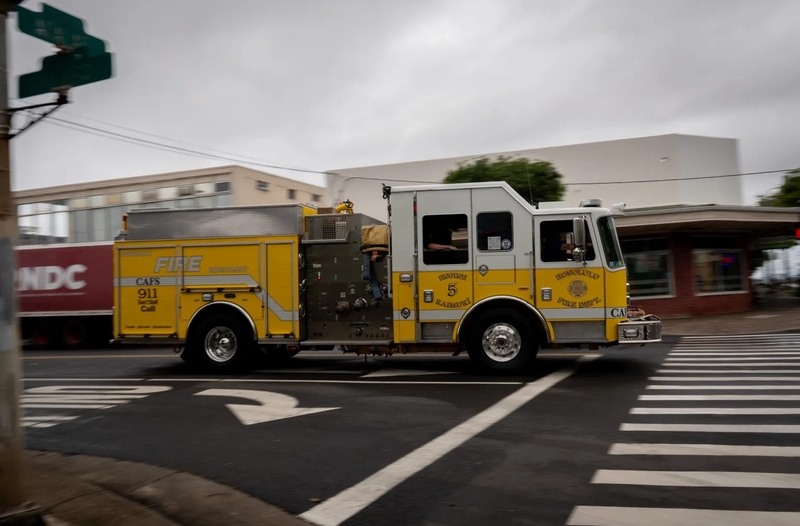
Honolulu Fire Department engine travels down Koko Head Avenue in Kaimukī. Craig Fujii/Civil Beat/2026
A Honolulu fire battalion chief accused of raping a colleague at fire headquarters has been getting paid to stay home for nearly two years as the department conducts an internal investigation.
Blake Takahashi was accused of locking a female subordinate in his office on Valentine’s Day 2025 before raping her. He turned himself in to police six days later and has been on paid leave ever since, the department confirmed to Civil Beat.
The administrative investigation has dragged on even as a criminal investigation apparently concluded.
The Honolulu Prosecuting Attorney declined to file charges, according to a lawsuit filed by the alleged victim last month. The lawsuit does not say exactly when prosecutors declined to file charges. The prosecutor’s office would not comment.
While administrative investigations can take longer than two years, the vast majority are wrapped up in less than six months, according to a 2024 Civil Beat review of paid leave periods for 350 employees across more than 24 state and county agencies.
Because the allegations in this case are so serious, the department should be pressing to complete its review thoroughly and quickly, said Ted Hong, a Hilo-based employment attorney. Hong said he has represented clients who’ve been accused of similar crimes in the workplace, and in his experience, the internal investigations are usually done within three to six months.
“Something this serious, it has to be resolved quickly,” he said. “When these types of investigations linger for a year or more, it affects morale within the department.”
For the last 21 months, Takahashi has continued to collect his salary, which is about $150,000 a year. The department must also pay more to cover his shifts, either by paying another battalion chief overtime or temporarily promoting someone of a lower rank to fill in.
Takahashi’s attorney, Thomas Otake, did not respond to calls and text messages seeking comment for this story. But Otake previously told Civil Beat that Takahashi denies the allegations. Takahashi did not return a voicemail seeking comment.
If Takahashi were to be charged and convicted of a felony, he could be at risk of losing part of his pension under the state’s pension forfeiture law.
‘Unacceptable’ Investigation Length
The investigation is being conducted jointly by the Honolulu Fire Department and the city Equal Employment Opportunity Office, fire department spokesman Jacob Pekelo said in an email.
When asked why the department’s investigation was taking longer than the criminal investigation, he said the department was “not familiar” with the prosecutor’s process nor what the prosecutor reviewed. He added that the investigation is ongoing and the department does not have a projected completion date.
The alleged victim, who has been identified only as Jane Doe, accused Takahashi of inviting her into his office to discuss work matters on the evening of Feb. 14, 2025. He then encouraged her to drink alcohol with him, and made sexual advances toward her, as she pulled away and told him “no,” the lawsuit says.
He locked the door, physically restrained her and raped her while she cried “tears of pain and fear,” the lawsuit says.
The department has yet to release any determination from its internal investigation, which has caused Doe distress, according to the lawsuit.
A recent Civil Beat public records request for surveillance footage from fire headquarters the night of the alleged rape was denied by the fire department, which cited its ongoing investigation.
Fire officials will likely have to release some evidence from their investigation during the discovery process now that a civil lawsuit has been filed, Hong said. But much of it could remain sealed from public view because of the pending investigation.
Nicole Kalakau, an attorney representing Doe, said the slow pace of the investigation is a major reason why Doe wanted to sue the department. In the suit, Doe accuses the Honolulu Prosecuting Attorney of declining to file charges against Takahashi to protect him and shield the county from liability.
Kalakau called the length of the internal investigation “unacceptable.”
“It leaves you to wonder whether (the department) was simply hoping to wait Jane Doe out, betting that if they stayed silent long enough, she’d give up and go away,” she said. “Meanwhile, Battalion Chief Takahashi keeps collecting a paycheck, and Jane Doe is stuck with no answers and no way to move forward.”
Kerrie Urosevich, CEO of the Domestic Violence Action Center — an organization providing support and legal services for victims of domestic violence — said the message the protracted investigation sends to women in the workplace is: “The system is going to fail you.”
While she said she recognizes the need for due process and the importance of a thorough investigation, the lack of answers from the department raises more questions.
“Why does it take two years to investigate an incident like this? And why are taxpayers paying that kind of money to pay somebody on paid leave?” she said. “For me, it tells me they didn’t value the situation enough to investigate in a timely way, and to me, that’s a culture problem.”
Bobby Lee, president of the Hawaiʻi Fire Fighters Association, the union representing firefighters statewide, said because battalion chief is a managerial position, Takahashi is not represented by the union. Lee declined to comment on Takahashi’s case, but said generally, when there is a vacancy in a high-ranking position in the department, someone immediately below will step up to fill it.
In this case, a captain would normally move up to fill in for the battalion chief position, a third-tier firefighter would move into the captain role, and so on.
“It basically pushes one person up to cover the next person,” he said.
How Long Should Investigations Take?
Lee said when investigations involve union members, the union tries to push for them to get resolved as quickly as possible, but they can sometimes drag on for years. He recalled one case involving a Big Island firefighter charged with negligent homicide that lasted seven years.
But that is not the norm.
According to Civil Beat’s 2024 review, the average paid leave period for employees under investigation was six months while the median was three months.
Debra Allen, a Honolulu-based private investigator who does workplace investigations, said she has conducted investigations that lasted a little over a year, but it’s rare.
Internal investigations are supposed to run concurrently, but entirely separately, from criminal investigations, she said. While police investigate whether any crimes were committed, workplace investigations focus on any policies that may have been violated.
When a third-party investigator, like Allen, who owns 808 Investigations, completes its review, it will usually present a final report to the agency, which in turn will determine whether any discipline will be doled out to the employee.
Butch Galdeira, chair of the Honolulu Fire Commission, which is responsible for oversight of the fire department, also declined to comment for this story, citing the pending lawsuit.
Hong said the burden of proof in an internal investigation is much different than that of a criminal investigation. For prosecutors to file charges, they must believe that they can prove their case beyond a reasonable doubt.
An employer only needs to have “clear and convincing evidence” that a worker violated policy in order to take disciplinary action, he said. That would mean they considered the allegation substantially more likely to be true than untrue, though they could still have some doubt.
Even though Takahashi was never charged criminally, an internal review could still deem him eligible for termination or some other disciplinary measure.
“It makes no difference what happens on the criminal side,” Hong said. “The department and the city and county have their own standards of conduct for employees.”
He also said he sees little reason for the investigation to take so long.
“Barring one of the key witnesses being in a coma for two years,” he said, “I can’t see how this should be taking this long.”
Honolulu, HI