Utah advocates ask Cox to pause Flock cameras on state roads until new law is finalized
Nov 16, 2026 | 9:03 pm ET
Description
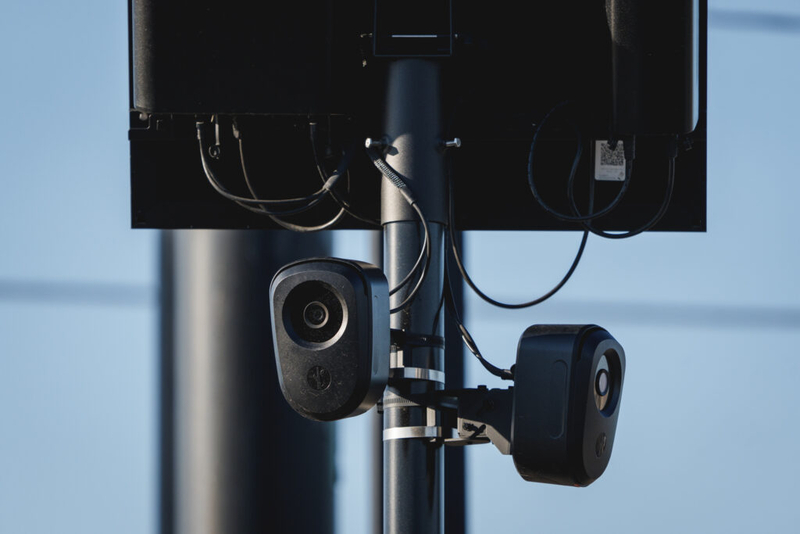
Flock Safety cameras are mounted on a pole in the parking lot of the Home Depot in Salt Lake City on Tuesday, Aug. 25, 2026. (Photo by Spenser Heaps for Utah News Dispatch)
A Utah group advocating for more regulation of automated license plate readers is asking the governor’s office to turn off the Flock cameras installed on state highways by the end of this month and until a new regulatory framework is established.
The Utah Civic Compact, a nonprofit that has investigated how the Flock Safety cameras are used in the state amid intense scrutiny over misuse and surveillance concerns, says the Utah Department of Transportation has exceeded its authority by establishing a rule that requires the department to sign a license agreement with the company to operate on state right-of-ways.
“No statute gives UDOT the power to license the vendor,” Jarom Gillins, director of policy at the Utah Civic Compact said at a Monday news conference.
A Utah 2023 law allowed UDOT to issue permits for the use of the cameras on state highways if law enforcement agencies request them. However, the Utah Civic Compact criticized that the department of transportation’s license agreement with Flock established conditions for camera operations “regardless of which (law enforcement agency) has contracted for the company’s services,” according to the document.
Utah group says there’s a faster way to block Flock cameras — without legislation
The Utah Civic Compact has been analyzing UDOT’s agreement with Flock for over a month, hoping to find a way to turn off the cameras installed on state property.
In October, the group asked UDOT to cut its contract with the company, arguing that UDOT is able to terminate the agreement if it “determines that the public does not support the Company’s activities.” On Monday, the group switched that request for a direct call to Gov. Spencer Cox to pause the cameras’ operations until new legislation is enacted.
“If vendors are going to be part of plate reader systems on state highways, the Legislature should set the terms in statute, with the agency responsible for every camera and no vendor license the law does not provide for,” Gillins wrote on the organization’s website. “The Utah Privacy Commission’s task force has recommended that agencies own and control the data their systems collect and that vendors process it only on the agency’s behalf.”
However, John Gleason, a spokesperson for UDOT, said the department’s role is only focused on ensuring the equipment is properly permitted and secured so it doesn’t cause any issues with traffic.
“We don’t install the equipment and we don’t use Flock cameras. We really have no involvement in the use of the equipment,” Gleason said. “We’re just required by state law to issue the permits if they’re for law enforcement use, and to ensure that the equipment is safely installed and not posing a concern for traffic.”
Utah lawmakers have been studying legislative proposals during their off-session meetings after the Utah Civic Compact revealed that the vast majority of searches for Flock Safety data from cameras installed in Weber County were made by out-of-state law enforcement agencies, a fact that the governor said had him “deeply troubled.”
The question, lawmakers said, isn’t whether the state should allow the cameras, but how to regulate them.
Utah law limits searches of license plate camera databases to active criminal investigations, outstanding warrants, or to search for a missing or endangered person or a stolen vehicle. But, concerns about misuse have recently emerged as police officers in other states have been accused of using Flock camera data to track people they know, and not for their jobs.
Earlier this month, a KSL investigation revealed a former Tooele County Sheriff’s Office detective had searched the department’s license plate reader system for a vehicle belonging to the estranged husband of a woman he was dating, using a case number from a closed investigation to do so.
“Ideally, we want all network surveillance paused across the state of Utah until the legislature can act and regulate these systems properly, and we know exactly where our data is going and what is happening with our data,” Gillins said.
Salt Lake City, UT