Past rulings, questions of experience dominate SC Supreme Court candidate screenings
Nov 17, 2026 | 8:30 am ET
Description
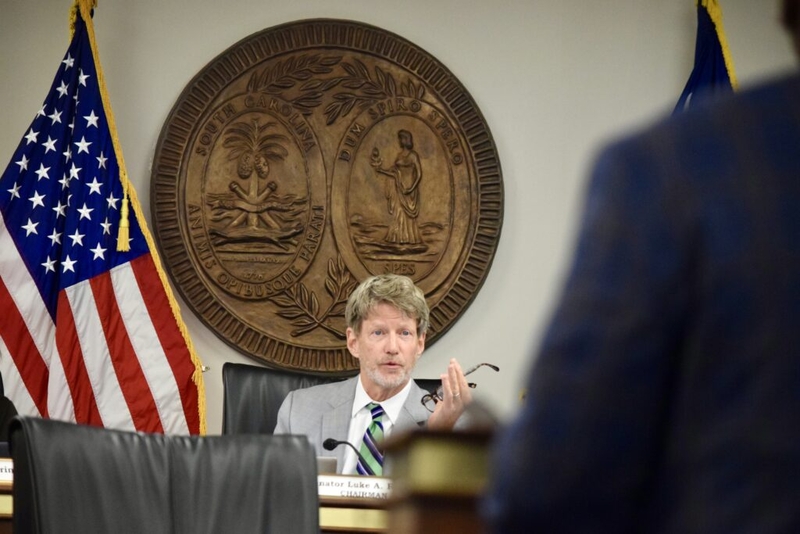
South Carolina Judicial Merit Selection Committee Chairman Luke Rankin, R-Myrtle Beach, questions candidates for the state Supreme Court Monday, June 16, 2026, in Columbia, as part of the judicial screening and election process. (Photo by Jessica Holdman/SC Daily Gazette)
COLUMBIA — South Carolina Supreme Court hopefuls responded to criticisms ranging from a lack of experience to perceptions of arrogance and fielded questions about past rulings, including a high court case involving race.
The questioning came Monday as the five candidates seeking a 10-year term on the state’s highest court appeared before the panel tasked with screening them for the job.
Those running include:
- Administrative Law Court Chief Judge Ralph “Tripp” Anderson of Columbia
- S.C. Appeals Court Judge John Geathers of Georgetown
- Judge Eugene “Bubba” Griffith Jr., a Circuit Court judge of Newberry
- S.C. Appeals Court Judge Blake Hewitt of Conway
- Judge Maite Murphy, a Circuit Court judge of Summerville
Each is seeking the opening created after former Justice John Few dropped his bid for re-election in March, a day before the Legislature was scheduled to vote.
Few had become the first sitting justice in more than 20 years to face a challenge to keep his seat. His three opponents included the former leader of the state House.
When it became clear that former Speaker Jay Lucas had sealed up enough votes from legislators to win, Few pulled out, triggering a clause in state law that restarted the process.
Monday’s screenings began with two candidates with the longest careers on South Carolina’s judicial bench. The Legislature first elected Anderson and Geathers in 1994 to the Administrative Law Court, which handles public disputes with state agencies.
Race and what’s ‘reasonable’
During the questioning of Geathers, the panel appeared most interested in a dissent written by then-Chief Justice Don Beatty that he signed on to.
Geathers was filling in on the high court for State v. Spears. It was one of roughly a dozen times Geathers has served as a substitute justice.
The 2020 split ruling in question upheld a 30-year sentence for trafficking crack cocaine.
Before the original trial, the attorney for Eric Terrell Spears, a Black man, sought to suppress evidence of the drugs found in his waistband, arguing the 2012 frisking at a bus stop violated Spears’ Fourth Amendment rights against unreasonable search and seizure.
The high court agreed 3-2 with the trial judge, finding Spears voluntarily engaged with the agents and his actions “created a reasonable suspicion that he may have been armed and dangerous,” justifying the pat-down.
Retired SC chief justice tells Black teens diverse perspectives matter: ‘Never be intimidated’
In his dissent, Beatty argued courts should consider a person’s race in determining what’s reasonable.
A “reasonable Black person” would not have felt free to walk away, and Spears’ nervous reaction to officers was normal, he wrote: “An objective eye would acknowledge the fact that African-Americans are being reasonable when they respond in accordance with their collective experiences gained over two hundred years.” The drug evidence should have been suppressed from trial, he concluded.
The chief justice, who was the only Black justice on the high court, selects who fills in when there’s a temporary vacancy or absence for whatever reason.
Had he not chosen Geathers, the state’s lone Black Appeals Court judge, to sit in on that case, Beatty would have been the only racial minority weighing in. And Geathers agreed with Beatty, who retired in 2024.
Peter Protopapas, a Columbia personal injury lawyer appointed to the 12-member screening panel by Gov. Henry McMaster, called the dissent powerful and thought-provoking. He asked Geathers whether he thought individual characteristics, such as race, should be taken into account in future cases.
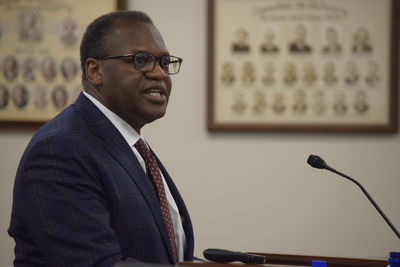
Geathers didn’t address questions about race. He said he remembered the argument being about whether the plainclothes officers had “reasonable suspicion” to follow and stop Spears in the first place, not about Spears’ race.
Asked again by Senate Judiciary Chairman Luke Rankin about the dissent and the studies cited in it, Geathers said he did not recall.
As part of his screening, Geathers received only positive comments from lawyers and citizens who weighed in.
And Christian Stegmaier, a retail and hospitality lawyer in Columbia, praised Geathers’ handling of a case from his Administrative Law Court days.
The 1998 case involved landowners from Newberry County, who were representing themselves in a septic tank permitting dispute with state environmental regulators. Geathers traveled to the property for an in-person explanation from permitters about the denial.
Candidates face criticism, questions of experience
Anderson, on the other hand, faced a rare series of criticisms.
Anonymous complaints from lawyers accused him of being sarcastic in the courtroom and comments submitted from a citizens’ panel claimed he was arrogant. Similar criticisms didn’t come up during his previous hearings before the panel.
Anderson, chief judge of the Administrative Law Court since 2009, has run for an opening on the high court several times.
Responding to the criticism, he said, “The one that really bothers me the most would be the arrogance. I’ve been before this screening committee for over 30 years, and that’s never been raised. I’m the same judge.”

He then went on to talk about his physical disability due to an accident a week before he graduated college and how learning to live as a quadriplegic instilled humility.
Staff also questioned him about complaints against several agencies that he declined to hear until the Court of Appeals sent it back to his courtroom.
Anderson had initially declined to take the cases because he didn’t think the questions fell within the purview of the Administrative Law Court or thought state law was ambiguous. He gave details for his reasoning on two of those cases.
What didn’t come up, at least not during the public hearing, were Anderson’s decisions in the high-profile case of an illegal sea wall constructed by millionaire Rom Reddy to guard his Isle of Palms mansion from erosion — a case that led to Reddy’s unsuccessful run for governor earlier this year.
Anderson sided with environmentalists in ruling Reddy would have to take the wall down but dismissed the nearly $300,000 fine Reddy faced. And as the case goes through appeal, the wall can stay up.
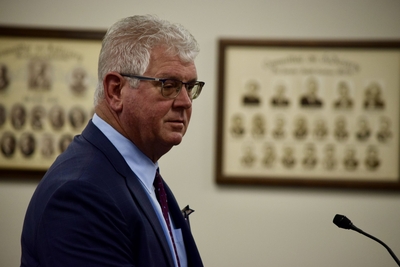
When it came time to hear from Griffith and Murphy, the panel asked the pair of Circuit Court judges whether they’d enjoy the slower-paced, academic side of the judiciary rather than the hustle and bustle of the lower court.
Griffith, a Circuit Court judge for 22 years, acknowledged he’d need to brush up on opinion writing. Outside of the Supreme Court, he wants to help educate local magistrates, who are appointed by senators and often aren’t lawyers.
“I want to help teach lawyers how to be better lawyers and teach magistrate judges how to be better judges,” he said.
The 62-year-old also acknowledged he wanted to seek the job before retirement. In South Carolina, judges must retire from full-time work the year they turn 72.
Murphy, a magistrate and master-in-equity before the Legislature elected her to the Circuit Court in 2013, said its “always important to evolve, to learn, to grow,” and thinks the Supreme Court would provide that opportunity.
The now 57-year-old previously ran for the Supreme Court to replace Justice Kaye Hearn, who retired after turning 72 in 2022.

Murphy dropped out in fall 2022, almost two months before screenings began, amid questions about whether electing her to the Supreme Court would put too much judicial power in one couple. At the time, her husband was House Judiciary Chairman Chris Murphy. They later divorced, and he died in July.
There was similar precedent: The Legislature elected Hearn, who Murphy sought to replace, to the Supreme Court while her husband, GOP Rep. George Hearn of Conway, sat on the House Judiciary Committee. But he was a freshman legislator, not the chairman.
The panel didn’t bring up that previous withdrawal.
Instead, Murphy fended off anonymous allegations Monday from lawyers that she has been impartial and unprepared for court. In response, she said she tries to be as fair as possible.
In his third run for the high court in three years, Hewitt was again dogged by criticisms that he lacks experience.
Prior to his election to the Court of Appeals in 2019, he practiced law for a decade with Bluestein Attorneys.
“I used to bristle a little bit with the comments that I lack experience because I thought they really didn’t account for the relatively broad experience I had in 10 years as an appellate litigator,” Hewitt said.
As long as the screening panel finds no reason to disqualify any of the candidates, all five will advance to an election by the General Assembly scheduled for March 3.
Columbia