A new documentary looks not-too-far back at NC college student voting this election
Nov 06, 2026 | 2:42 pm ET
Description
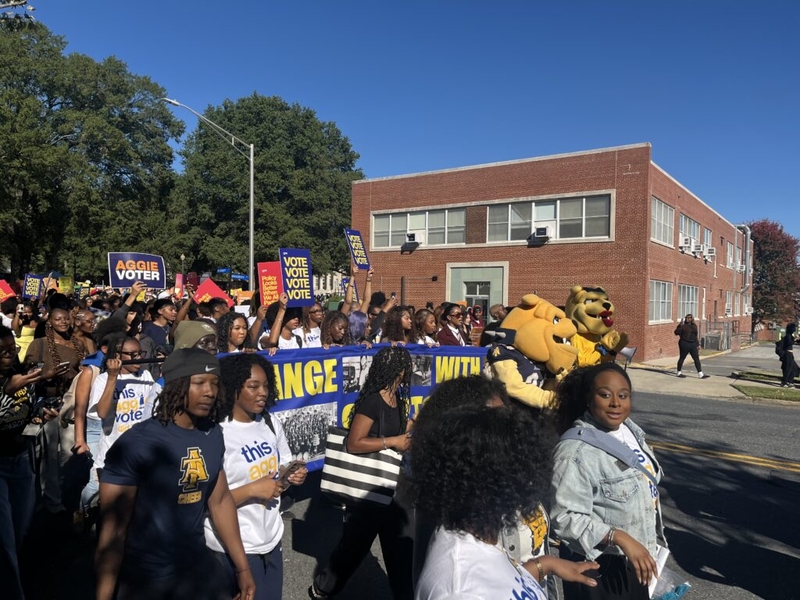
Students at North Carolina A&T State University in Greensboro, North Carolina, begin a 40-minute walk to the nearest off-campus early polling site on Oct. 22, 2026. Election officials declined to put an early campus voting location at the school despite protests. (Photo by Elisha Brown/Stateline)
Some ballots haven’t even been counted yet, but a documentary about the 2026 election from the perspective of North Carolina college students fighting for campus early voting sites has already had its debut.
“Where Do I Vote Again?” screened Thursday night at The Rialto in Raleigh. It encapsulates the work of students who tried to convince election officials to locate early voting sites on their campuses. It also highlights the work of Influence NC, the nonprofit that held voter information parties at a dozen campuses and offered students rides to the polls at three of them.
The prelude: The Guilford County Board of Elections and the state Board of Elections didn’t give N.C. A&T State University students the campus early voting site they wanted.
The N.C. State University site was moved from the centrally-located student center to a building at the edge of campus that students argued was inconvenient.
A push from the state auditor’s office to prevent an early voting site at Western Carolina University failed.
The documentary didn’t show all that resulted, but here’s part of the postscript:
A&T student marches to an early voting site made national news.
The WCU early voting site Republicans fought was the second-most used in Jackson County.
According to data from NC Election Live, voters ages 18-29 cast 11% of early ballots this year, compared to 5.4% in 2022.
The documentary featured interviews with students; Jeff Carmon, a Democratic state elections board member; Dallas Woodhouse, a Republican political operative who worked at state Auditor Dave Boliek’s office advising counties on their early voting plans; voting rights advocate Bob Hall; and Gerry Cohen, a Democrat on the Wake County Board of Elections.
Boliek was recorded at an event sponsored by The Assembly and included his comments about locating an early voting site at Union Square Campus, a building used by A&T, UNC-Greensboro and Guilford Technical Community College.
Ahead Media produced the documentary in collaboration with Influence NC.
At the question-and-answer session following the screening, Hannah Preston, director of Influence NC, said organizing young people is easy.
Proposed ban on amplified music outside NC polling places draws criticism
“We had doughnuts, we had coffee, we had t-shirts,” she said. “You have to have something fun to motivate folks, and not just younger people.” About 3,000 students attended its campus events, she said. Influence NC is a nonprofit that was originally sponsored by the progressive group Carolina Forward.
Does gerrymandering matter?
Democrats scored surprising victories on Tuesday to nearly win a supermajority in the state House, flip at least five congressional districts from Republican to Democrat with five more still too close to call, and to appear to fall just one seat short of a 25-25 tie in the state Senate.
During the Q&A, Western Carolina University political science professor Chris Cooper compared Democrats’ sweeping victories to a 100-year flood, one that breached the walls meant to protect Republicans in gerrymandered districts.
It would be a mistake, however, to argue that gerrymandering doesn’t matter, he said. “It absolutely does.”
Democrat Roy Cooper won the U.S. Senate race by nearly 20 percentage points, the largest US Senate win since 1974, he said. Yet, the state Senate still didn’t flip. “So why is that? The way the lines are drawn.” the WCU professor said.
‘Vulgar music’
The documentary may have helped solve a mystery.
One of the election rules the state Board of Elections approved along party lines this year bans amplified sound at polling sites.
Students and voting rights advocates argued that the rule was aimed at Black and brown students and is meant to discourage activities that make voting a fun community event.
Board members never said why they wanted the rule, but Woodhouse offered one explanation in the documentary.
“I don’t think we ought to have DJs blasting vulgar music outside of early voting,” Woodhouse said, because it intimidates people.
“If I went and played a bunch of Hank Williams, Jr. and a bunch of country artists outside of early voting sites in certain parts of the state, people would think that’s offensive or I’m trying to chase voters away. That’s inappropriate. These are not dance parties.”
Woodhouse’s comments prompted one student at the Q&A to ask if “vulgar music” was a racist dog whistle.
Travis Fain, a former WRAL reporter who is an Influence NC board member, said he couldn’t say what Woodhouse meant because he wasn’t part of the conversation.
Sometimes public relations professionals say things they don’t believe, Fain said. And for people who have been in that business for a long time, “the line starts to blur” between what they believe and what they say to win, Fain said.
“I don’t want to judge based on a snippet of a conversation that I was not a part of, and you could be proven exactly right,” he told the student. “But we all just have to extend so much damn grace in this world these days to each other, whether people deserve it or not.”
Raleigh, NC