Kansas revenues climb to unexpected heights, providing a stable outlook for the state budget
Nov 06, 2026 | 2:01 pm ET
Description
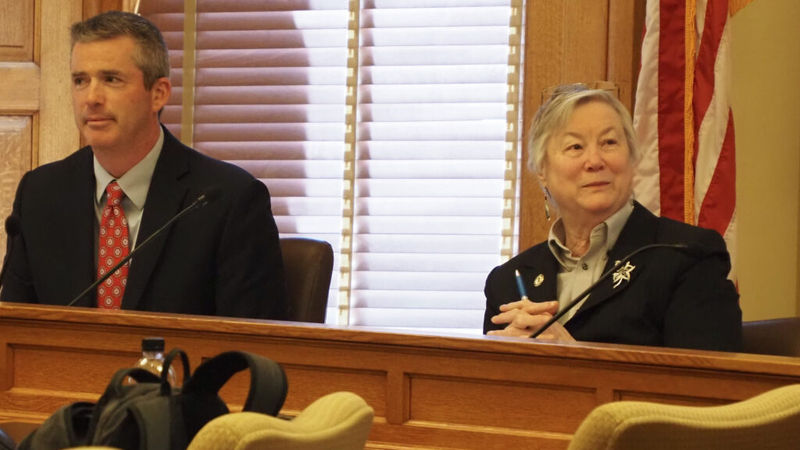
Budget director Adam Proffitt and Kansas Legislative Research Department director Shirley Morrow talk to reporters during an April 20, 2026, briefing on the state budget. (Photo by Anna Kaminski/Kansas Reflector)
TOPEKA — The new governor and lawmakers will enjoy an improved budget forecast when they take office in January, based on a revised estimate of state tax collections and expenditures.
Forecasters revealed the latest “consensus revenue estimate” on Thursday, based on input from the Kansas Legislative Research Department, state agencies and economists from the University of Kansas, Kansas State University and Wichita State University. The estimate is revised each April and November.
For the current fiscal year, which began July 1, the state is now expected to collect $426 million more than the same forecasters predicted in April. The change is based mostly on robust corporate and individual income tax collections, as well as sales taxes on goods that have seen higher-than-expected inflation.
The five-year budget outlook also underwent a transformation from when the Legislature finished its work seven months ago. At the time, it looked like a new governor and Legislature would have to deal with budget-busting deficits that would rapidly deplete reserves, starting in 2028. Now, the forecast shows surpluses will increase from $489.1 million in fiscal year 2028 to $813.8 million by fiscal year 2031.
And instead of eating into reserves, the rainy day fund is expected to grow from $2 billion now to more than $2.3 billion in five years.
Democratic state Sen. Cindy Holscher, who was leading Republican Senate President Ty Masterson by about 7,000 votes in the governor’s race, will benefit from the state’s financial stability as she launches her administration. Her predecessors were less fortunate: Republican Gov. Sam Brownback took office in 2011 following an economic downturn, and Democratic Gov. Laura Kelly inherited Brownback’s failed tax experiment.
Budget director Adam Proffitt, who also serves as secretary of the Department of Administration, attributed the state’s strong financial standing to Kelly’s “steadfast stewardship.”
“We were facing a budget crisis eight years ago, and there’s been a lot of work that’s gone into stabilizing the budget, undoing all the budget maneuvers, the accounting gimmicks, making sure that we get back to crystal clear budgeting,” Proffitt said.
“There’s been a restoration of real budgeting in the state of Kansas,” he added.
House Speaker Dan Hawkins, a Republican from Wichita who just won the race for insurance commissioner, also took credit for the economic recovery.
For the past two years, the GOP-dominated Legislature ignored the governor’s budget proposals and built its own spending plan. State spending continued to increase, and Republicans clashed with Kelly over her numerous line-item vetoes.
“House Republicans took the reins of the budget process because Kansans deserve responsible stewardship of their hard-earned money,” Hawkins said. “We’re seeing strong revenues, and we’re committed to making sure those dollars are managed wisely. Strong revenues don’t mean a blank check for bigger government. It means we have an obligation to stay disciplined, protect taxpayers, and keep Kansas on solid financial footing. That’s why Republicans took charge of the budget, and our state is stronger for it.”
In terms of the revised revenue estimate, Kansas Legislative Research Department director Shirley Morrow said “the most noteworthy and the biggest factor” was the reemergence of inflation during this calendar year.
Morrow said agriculture producers “are especially exposed to the inflation and price pressures that are prevalent in the economy.”
She also pointed to a stable unemployment rate of just below 4% in Kansas, and a strong job market, especially in construction, leisure and hospitality, and health services.
Topeka, KS