As Democrats gain power in Pa., some business leaders wonder about moderation
Nov 05, 2026 | 5:30 pm ET
Description
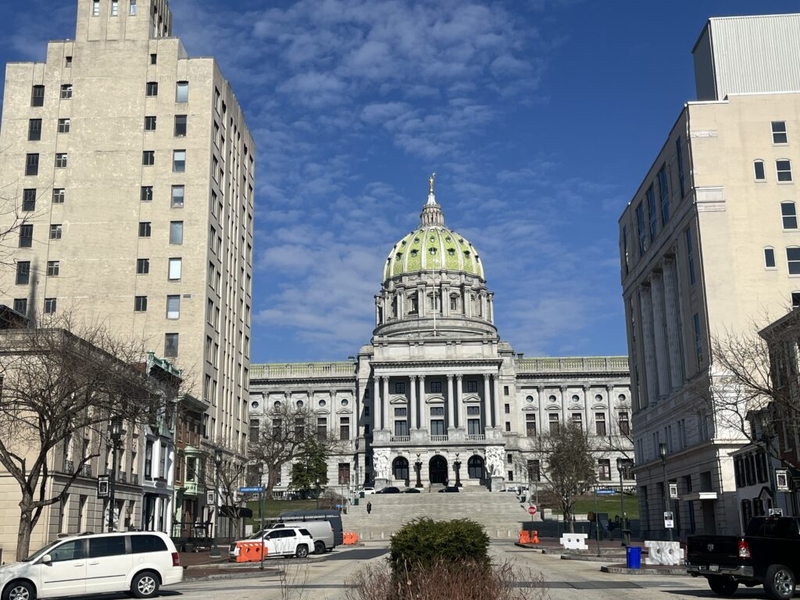
The Pennsylvania State Capitol on March 19, 2026. (Photo by Whitney Downard/Pennsylvania Capital-Star)
In the next legislative session, Democrats in Pennsylvania will not necessarily have to compromise with Republicans to pass laws. On Tuesday, voters handed both chambers in the General Assembly and the governor’s office to Democratic candidates.
The results were part of a nationwide “blue wave” that ousted GOP lawmakers on the state and federal levels across the country.
“The outlines of this race, the contours, were very clear: voters were deeply unhappy with their economic circumstances,” said Berwood Yost, who has long studied where the state’s voters stood on issues.

Yost is the director of the Floyd Institute for Public Police and Center for Opinion Research at Franklin & Marshall College in Lancaster. He was part of a virtual panel Thursday organized by RKL, an advisory firm.
Having a Democratic majority for the first time since 1993 — which, Yost noted, only happened at the time because a member changed their party affiliation — is “a sea change in Pennsylvania politics.”
Having that Republican Senate for so long has “moderated” policies in the commonwealth, Yost continued.
“It has forced there to be compromise,” co-panelist Luke Bernstein, the president and CEO of the Pennsylvania Chamber of Business and Industry, agreed. “No bill has been signed in the last four years that has not been bipartisan … we are in a much different environment now.”
Bernstein claimed that “significant positive economic movement in the last four years” were the result of bipartisan policies like lowering the corporate net income tax, which he credited for attracting recent major investments from Chobani, Eli Lilly, Johnson & Johnson and Merck.
That cut was a “significant policy win” that was bipartisan, but was “led by the Republican Senate,” he said. “Without that force on that side, what does this come to?”
He said that the legislative body “has been a pro-business majority … for a number of years,” and that having a divided government protected the commonwealth from extreme legislation.
The first agenda item for Democrats, increasing the state’s minimum wage from $7.25 to $15/hour, required more nuance, he claimed.
“From a business community standpoint, we want Pennsylvanians to earn more. And while we should suggest — I would say — different approaches, I understand that this is a policy priority for lawmakers in this new trifecta,” said Bernstein. “From our standpoint, we’re certainly willing to work toward some type of compromise that … mitigates negative impacts on businesses.”
He pointed to a 2025 study from the National Federation of Independent Business, which projected “more than 101,000 jobs would be lost over the next 10 years,” more than half of which would be small business posts.
The bill studied would have doubled the wage by 2026, rather than phasing in a $15/hour wage, and tie future increases to inflation.
Bernstein pointed to other considerations, such as tip credits — which allows tips to be counted toward the minimum wage for tax purposes — and consistency with federal law.
Raising the minimum wage would also increase prices, he argued, running counter to campaign promises to make life more affordable for everyday Pennsylvanians. Supporters argue that higher wages “may lead to a small increase,” but employers will save money because turnover will fall and employee morale will improve.
He criticized several other measures advanced by House Democrats, like increasing nursing ratios, capping return on equity for publicly traded companies, paying unemployment benefits to striking workers and the “Fair Share Tax Plan,” the last of which he said would quadruple small business taxes.
“These are all bills that have passed in the state House under Democratic control the last four years that are concerning,” he continued.
Data centers and maintaining power
A recent focus for the state chamber has been making “The Case for Data Centers” and turning public opinion, which has soured on projects in communities across the state. But voters overwhelmingly voted to restrict data centers in 44 ballot measures across the country, with just one pro-data center initiative advancing.
“How we’re approaching this is, ‘Data centers are part of the critical infrastructure of today and tomorrow’s future economy.’ We truly cannot have the type of medical advancements, the type of communication opportunities, the type of innovation (we have) without a strong critical infrastructure. And data centers are a huge part of that.”
He emphasized a need to build responsibly, pointing to “efficient” technology that uses fewer resources.
Bernstein said there was mis- and disinformation swirling around data centers, especially in some campaigns, but hopes “now that the temperature is lowered, we could really have a factual discussion on what are the challenges and how do we mitigate some of those challenges.”
Yost noted that as many as 80% of people will say they oppose data center development, but he thinks “public opinion data overstates how much opposition there is.”
“Their knee-jerk (reaction) is to oppose it, but what they really want and what really bothers them is that they don’t know anything about them,” Yost continued.
Sentiment changed, he said, when people were given more information. People also don’t like feeling “forced” to accept a project.
“I think part of the problem with data centers is no one knows what goes on inside them,” Yost said. “It’s the black box that people are reacting to, and I think there may be opportunities for that to change.”
Putting “guardrails” around data centers was identified as a priority for a Democratic trifecta by Senate Minority Leader Jay Costa (D-Allegheny) on Wednesday. He is in line to hold a leadership position when the new Democratic majority takes power.
He and others will be under pressure to deliver quickly, though Yost wondered if Gov. Josh Shapiro’s rumored presidential aspirations might force some moderation.
“They’re going to move faster than we typically see. There probably will be more legislative output than we’ve seen in recent years,” Yost said. “I think (Shapiro’s) primary brand, for lack of a better word, has been as someone who’s pretty pragmatic and tries to address issues in a way that solves problems. I wonder if that has a constraining force as he thinks of higher office.”
Democrats’ ability to hold on to their majorities in the 2028 election will also depend on whether Pennsylvanians feel like the party delivered on their promises — which may also act as a moderating force, he continued.
“It really depends on what kind of progress voters think has been made between now and then,” Yost said. “The farther the legislature strays from enacting policies that people perceive as helping them, the more likely we are to be back here in two years having a webinar about how Republicans flip things back.”
Harrisburg, PA