‘He could barely hear me’: Deacon recounts Indiana death row inmate’s final hours
Nov 05, 2026 | 4:36 pm ET
Description
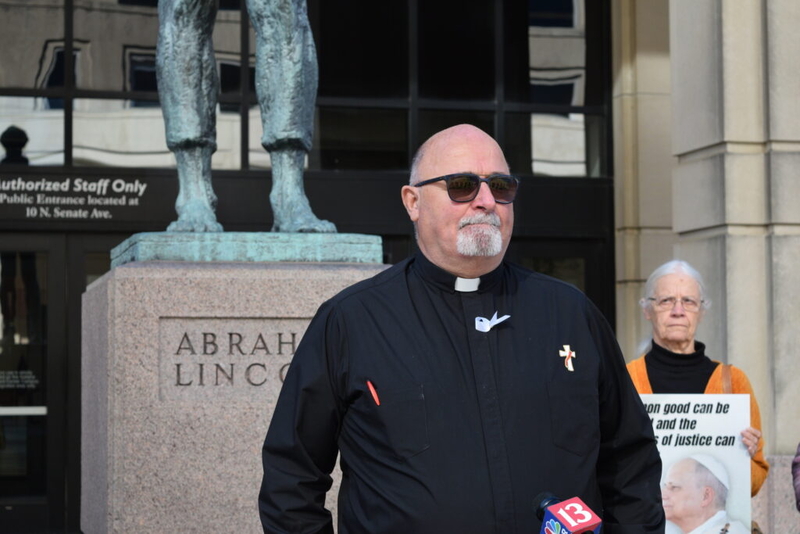
Deacon Brian Nosbusch speaks outside the Indiana Government Center in Indianapolis on Oct. 19, 2026. Weisheit’s longtime spiritual adviser urged clemency ahead of the scheduled Nov. 5 execution. (Photo by Casey Smith/Indiana Capital Chronicle)
Jeffrey Weisheit’s spiritual adviser said prison staff kept him outside the condemned man’s cell during their final hours of prayer together, then allowed him only a few minutes at Weisheit’s side in the execution chamber early Thursday.
Deacon Brian Nosbusch, who had ministered to Weisheit for about 13 years, described struggling to communicate through thick glass before being separated from him for roughly 90 minutes on Wednesday night. When prison staff brought him into the execution chamber, Weisheit was already strapped to a gurney with intravenous lines in his left arm.
Nosbusch said the execution appeared “calm.” But he left Indiana State Prison troubled by the restrictions on their time together and how little of the process anyone outside the execution team could see.
Rep. Andrew Ireland, a Republican death penalty supporter, also called Thursday for greater transparency in the process.
“My prayer was through that window,” Nosbusch told the Indiana Capital Chronicle of their hours outside the chamber. He leaned toward a small opening in the glass to speak and pray with Weisheit.
“He could barely hear me, and I had to sit outside the cell,” Nosbusch continued.
His account offers a closer look at an execution that other witnesses could see for only three minutes through a small, tinted window. Still unknown are when Indiana began administering pentobarbital, how much was used and what happened before witnesses were allowed to look inside.
Hours after the execution, Gov. Mike Braun defended carrying out Weisheit’s sentence but suggested that state lawmakers could examine Indiana’s execution secrecy provisions and difficulties acquiring lethal injection drugs.
“And then when it comes to even the transparency, that evidently is engulfed in our own code, that might be worthy of a legislator looking at,” Braun said Thursday morning.
The Department of Correction also released a temperature log Thursday showing six of seven recorded readings below the log’s stated target range of 68 to 77 degrees Fahrenheit in the days preceding the execution.
DOC had not yet provided the Capital Chronicle with an updated inventory log showing how much pentobarbital was used for Weisheit’s execution, however.
Weisheit was pronounced dead at 12:45 a.m. Central Standard Time for murdering 8-year-old Alyssa Lynch and her 5-year-old brother, Caleb, in a 2010 house fire near Evansville. Their mother, Lisa, was working overnight and had left the children in his care.
Victims were also allowed up to five witnesses in a separate room but their identities are protected.
Braun denied clemency Monday. His office did not publicly announce a decision on the attorneys’ separate requests for a temporary reprieve and an independent investigation of Indiana’s lethal injection procedures and drug procurement before the execution.
Praying through glass
Nosbusch, a Catholic deacon in the Diocese of Gary, said he visited Weisheit about twice a month for years and increased those visits to three times a week during his final month.
They talked about reconciliation, forgiveness and anger. They prayed for Weisheit’s parents and sister, for the children he killed and for the children’s mother and family.
About three months before the execution, Nosbusch said, a priest visited the prison to baptize and confirm Weisheit and give him Holy Communion.
Nosbusch had also served as spiritual adviser to Roy Lee Ward, whom Indiana executed in October 2025. During Ward’s final evening, he said, he was permitted to sit inside the holding cell with him.
He expected similar access Wednesday.
Indiana executes Jeffrey Weisheit for 2010 murders of two children
Instead, after arriving at the prison around 6 p.m., Nosbusch said a masked staff member told him he had not been informed that the deacon could enter Weisheit’s cell. Nosbusch said his requests to contact a supervisor did not resolve the issue.
Nosbusch said he had called the prison’s new warden, Erik Kruper, several times beforehand to clarify arrangements for the execution. He did not know why staff had not received instructions allowing him inside Weisheit’s cell.
He sat outside the glass, leaning toward a small opening to make himself heard. He could pass Communion through the opening and hold Weisheit’s hand, but said the arrangement made conversation and prayer difficult.
Nosbusch said prison staff stood nearby talking and repeatedly went in and out of the room, making it harder to hear Weisheit or have a private exchange.
“It was not personal,” Nosbusch said. “It was not anything.”
He said Weisheit tried to reassure him as he grew frustrated.
“Jeff calmed me down,” Nosbusch recalled. “He said, ‘Brian, don’t worry about it. It’ll be fine.’”
Nosbusch said he plans to write to prison leadership after taking more time to reflect. He wants to explain why he found their final hours together disappointing and ask for greater consideration of the spiritual adviser’s role.
At about 11 p.m., staff moved Nosbusch into another room at the state prison, he said. He waited there until approximately 12:30 a.m., wondering at times whether the governor might have granted a reprieve.
Nosbusch did not see Weisheit being moved into the chamber, restrained or fitted with intravenous lines.
Once brought inside, he said, he immediately began the prayers and Gospel reading he had prepared. He placed a hand on Weisheit’s shoulder and later touched his hand.
Nosbusch estimated he was in the chamber for six minutes at most.
It was not personal. It was not anything.
He said he saw two intravenous lines in Weisheit’s left arm but did not examine the right. Weisheit had told him beforehand that he intended to keep his eyes closed, Nosbusch said, and the deacon said he did not see him open them.
Nosbusch described a slight movement of Weisheit’s head when he touched his shoulder, followed by stillness. Toward the end, he said, Weisheit’s hand felt cold and his lips appeared to be turning blue.
Nosbusch was escorted from the chamber before DOC’s reported time of death and did not witness the official pronouncement.
“But it was very peaceful — very peaceful, from what I saw,” Nosbusch said.
He remained in the chamber only briefly after the witness room blinds closed.
“I was in there about a minute longer, so I prayed again and blessed him,” Nosbusch said. “And that was it. Then they took me out.”
The Capital Chronicle’s reporter, who witnessed Weisheit’s execution, saw no visible movement during the three-minute viewing period. The blinds opened at 12:34 a.m. and closed at 12:37 a.m., eight minutes before DOC’s reported time of death.
DOC spokesperson Noelle Russell declined to provide a detailed execution timeline early Thursday morning, citing security concerns, but said the process begins shortly after midnight and proceeds slowly to ensure nothing is rushed. Asked whether Weisheit showed any reaction suggesting complications, Russell said, “Not at all.”
“I am told he did not move at all,” she said.
Indiana does not guarantee journalists access to executions. The Capital Chronicle, which is challenging those restrictions alongside other news organizations, was the only media outlet to witness Weisheit’s execution. Its reporter attended via Weisheit’s personal witness list.
New storage records — and more questions
The November temperature log DOC provided Thursday lists a desired range of 68 to 77 degrees Fahrenheit — the same recommended storage range listed in prescribing information for Nembutal, the brand-name pentobarbital product.
The state received six 50-milliliter vials of pentobarbital on Oct. 29.
Its seven entries run from Nov. 1 through the morning of Nov. 4. Readings range from 65 to 68 degrees, with only one — the evening entry for Nov. 2 — reaching the stated range.
Story continues below.
Nembutal’s prescribing information also permits brief temperature excursions between 59 and 86 degrees.
All seven readings fall within that broader interval. But the twice-daily entries do not show how long temperatures remained below 68 degrees, and the log does not indicate whether those conditions affected the drugs’ quality.
The Capital Chronicle was still awaiting an updated drug inventory to determine how much pentobarbital was used in Weisheit’s execution as of late Thursday. Earlier inventory records obtained by the newsroom have documented the state’s purchases, use and destruction of execution drugs.
Dr. Jonathan Groner, an emeritus professor of clinical surgery at Ohio State University’s College of Medicine, said the limited viewing period left important questions about the procedure unanswered.
“When pentobarbital is properly administered as an IV bolus, it should cause rapid unconsciousness — 30 to 60 seconds,” Groner told the Capital Chronicle.
Groner did not attend the execution. Neither the witnesses’ observations nor Nosbusch’s account make clear when the drug was administered or whether Weisheit was conscious while witnesses could see him.
Weisheit’s attorneys had sought testing and storage records before the execution, raising concerns about the Indianapolis pharmacy they identified as the supplier, Pharmaneek Inc. The pharmacy is on probation and faces further disciplinary proceedings. Those proceedings do not establish that the execution drugs were contaminated or ineffective.
The Indiana Professional Licensing Agency confirmed Thursday that Pharmaneek’s disciplinary hearing has been postponed to Dec. 14 after its new counsel requested a continuance last week because of a scheduling conflict.
Before the execution, DOC said it remained confident in its ability to carry out the sentence humanely. The attorney general’s office likewise expressed confidence it could proceed safely and lawfully. Both cited state confidentiality law in declining to discuss supplier information.
Braun signals possible legislative review
Asked Thursday morning whether lawmakers should revisit capital punishment, Braun said the three executions carried out during his administration involved clear cases and lengthy court proceedings.
“I think going forward with it made perfect sense,” Braun said. “I think most Hoosiers would agree with it.”
He said the death penalty was not a particularly high priority but could be examined, including the transparency restrictions written into state law.
“But I think here, the way that drug is acquired certainly looks like it’s not easy, and the whole discussion probably needs to be looked at more broadly, and we’ll see where that goes,” Braun said.
The discussion would return to a Legislature changed by Tuesday’s election, which defeated two Republicans who approached capital punishment from different directions but supported greater scrutiny.
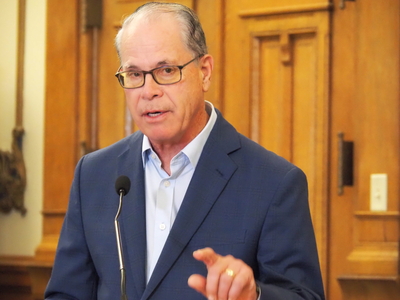
Ireland, R-Indianapolis, who lost his reelection bid Tuesday night, additionally called attention Thursday to the Legislature’s failure to pass execution transparency language.
“One regret this last legislative session was not getting our death penalty transparency language passed,” he wrote.
Ireland said supporting capital punishment should also mean allowing reporters to observe whether executions are carried out lawfully, rather than requiring news organizations to sue for access.
Rep. Bob Morris, R-Fort Wayne, who also lost Tuesday, has been a vocal Republican opponent of capital punishment and sought more transparency around execution procedures.
After unsuccessfully seeking repeal in 2025, Morris introduced legislation this year that would have required execution teams to consist of volunteer legislators and made their names public records.
Lawmakers also considered expanding the methods Indiana could use to carry out death sentences. A House firing squad bill fell short in a narrow 48-47 vote in January, failing to secure the required 51 votes. A separate Senate proposal stalled without a committee vote.
Despite those unsuccessful efforts, DOC confirmed to the Capital Chronicle in June that the new prison in Westville was designed to accommodate both lethal injection and firing squad executions. The agency declined to provide design details, citing security concerns.
Indiana currently authorizes only lethal injection.
Groner said the public has an interest in understanding how the state carries out death sentences.
“If capital punishment is portrayed as a public good, then the public should be allowed to know how executions are performed,” he said.
For Nosbusch, the immediate concern is continuing a ministry that has taken him inside the prison for more than two decades. He intends to keep visiting men on death row and in protective custody.
After leaving the prison early Thursday, he sat in his car to gather his thoughts, then stopped for coffee before driving home.
Nosbusch described Weisheit as a friend. Accompanying him through the execution was difficult, he said, but he was grateful he had been there.
“It makes it hard,” he said. “But I’m so glad I did it.”
Indianapolis, IN