Louisiana Democrats’ near-miss on senate seat gives party hope for governor’s race
Nov 05, 2026 | 5:18 pm ET
Description
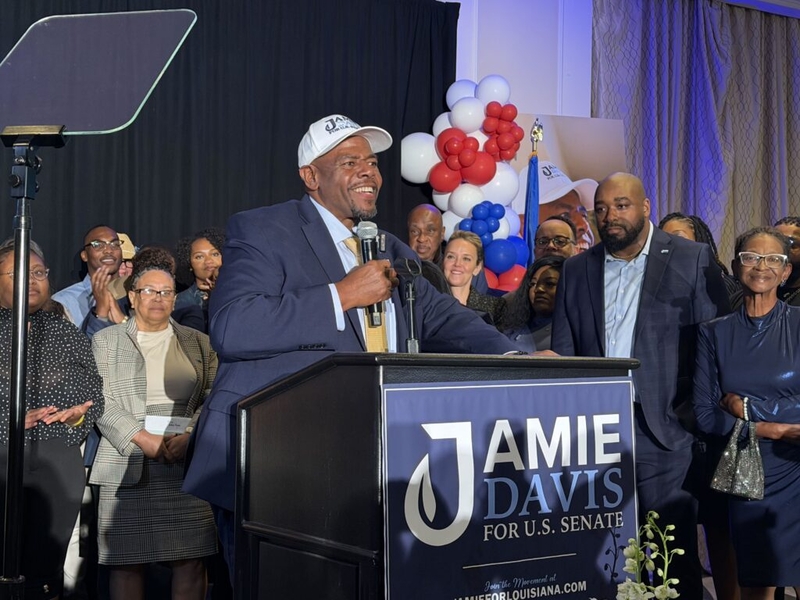
Jamie Davis, the Democratic candidate in Louisiana's U.S. Senate race, addresses supporters at his election night party Tuesday, Nov. 3, 2026, in Baton Rouge. (Photo by Piper Hutchinson/Louisiana Illuminator)
Jamie Davis’ narrow loss to U.S. Rep. Julia Letlow, R-Baton Rouge, has given Louisiana Democrats hope they could unseat a slate of Republican statewide elected officials next year, including Gov. Jeff Landry.
“Jeff Landry, you’re on notice, buddy,” Davis told his supporters on election night, later confirming to reporters he is mulling a run for governor.
Davis’ loss to Letlow by about 25,000 votes — less than a two-point margin — was remarkably better than any Democrat has fared in a Senate race since former Sen. Mary Landrieu was elected to her last term in office in 2008.
The narrow loss was among the strong Democratic turnout in this week’s midterm elections, when they were elected en masse in red states across the South.
“Jeff Landry should [praise] God that he was not on the ballot right now because if he was on the ballot today, Jeff Landry would have been a one-term governor,” said Public Service Commissioner Davante Lewis, D-Baton Rouge. “But I think we’re still going to make him a one-term governor because the investment shows that the South is back.”
Lewis, whose seat on the five-member PSC makes him the Democrat in Louisiana who represents the most constituents, is among the Democrats who could throw their hat in the ring for a gubernatorial run next year. Other candidates speculated to run include State Sen. Jay Luneau, D-Alexandria, former State Sen. Gary Smith, D-Norco, former state Treasurer candidate Dustin Granger and former Gov. John Bel Edwards, though his candidacy is dependent on whether a just-passed constitutional tweak restricting governors to two terms is determined to be retroactive.
Landry and Republican Attorney General Liz Murrill both said Wednesday they are not worried about their re-election bids next year.
“I will tell you that I feel very confident. I’m happy to put my record against the Democrats’ record next year. In fact, I look forward to it,” Landry said. “The senate candidate made some mention of me on the stage. I would implore him to get into the governor’s race. I’d be happy to debate him.”
Unlike Letlow, who had to face a Democratic opponent head-on due to newly reinstated party primary elections for federal offices, Landry, Murrill and other state-level Republicans will face their challengers in a jungle primary.
In these elections, all candidates, regardless of party, are on the same ballot. If no candidate gets more than 50% of the vote, the top-two vote getters advance to a runoff election.
Usually that means the top Republican and top Democrat face-off, but in 2023, Landry was easily elected on the first ballot and did not have to face any candidate in a runoff.
Landry was also elected with a much lower voter turnout than came out for the senate race. About 49% of registered voters in Louisiana turned out for the midterms, compared to about 36% who voted in 2023.
The Black voter turnout was also much higher this election cycle.
To repeat and build off of Davis’ success, Democrats are considering coalescing around a single Democrat.
“We were all rowing in the same direction, and so we do need to figure out strategically how we recreate this same energy, the same synergy, because that’s one of the main reasons why we were so competitive,” progressive commentator Quenton Anthony Anderson said of Davis’ performance.
Louisiana Democrats will have the benefit of Louisiana being one of a small number of states holding statewide elections next year.
That means more attention, and more money, potentially coming Louisiana’s way.
Davis received essentially no money from national Democratic donors and groups, such as the Democratic Senate Campaign Committee, leading many Democrats to wonder what could happen for Louisiana if there were more investment.
“If Jamie loses by two points, we are going to get up Wednesday morning, and we are going to wonder where the hell were you [national Democrats]?” Democratic campaign consultant James Carville said in an interview with the Illuminator before the election.
Julie O’Donoghue contributed to this report
Baton Rouge, LA