Alaska’s U.S. Senate race draws significant donations from AI company employees
Nov 03, 2026 | 3:00 pm ET
Description
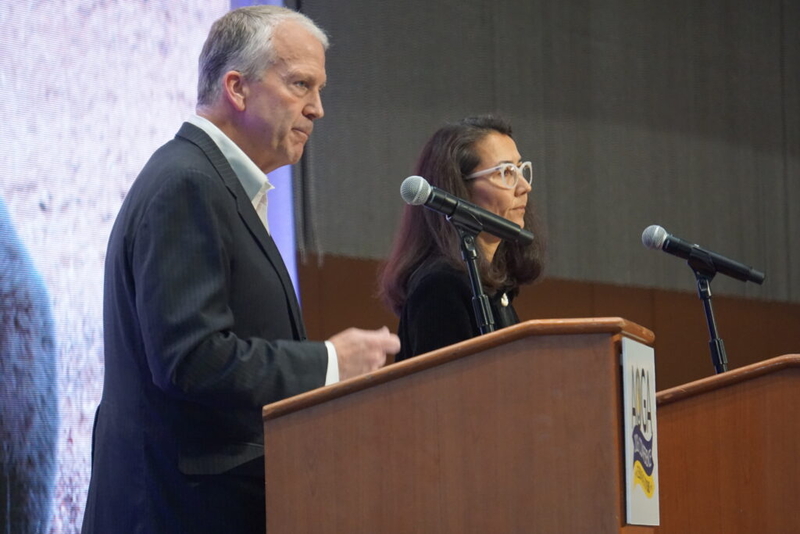
Sen. Dan Sullivan, R-Alaska, and former U.S. Rep. Mary Peltola, D-Alaska, listen to a question at a candidate forum held Aug. 27, 2026, by the Alaska Oil and Gas Association. (Photo by Yereth Rosen/Alaska Beacon)
Alaska’s U.S. Senate race has drawn more money to campaigns from employees of AI companies than any other 2026 Senate race, an analysis of Federal Election Commission records shows.
The actual numbers of donors are small, but at least 19 employees contributed approximately $119,000 to the campaigns of Republican Sen. Dan Sullivan and his Democratic challenger, Mary Peltola, with most people giving close to the maximum legal contribution limit. A donor can give $3,500 per election, or $7,000 for the primary and general together, and $5,000 a year to a leadership Political Action Committee or PAC.
Many of the donations to both candidates came from employees of Anthropic, one of the country’s leading AI companies. None of the AI-company donors list an Alaska address, with most living in California.
Sullivan is seeking reelection against Peltola in a tight contest that could help determine control of the Senate. Neither campaign responded to requests for comment. The race also includes Republican Gerald Heikes and Daniel J. Sullivan Jr. Heikes does not have a campaign, which makes it impossible for him to get donations. Sullivan Jr. has not received any contributions from the AI-company employees examined.
The already close race has become even more contentious following a report in the New York Times that Peltola recruited Daniel J. Sullivan as a spoiler for the race. Peltola’s campaign has denied any involvement in the effort to the Times.
The Alaska race is only first when counting money flowing from AI company employees to both candidates’ campaigns. Once donations to PACs are included, South Dakota Senate campaigns pulled in the most in contributions. Other individual Senate candidates received more money, but the donations going to both Sullivan and Peltola pushed Alaska to the top. For example, in Florida, the Republican candidate for Senate received $68,000 from AI company employees and $113,000 when including donations to PACs, but the Democratic candidate, Angela Nixon, received just $250.
Sullivan alone was fifth out of other candidates for Senate races around the country in terms of donations received from AI company employees and Peltola was 14th. The top individual candidate is Republican Mike Rounds of South Dakota with $165,100 to his campaign and PACs from AI company employees.
In the Alaska races, Peltola received at least $56,000—nearly all of it from Anthropic employees. Sullivan received approximately $63,000 from AI-company employees for his campaign. Another $35,000 came through his leadership PAC, True North, bringing his combined total to about $98,000. Of the 10 Senate candidates receiving the most from AI-company employees, Sullivan had the fewest donors, but he received the most per donor.
For the analysis, Anthropic, OpenAI, and xAI were counted as AI companies, while the larger universe of big tech counted employee contributions from Google, Microsoft, Meta, Nvidia, Amazon and Apple.
Big Tech and AI-company donors reveal different patterns
When including contributions from employees at Google, Microsoft, Meta and other Big Tech firms, Peltola’s campaign ranks fifth among Senate candidates nationwide, compared with Sullivan’s 16th-place ranking. Peltola has received support from close to 150 Big Tech employees when compared with four for Sullivan. Most of Peltola’s big-tech money came through online fundraising platforms such as ActBlue.
Most of the money to both candidates came through joint fundraising committees rather than direct donations. Joint fundraising committees raise money from large donors and split the funds across campaigns. Sullivan’s contributions mainly came from One Team Senate Majority, which splits contributions among the National Republican Senatorial Committee and other Republicans’ campaigns, and his joint fundraising committee, Sullivan Victory. More than half of Peltola’s contributions came from the Fish Family Freedom Fund, which she formed in January with the Alaska Democratic Party and the Democratic Senatorial Campaign Committee.
Large contributions from a small number of employees in the same industry can suggest that donors see a candidate as favorable to their interests, said Brendan Fischer, Director of Strategic Investigations at Campaign Legal Center. However, he cautioned against using employer data as proof of coordinated giving.
Political money often flows toward races where donors believe their contributions can have an impact, Fischer said. Donors wanting to influence the chamber’s balance of power may be attracted to Alaska’s race since it could determine control in the Senate.
The issue of data centers and AI has become contentious, recent polling shows. Data centers contain the IT infrastructure needed to train and implement artificial intelligence. Some people are concerned about the environmental impacts of data centers through their electricity and water use, according to an AP-NORC poll from September. The poll concludes that in America, 67% of Democrats and 49% of Republicans are worried that data centers will impact water supply. The poll also establishes that 57% of Democrats and 50% of Republicans believe that AI will harm society more than help it in the next 10 years. Additionally, Republicans have expressed greater support for data centers than Democrats, USA TODAY reported.
Alaska’s data center debate
The AI-employee money comes as Alaska candidates debate over AI infrastructure investment in the state. Sullivan has advocated expanding data center development in the state, and has pushed for the federal government to locate advanced AI data centers on Alaska’s military bases. In April, the Air Force sought developers for potential AI data centers on about 4,700 acres across three Alaska installations. Peltola has focused less on data centers and more on “affordability and energy costs,” according to a Newsweek report.
Sullivan also has a personal financial connection to the data center industry. According to The Alaska Current, Sullivan holds approximately $5 million in stock in his family’s chemical company, RPM International, whose subsidiaries supply specialized coatings used in data centers.
The issue of AI infrastructure also has drawn scrutiny from groups within the state.
Krystal Lapp, the Interim Executive Director of Alaskans for Data Center Accountability — one of the most vocal groups expressing their dissatisfaction with large-scale data centers — says this election will have significant impacts on the Alaskan land and the allocation of resources.
“With the boom of AI, we’re definitely seeing politicians and everybody else inviting people up here because we’re Alaska. Everyone has thought of us as a place that they could take from,” Lapp said, referring to land grabs for building data centers. “We look like a cash cow, but they’re not going to benefit us.”
In September, the Alaska Beacon reported that the Alaska Department of Natural Resources decided to transfer 30 square miles of land to the state-owned economic development agency AIDEA for a “multi-use industrial and energy development district.” The Matanuska-Susitna Borough uses natural gas energy. Data centers in this area could increase demand for insufficient natural gas resources. AIDEA officials have said that there aren’t existing plans for data centers, but that they could potentially be built.
“I am against the executive orders that were put through and I am against the gutting of the public process,” Lapp said. “By taking away that public process, they take away that responsibility piece.”
Stanford student journalists Arshya Gaur and Bridget Stuebner reported this story with the DataTalk campaign finance AI agent developed by Big Local News and the Stanford Open Virtual Assistant Lab as part of a journalism class at Stanford. The FEC data was independently fact-checked and verified by Gerald Rich of Big Local News at Stanford.
Juneau