The latest updates from the 2026 election in Pennsylvania
Nov 03, 2026 | 4:18 pm ET
Description
(Getty images)
This story will updated throughout the day and night.
‘Here as polling observers and peacekeepers’ in Harrisburg
4:38 p.m.
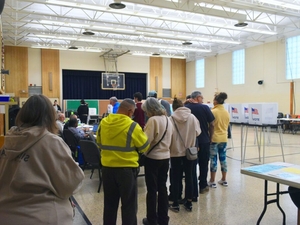
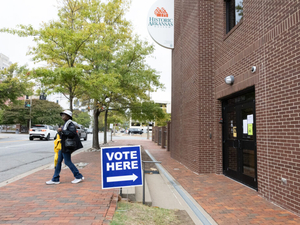
Anjel Scarborough, 62, an Episcopal priest at All Saints Episcopal Church in Hershey, is spending most of her day at the 11th precinct polling place in Harrisburg.
She’s with a left-leaning organization called Changing the Conversation Together that’s been canvassing and working to get out the vote in underserved neighborhoods nearby.
“We’re here as polling observers and peacekeepers, and helping people exercise their right to vote,” she said about their role on election day.
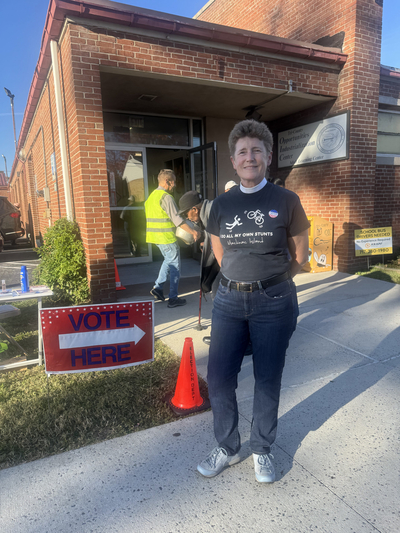
Scarborough said she herself supports any candidate opposing the Trump administration. She said President Donald Trump’s agenda has been “harming the most vulnerable populations in our country,” pointing in particular to Project 2025, a comprehensive policy playbook authored by the conservative think tank, the Heritage Foundation. While Trump denied any affiliation with the project during the 2024 election, some of its key architects now serve critical roles in his administration.
“I think the theologian Karl Barth said it well, who said ‘You should preach with the bible in one hand and a newspaper in the other,’” she said. “For me it’s the bible in one hand and a smartphone in the other. You need to know how to really look at the ethics of our faith, and how do we apply those ethics towards evaluating candidates by their character.”
While her congregation is in one of the more affluent areas of central Pennsylvania, she said many of the members work or used to work at the Penn State Hershey Medical Center.
“I have a lot of doctors and medical people who saw the devastation firsthand of the COVID-19 pandemic, and they’re also living and dealing with, firsthand, the rise in measles and the public health policies that have been implemented by the Trump administration.”
She said many of her members are concerned about the looming impacts of Medicaid cuts that were enshrined into law as part of the One Big Beautiful Bill Act. While the bill was signed into law in 2025, it was authored so policies that are expected to lead to the steepest cuts, like new work-requirements for Medicaid enrollees, will go into effect after the midterms.
The nonpartisan Congressional Budget Office estimated that work requirements alone could lead to over 5 million people losing Medicaid coverage by 2034. Limited studies have shown that, in states that when Arkansas implemented work requirements for Medicaid, little impact was made on overall employment, but thousands lost coverage.
The changes are estimated to save around $325 billion over 10 years, largely because of an expected drop in the number of Americans covered. Advocates have warned the policy will likely lead to eligible workers losing Medicaid coverage, in part because of stringent new paperwork requirements.
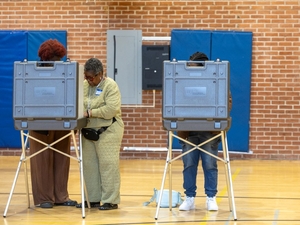
The 11th Precinct polling place had served 330 voters as of around 3:20 p.m., and is on track to see higher turnout than the 2022 midterm elections.
— Ian Karbal
Chester County reports mail-in ballot processing moving smoothly
4:15 p.m.

Mail-in ballot processing moved smoothly Tuesday in Chester County, where a foreign object in a ballot envelope forced election workers to evacuate the building last week.
After polls opened Tuesday, the first shift of county employees who volunteered to open and prepare ballots for scanning began work.
They included people from the county’s Public Defender’s Office, Finance Department, Assessment Office and other agencies who stepped up to aid election officials in processing more than 59,000 mail ballots received through Monday, with more to come in the mail and drop off boxes around the county.
Before the ballots can be electronically scanned to record the votes, they must first be checked for signatures and dates, removed from their envelopes, sorted and flattened. None of the work can begin until polling places open on Election Day.
“Things are going well. No news is good news,” said Kevin Seeling, a technical administrator for the county Board of Elections. He added the process was on pace to have the mail ballots tallied by the time polls close.
On Friday, the building was locked down after a worker identified a “non-liquid substance” inside a ballot envelope by feeling the outside. The Chester County Hazardous Materials Response Team was able to render the building safe within 90 minutes.
Preliminary testing directed by the FBI revealed there was no biohazard inside the envelope
County officials announced Tuesday morning that voting hours would be extended for 30 minutes in three precincts due to issues setting up voting machines.
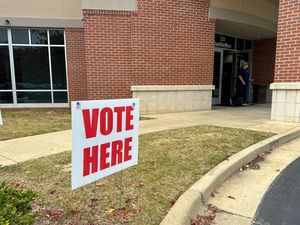
At Susan W. Starkweather Elementary School a few miles away, volunteers reported a slow, but steady flow of voters to the polls inside.
On the ballot, voters had to choose between incumbent Republican state Rep. Craig Williams and Democratic challenger Elizabeth Moro in addition to the gubernatorial and congressional races. It’s one of a handful of districts where Democrats hope to flip the seat to retain and deepen their majority in the state House of Representatives.
But those who spoke with a reporter said they had broader issues than the state legislature on their minds.

Kenny Gill, a math professor at LaSalle University in Philadelphia, said he has voted in every election recently and on Tuesday selected all Democrats.
“I voted a mixed ballot before … I feel like everything has gotten so radicalized. You know, there was a once upon a time where both the parties were kind of moderate,” Gill said. “There’s a lot of common ground, and I just feel like everything’s gotten so extreme. It’s not a new thing for the last five or 10 years, at least.”
Describing the federal government as “a clown show,” Gill said he’s disturbed by the Trump administration’s “purely punitive” policies and the tactics police and U.S. Immigration and Customs Enforcement are using across the country.
“There’s so much being funneled into defense and increasing security and funding more and more cruel devices for ICE agents to use against people, like those gloves that shock people,” he said.
Meanwhile, cuts to the federal budget have targeted programs that help people.
“Then we’re going to put billions into spending on this crap to torment our own citizens. Right? Things are ridiculous,” Gill added.
Kristin Grandzol said she voted because she wants Democrats to take control of the U.S. House of Representatives.
“With Trump in office, I just want anything that can help counterbalance some of his decisions,” she said.
The war in Iran, with no clear resolution in sight, was her biggest motivator to come to the polls.
“All this money is going to the war in Iran, and we have people here who can’t eat and get health care,” Grandzol said.
Nick Bonkoski brought his three daughters with him when he voted. Their futures were on his mind as he cast his ballot, he said.
“Raising three children these days, there’s a lot of things that are affecting the way that we look at what’s going on in politics around the world,” he said, adding that the cost of fuel and groceries were also a big concern with five mouths to feed.
Latisha Johnson said she votes “every single year” and said the economy and women’s rights were her main motivators in this election. She voted for all Democrats.
“I think that the underserved are being severely underserved with this presidency,” she said. “We live in a really nice, affluent area here. And I think as Americans, it’s our responsibility to take care of everyone, including and most importantly those that are underserved.”
— Peter Hall
Harrisburg, PA