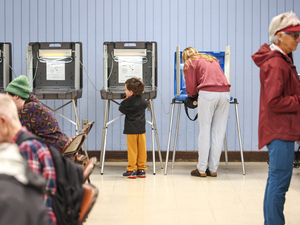
Polls open today as CT decides on governor, General Assembly
Nov 03, 2026 | 2:50 pm ET

Description
Photo courtesy of CT Mirror
This story has been updated.
Connecticut’s yearlong campaign for governor draws to a close Tuesday as voters go to the polls in all 169 cities and towns, with more than 500,000 of the 2.22 million eligible voters already having cast ballots. Polls are open until 8 p.m.
At a press conference Tuesday morning, Secretary of the State Stephanie Thomas said no major issues had been reported to her office thus far. There were reports of federal election monitors outside of polling locations in New Haven, but Thomas said the power of those federal officials was limited.
Thomas explained that her office, which is in charge of election administration throughout the state, was ready to respond to any physical or cybersecurity threats during the general election. She said staff were also prepared to respond to and correct any false information that could confuse voters about their voting rights.
“My message to voters is, ‘Please, don’t worry,'” Thomas said. “We’ve got this covered. The elections will be safe and secure here in the state of Connecticut.”
Around the state

Outside West Hartford Town Hall Tuesday morning, the stream of voters was light but steady. Two of the voters who showed up to cast ballots in person were neighbors Dawn Bratter and Patty Coleman. Bratter and Coleman may live next to one another, but they did not share the same opinion on the governor’s race.
Bratter said she was at the polls to cast a ballot for Republican gubernatorial candidate Ryan Fazio — and against Lamont. She cited taxes and Connecticut’s high utility costs as two of the primary reasons that she was eagerly voting to remove Lamont from office.
“Anybody but Lamont,” Bratter said before heading in the front doors to vote.
Coleman, a lifelong Democrat, was torn about the choices. She said she’s preparing to retire soon and she’s concerned about Connecticut’s high cost of electricity and the general cost of living. But she was not ready to hold Lamont responsible for those issues, largely because of her bigger concerns about President Donald Trump.
Coleman said she’d considered casting a vote for Fazio, but she was uncertain he would stand up to the Trump administration as a Republican. “I’m not sure that if Fazio gets into office he will be that person,” she said.
Avon resident Marie Shuck voted early this year, but she came to Thompson Brook School to help her 92-year-old mother Ann Duplessis cast her vote. Shuck said her main concern this year is the sorry state of the economy.
“I think corporations are getting way too much leverage, not paying their fair share,” Shuck said. “It’s coming down to, the people that live in this country with the higher gas prices and the higher taxes and the higher food costs.”
Which, she said, is why she decided to vote for Ryan Fazio.
“I felt like we needed a little bit of a change,” Shuck said. “The message that he is going to work for the people — I mean, they all say that, but I just felt like his was a little more sincere.”
She added, “I’m hoping he’s not siding with Trump. I hope he’s his own person and will do what’s best for the people that he represents.”
“I would just like to get Trump out of the White House,” her mother said.
Both Democrats and Republicans had tents set up outside the school, the former armed with donuts and cookies, the latter with candy. Republican Chris Gens said most voters seemed more interested in the other party’s tent. As of 1 p.m., he said he’d seen almost no young people.
About 55% of the town’s registered voters had cast ballots by mid-afternoon, according to the registrars of voters. Nearly 30% of all ballots received by then were cast early.
Avon resident Michelle Hay said the economy was also top-of-mind for her, having adult children who don’t earn enough to move out of the family home. Unlike Shuck, however, she planned to vote a straight Democratic ticket.
Hay said she thinks a number of factors have contributed to the economy’s dysfunction. The push for kids to go into academia was one; the rising cost of housing, another. When she and her husband graduated from college in 1996, they could afford a house, she said, even though interest rates at the time were around what they are today. Her children’s experience has been entirely different.
Another issue important to Hay: LGBT rights.
“I just want to see us moving in the right direction, where people are getting more rights, more freedoms, not less,” Hay said, growing emotional.
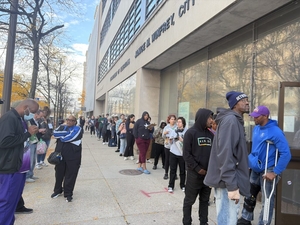
In downtown Hartford, there was a steady stream of people voting at City Hall in the morning.
“Online, there’s a bunch of things like ‘go vote,’ so you know, every vote matters. I had to make sure to register and vote here,” said Angel Ortiz, 18, who was voting in his first election. Ortiz said he opted for all the Democratic candidates on the ballot. His biggest concern this election cycle is immigration enforcement, he said.
“Mostly ICE and the way that they’ve been performing. Definitely don’t think it’s humane the way that they’ve been going around,” Ortiz said. “So I wanted to try to hopefully change that.”

Several Hartford voters also cited immigration as a top concern this year, along with the cost of living.
“Taxes are very high. Energy cost has been very high,” said Harold Cummings, 39, who cast his vote right after finishing an overnight shift at BJ’s, where he’s a supervisor. He said he doesn’t “have loyalty” to one political party or the other.
Minerva Quiroga, 78, and her husband, Alfredo Quiroga, 74, cast their vote at West Middle School in Asylum Hill. They are Democrats and are originally from Puerto Rico and Peru, respectively.

“We’re not happy with the government right now,” Alfredo Quiroga said. “Immigration. The cost of living. Apartment renting, gas, clothing, food. All these things that people are suffering.”
Minerva Quiroga added she doesn’t want to see any cuts to programs for the elderly.
Down in Bridgeport, Diana Kendricks, who has helped in elections for five years, was working as a poll worker at Central High School. She said she volunteers because she cares about the city and the people who live in it. She wants elected officials to focus on affordability, education and services for children with autism.
“We need to make sure that we can all afford to live in Connecticut,” Kendricks said.
Voters at Geraldine Claytor Magnet Academy in Bridgeport also had affordability on their minds. Resident Zenida Gonzalez said rising living costs, including housing, groceries and car insurance, motivated her to vote. She said everyday expenses are becoming increasingly difficult to manage.
“With everything going on in Bridgeport, with the new high-rises and not having affordable rent, not being able to afford groceries, car insurance is more than the car payment itself,” Gonzalez said. “You know, I felt it was important for me to come cast my vote.”
Gonzalez also expressed frustration with the ballot, saying she felt voters were being pushed toward a particular choice. She questioned why Paul Ganim, a longtime probate court judge and the mayor’s brother, was the only candidate listed for the probate court role and referenced what she described as recent corruption issues.

“I did not like the ballot. I felt like they’re forcing us to vote one way,” she said.
Gonzalez connected low voter turnout to frustration with the political process. She pointed to the defeat of a rent cap effort, saying residents felt their support for the proposal did not translate into the outcome they wanted.
“So that’s why now people don’t care to vote because they feel like even if the numbers show us that we win, we don’t ever win,” Gonzalez said.
Over at Harding High School, Michael Borges, a lifelong Bridgeport resident who returned to the city after spending six years in the military, was working as a poll worker. He said voting is one way residents can push for the change they want and expressed frustration with people who voice their opinions about the city but do not participate in elections.
“They want change. That’s the way to do it. You’ve got to come out and make a difference,” Borges said. Asked why he thinks voter turnout can be low, Borges said, “People are just not interested.”
“There are a lot of people giving their opinions, but they’re not coming out and voting,” he added.

First election with no-excuse absentee voting
All six statewide constitutional officers, five U.S. House members and 187 members of the General Assembly are on the ballot in a year dominated by states where control of Congress will be resolved.
Neither of the state’s two U.S. senators are on the ballot, and the Cook Political Report rates all five U.S. House races in Connecticut as “solid Democratic” — an assessment shared by independent expenditure groups that have shunned the state.
Gov. Ned Lamont voted Tuesday morning at Greenwich High School. He intends to spend the day working his way north to an election night party at Dunkin Park, the minor league baseball stadium in Hartford. His tentative stops include Stamford, Norwalk, Fairfield, Bridgeport, New Haven, Meriden, Newington, Hartford and West Hartford.
His Republican challenger, state Sen. Ryan Fazio of Greenwich, voted on Oct. 19, the first of 14 days of early voting. His Election Day schedule was focused on Fairfield County, with planned stops in Stamford, Norwalk, Fairfield, Milford, Trumbull, Westport and New Canaan. Fazio’s election night party is at the Doubletree by Hilton hotel in Stamford.

The election is a laboratory of sorts: Will Connecticut’s second statewide election with early in-person voting and its first with no excuse absentee voting produce a higher voter turnout?
In the midterm election of 2022, when Lamont, a Democrat, won his second term and U.S. Sen. Richard Blumenthal his third, the turnout was 57.62% Before the first votes are cast Tuesday, the turnout was already about 23%.
At the end of early voting Sunday night, 505,973 ballots had been cast: 455,169 during the two weeks of early voting and 50,804 by absentee ballot, the secretary of the state’s office reported Monday.
Another 20,854 absentee ballots had been issued and not yet returned. To be counted, absentee ballots must arrive at local clerk’s offices or be deposited in official drop boxes outside town halls by 8 p.m. Tuesday.
By nearly a 4-1 margin, more Democrats than Republicans voted in the first days of early voting, but the gap closed to a little more than a 2-1 Democratic advantage: 216,155 to 89,157, with 149,857 unaffiliated or minor-party voters.
As of late October, the state’s 934,070 unaffiliated voters were the largest bloc of voters in Connecticut, followed by 802,247 Democrats and 485,827 Republicans.
The governor’s race
The gubernatorial race between Lamont, a Democrat, and Republican Ryan Fazio is the first since the General Assembly dramatically increased the public financing grant to $18 million.
Whatever Fazio’s challenges have been as a Republican trying to unseat a wealthy self-funded Democrat in a blue state, money has not been among them. Spending by the two candidates has been roughly equal through Oct. 27.
Lamont had spent $18.7 million of the $20 million he contributed to his own campaign account, including a $2.2 million loan; Fazio, $17 million, with $2 million left to spend.
The money Lamont gave his campaign goes back to him if unspent. In 2022, Lamont spent $26.2 million.
From Oct. 21 to 27, the period covered by the last report, Fazio spent more than $2 million, nearly all of it on television advertising ($1.2 million) or direct mail ($848,306). Lamont spent $1.16 million, most of it on television.
The CT General Assembly
Neither party expects a significant change in the balance of power at the General Assembly, where Democrats have won strong majorities in every election since the 2018 midterm.
Democrats have majorities of 102-49 in the House and 25-11 in the Senate.

On Thursday, Democrats plan to endorse the reelection of House Speaker Matt Ritter, D-Hartford, for an unprecedented fourth term as speaker and House Majority Leader Jason Rojas, D-East Hartford, as his second in command. The caucus will take place with a buzz about Ritter’s potential departure to become interim president of the University of Connecticut.
With the retirement of Senate President Pro Tem Martin M. Looney, Senate Democrats are set to endorse Senate Majority Leader Bob Duff of Norwalk as Looney’s successor and Sen. Gary Winfield of New Haven as Duff’s.
House Minority Leader Vincent J. Candelora, R-North Branford, and Senate Minority Leader Stephen Harding, R-Brookfield, are expected to continue as the GOP leaders.
The new legislative terms begin Jan. 6, the opening day of the annual legislative session. The winner of the gubernatorial will be sworn in and address a joint session of the General Assembly the same day.
This story will be updated.
CT Mirror reporters Andrew Brown, Theo Peck-Suzuki and Sandy Battulga contributed to this story.
Hartford, CT