Rogers, El-Sayed outline differing approaches to tariffs and AI during Detroit Economic Club forum
Oct 20, 2026 | 5:50 pm ET
Description
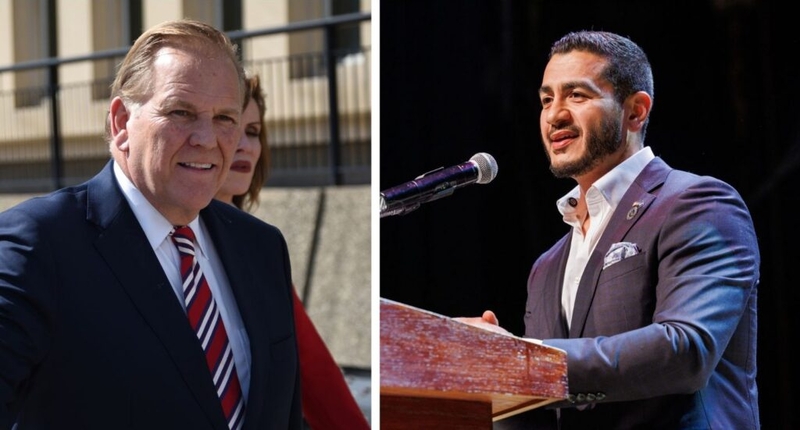
Republican nominee for U.S. Senate Mike Rogers, left, and Democratic nominee for U.S. Senate Abdul El-Sayed. (Photos by Katherine Dailey and Andrew Roth/Michigan Advance)
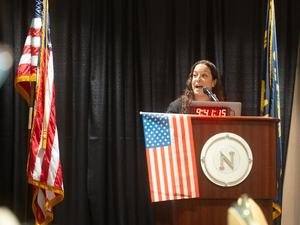
U.S. Senate nominees Abdul El-Sayed and Mike Rogers, during a forum hosted Tuesday by the Detroit Economic Club, both agreed that international tariffs could be sound economic tools — if used correctly — and that AI could be dangerous without federal guardrails.
With just two weeks until the Nov. 3 general election. El-Sayed and Rogers are battling it out in a race that is currently rated as a tossup, according to Cook Political Report. A recent debate between the two candidates ended up turning contentious, with few opportunities to talk policy in a calm setting.
As El-Sayed and Rogers are set to take the debate stage again on Wednesday evening, the forum hosted Tuesday by the Detroit Economic Club allowed each candidate to answer more complex questions about policies affecting Michigan.
On tariffs, one of the primary economic tools used by President Donald Trump during his second term in the White House, both Rogers and El-Sayed agreed that they could be used in a positive way that might not hurt Michigan’s economy in the way that Trump’s tariffs reportedly have.
El-Sayed said he was not against using them, but not in the way Trump has, while Rogers said he would advocate for the president to make adjustments.
“Like all the things that Donald Trump does, they are chaotic, they are ham-fisted, and they are self-serving,” El-Sayed said. “His version of tariffs is about accruing power either over corporations or over trading partners. That’s exactly why he’s doing this, and this version has been terrible for the American auto industry. It has been terrible for workers.”
Using an analogy that he’s espoused during campaign rallies, El-Sayed likened Trump’s tariff policy to an oncologist giving too much life-saving chemo to a cancer patient, which could be deadly, instead of a little at a time to fight the disease. El-Sayed said he believes in a tariff policy that is tied to an industrial policy “that actually makes sense.”
“I think we need to continue to be the world’s leader in internal combustion engines, and I think we should build a $25,000, 300-mile range EV over the next seven years,” El-Sayed said. “We should subsidize so that we can do that off the top in the next two years, and then slowly pull those subsidies. And as we do that, we should be tariffing the EV market so that we can use our own market to incubate that product, so that we can sell it on the global market and compete with Chinese low-cost EVs.”
El-Sayed clarified that he believes that the U.S. will continue to be the world’s leader in internal combustion engines, but he also doesn’t “want us to cede the global EV market, which is growing every single day.”
“You cannot do tariffs without hooking it to a smart policy that actually makes sense around your industrial viewpoint,” he said. “And there has to be some subsidies because the whole point of a tariff is to protect and use your market to incubate something that you’d like to grow in your domestic market.”
Rogers, who had been a champion of Trump’s tariff regime when it was first rolled out, has since softened that tone. He has more recently said, in campaign ads and on the trail, that Trump should end his tariffs against Canada, and did so again Tuesday.
“When they went to Canada, I thought that was not the right direction,” Rogers said. “Mainly because they didn’t account for how integrated we are in the automotive business, and content providers here sell into Canada for cars that actually come back to be finalized in an American plant. I just don’t think they factored all of that, so having that conversation, to me, is important.”
Rogers noted information he said was relayed to him by Detroit Diesel, and said that the company was adding a third shift because of Trump’s tariff policies.
“We talk to small fabrication shops, they haven’t added shifts in decades,” he said. “They’re adding second shifts. That’s good for us in the long run. We just have got to get this thing right.”
In that vein, Rogers did praise Trump’s tariffs that he claimed have been helpful.
“The very fact that cars are coming back to the United States, including Michigan, from Mexico and China, are because of the tariffs that were applied to help us, I think, correct about 40 years of bad trade policy,” Rogers said. “So you see that the Silverados are coming to the Orion plant. That’s huge. It’ll be a multi-billion-dollar investment. General Motors is actually bringing about 500,000 new cars to be built in the United States, and we’ll have some of that up here in Michigan.”
Although the forum was not a debate, and both men were not in the room at the same time, El-Sayed noted that policies Rogers supported when he was a congressman led to the economy needing to be saved from past trade deals and economic strategies.
“The guy you just heard from said that NAFTA in the long run would be a good thing for Michigan,” El-Sayed said. “If you’re an auto worker, it has not been a good thing for Michigan. We’ve hemorrhaged jobs.”
Nominees agree on strict guardrails for AI
Rogers and El-Sayed both agree that AI research needs stronger federal guardrails, but their approaches differ.
Rogers said that guardrails were needed because he’s seen “personally” how intelligent systems can go haywire quickly, recalling his time chairing the U.S. House Intelligence Committee and was briefed on an early AI-guided missile that appeared to make its own decisions during a test.
“It gave you a little bead of sweat on your forehead. This was back when I left Congress in 2014. Think about what happened and how fast this stuff has advanced,” Rogers said.
It was that experience that led Rogers to call for stronger guardrails under the guise of a national security framework, which is already in the works, and he said he would support it if he is elected to the U.S. Senate.
“I still need to go through the details of the bill, and see if it can be improved,” Rogers said, who added that it may be time to rewrite the federal government’s anti-trust laws to craft a narrow exemption allowing AI companies to cooperate on safety issues, which they currently cannot do. “One of these companies is going to see something that they know is not going to work. If the other company doesn’t see it, they plow through it. My argument is: let’s have that narrowly crafted anti-trust exemption so you can talk to each other on safety, not on anything else in the business, but on safety.”
El-Sayed, a noted AI skeptic, said he was deeply worried about the fact that AI companies, with the help of the federal government, were “about to open Pandora’s Box and nobody knows what’s about to happen.” He brought up an analogy from the Disney film “Fantasia,” likening AI systems getting out of hand, much like Mickey Mouse’s sorcery leading mere broomsticks to come to life and self-multiply.
“That’s what recursive self improvement looks like. The CEOs of both OpenAI and Anthropic don’t agree on everything, but they agree that this could take 50% of the white collar jobs in America, and the problem with that is that transition is not going to happen over a 25 to 50 year time horizon. It’s going to happen over a five to 10 year time horizon,” El-Sayed said. “Beyond the question of what these technologies are able to do to slip human control, or empower the worst actors — terrorists or rogue states — to create bio weapons we can’t even imagine, that’s where we sit right now.”
El-Sayed added that the situation compounds when those real-world dangers are coupled with the physical footprint and potential environmental dangers of AI support facilities. He has called for democratic control of AI systems to avoid systems being built that could fundamentally alter everyday life for Americans.
“AI should not be able to do certain things like fire weapons or fire you or deny your healthcare. We need an SEC or FDA-style regulatory agency that can oversee the development of these models to make sure we don’t open Pandora’s box only to hate it at the very end,” El-Sayed said. “I think that the legacy AI corporations right now need to be rebuilt as public interest corporations, shorn of traditional big tech.”
El-Sayed also called for “democratically appointed leadership of at least 50% of their boards.”
“I think the government should hold about 50% of the value,” El-Sayed said. “Why? Because if in fact this is going to sweep through the economy and take 50% of our jobs. We’re going to have to figure out what people do after that.”
Lansing, MI