Too Hot, No Swings: Why Hawaiʻi’s Playgrounds Don’t Hit The Fun Spot
Oct 20, 2026 | 6:01 am ET
Description
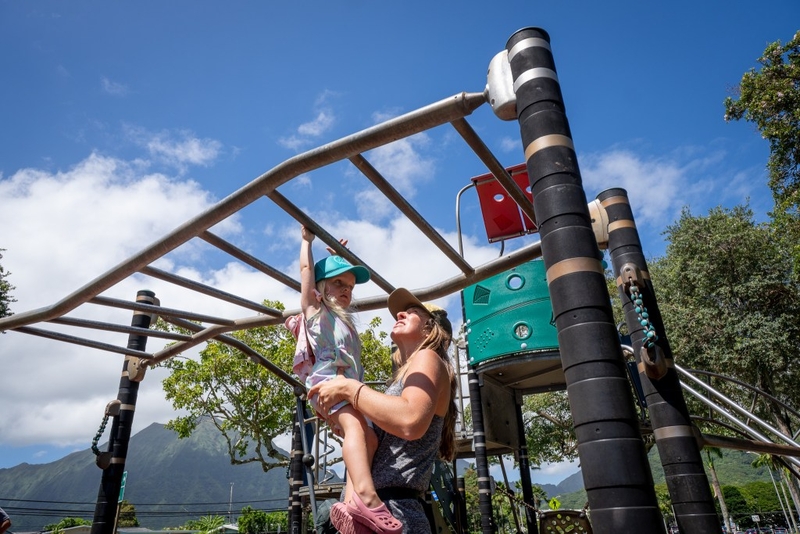
Photo courtesy of Honolulu Civil Beat
Ask Hawaiʻi families what features they’d like to see at their local playgrounds and you’ll hear a pattern of wishes rarely fulfilled.
New mother Vanessa Kawata said she’d like to see clean bathrooms and good access to water fountains. Caryn Tomita said she wishes there were more spaces geared toward toddlers. Crystal House, the mother of a 5-year-old daughter, said she’d like to see more swings.
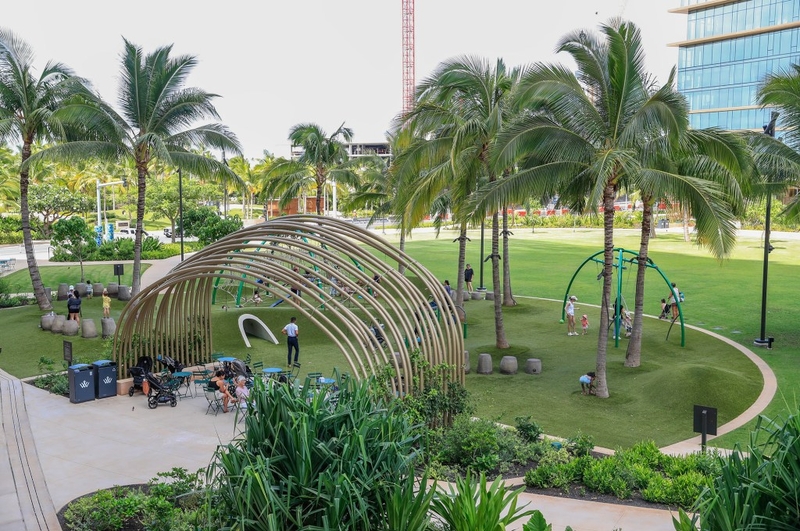
All three women were sitting in the shade on a recent Friday at Kakaʻako’s new Victoria Ward Park playground, constructed as part of a new condo development. The playgrounds built and maintained by the Honolulu Department of Parks and Recreation, parents told Civil Beat, are less of a draw.
While Honolulu ranks highly nationwide for its parks overall, the island has far fewer playgrounds per child than other major cities, according to a survey by the Trust For Public Land. (Omaha, Nebraska, for instance, has more than twice as many per kid.) Honolulu ranked 86th out of 99. Civil Beat roughly calculated that Maui County has a similar ratio as Honolulu, while the Big Island has slightly more playgrounds per child. Kauaʻi has almost three times as many as Oʻahu.
Many of the ones that do exist on Oʻahu are often sparsely visited. Families on the neighbor islands also told Civil Beat their local parks are lacking.
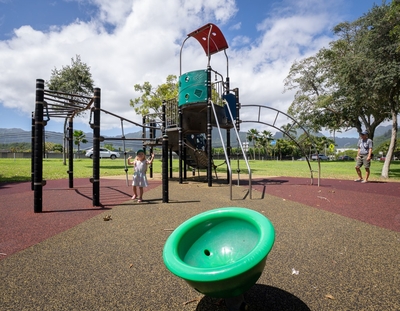
Hawaiʻi’s playgrounds often don’t check families’ boxes. They can be sunny to the point of discomfort. They’re not made for youngsters. Some have fallen into disrepair. On Oʻahu, swings — a hugely popular feature — are present in just 13 out of 135 playgrounds, all but one of which are in town or in Kailua. Many have cookie cutter play equipment that fails to spark children's imaginations, and parents across the islands sometimes drive 30 minutes or more to seek alternatives.
Meanwhile, social media influencers tout the fun to be had at privately developed playgrounds, such as at Hoʻopili on Oʻahu’s West Side, and private indoor playspaces like Keiki Kingdom and Kid City, which charge for entry. Splash pads on Oʻahu are few and far between, found mostly on military bases.
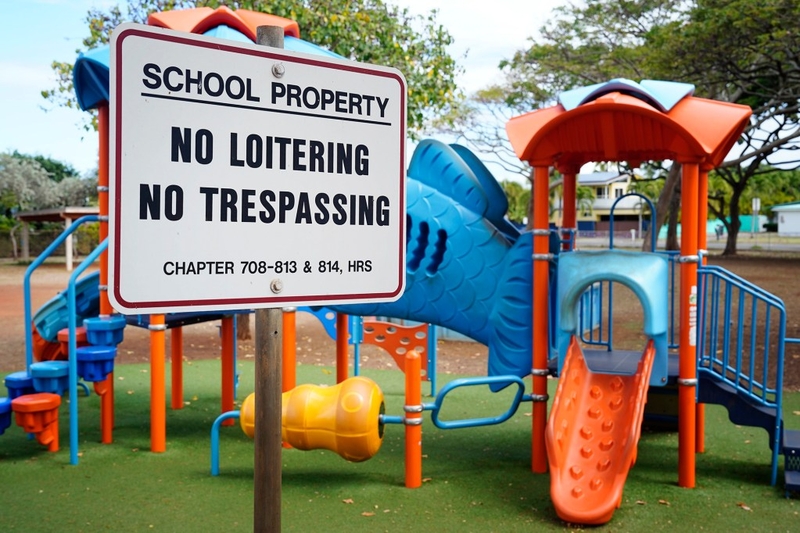
In Kailua, families are so desperate for decent recreation space that they’re willing to hop fences and risk trespassing charges just to access the delightful play space at ʻAikahi Elementary School. The state education department has locked the community out of that playground, even though it was constructed with private donations.

It’s a big adjustment for House, whose family moved to Honolulu a few years ago from Indianapolis. There, she said, she easily found playgrounds such as Westermeier Commons that were huge and packed with all kinds of features such as tall slides, tunnels and splashpads.
“We would go and stay for five hours,” she said. “Coming here, I just did not see how we were going to be able to stay at a park for five hours.”
The parks department knows Oʻahu’s current playground offerings could be better. Spokesperson Nate Serota said the city’s old method was to use a “cookie cutter” design without a sense of place. Parks Director Laura Thielen acknowledged there are a lack of options for younger children, and regulations have stifled the inclusion of swings.
“I would love to get back to more swings,” she said.
New play spaces are on the way. The city recently entered a procurement master agreement that makes it easier to order more custom and creative playground parts, allowing it to expand the realm of playing possibilities.
Three new playgrounds under this agreement – in Waiʻanae, ʻĀina Haina and Ala Moana – are set to open in the coming months, the first on Friday. The city released renderings of all three to the public last week. Public reaction on Instagram was mixed, with some celebrating new recreation areas and others taking issue with what they see as a problematic lack of shade, benches and creative vision.
In an emailed statement, Serota said trees, including large monkeypod trees at the ʻĀina Haina and Ala Moana sites, will provide additional shade not shown in the drawings. Serota also said cost is sometimes an issue when it comes to artificial shade structures.
It remains to be seen how many more new playgrounds will be built under this new agreement and what each of their designs will be. What is clear, however, is that the city has perhaps its best opportunity in years to incorporate resident wishes and upgrade Oʻahu’s middling stock of playgrounds.
Play Primes Kids For Life
Victoria Ward Park’s popular new playground is an exception that proves the rule. When Civil Beat visited on Statehood Day, it was packed with parents and keiki from around Oʻahu’s South Shore.
Kawata, who lives roughly half an hour away in Kunia, said she’s been coming to the playground since it opened in February. The park is a prime spot to meet other families from her church because it’s close to coffee shops and away from busy roads.
“It’s a great place for babies to just kind of cruise,” she said. “The swing is a big deal, but for them they also love the tunnels. And you see the hills? They’ll bring cardboard and slide down.”
When designing playgrounds, landscape architect Meghan Talarowski said her firm, Studio Ludo, prompts clients to ask themselves why they’re building one in the first place. Her team asks decision makers to remember their own fond childhood memories and dissect who was there and in what ways the physical environment contributed.
“Can you do your part to ensure that kids have access to great places to play so they can have the memories that we did?” she asks them.
Talarowski said playgrounds have always been training grounds for the adult world. She said they started sprouting up during the late 1800s and early 1900s as backlash grew to kids working their lives away in dangerous factories.
The standard playground model of a slide, swings and a sand pit came from the controversial New York City urban planner Robert Moses, Talarowski said. Much like Moses’ urban highway model — which cleared portions of neighborhoods to make way for massive road projects — his playground model quickly spread across the United States.
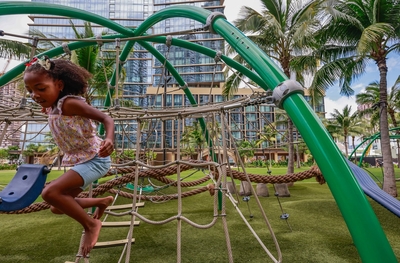
Talarowski said that Moses wanted playgrounds to teach children how to be good productive members of society. His model won mainstream acceptance, contrary to other more freeform models championed by the mid-20th century sculptor Isama Noguchi, who at one point designed geometric playground features for Ala Moana Regional Park that were never added.
“The environments we create for our children will turn them into something,” Talarowski said. “The thing about most modern playgrounds is there is no agency for children to manipulate or change their environment.”
Some parents at Victoria Ward Park said they weren’t sure exactly how their keiki would use the park’s more abstract features, such as its small rolling hills and the accompanying tunnels beneath them. But armed with pieces of stray cardboard, the kids quickly figured out how to have fun.
“It’s kind of opened their imaginations,” mother Gabrielle Wilmer said. “They were just literally sliding down the hill and pretending they were penguins. So definitely an opportunity to explore a little bit more, and have stuff to climb on as opposed to climbing on the furniture.”
For children who spend most of their young lives in a world made for adults, interactive features such as water or loose cardboard scratch an itch they have to control their immediate surroundings – even if their parents struggle to make sense of the results.
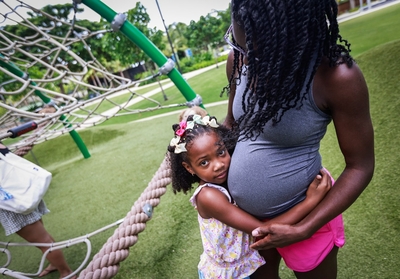
House, the mother of energetic Ta’Aleigh, said she used to be a more active participant on the playground with her daughter.
“But she’s so adventurous and independent,” she said. “She had it by the time she was 2, so I would just sit in the back and just watch her play. Which, I mean, I love it.”
Families Yearn For Swings, Shade
It isn’t just Oʻahu. Some families on the neighbor islands are dissatisfied with their playgrounds, too.
Dozens of kids ran around the playground at Kalama Park on a recent Sunday evening in Kīhei. Some parents — a combination of Maui residents and visitors — watched from a nearby bench while others joined their child on the playground.
Alexa Helgi was there, laughing and making faces as she gently pushed her one-and-a-half-year-old daughter on the swings — an activity for which she drove a half hour from Wailuku.
“I come here because there are, like, no other swings!” she said. "And the swings are everyone’s favorite.”
To Helgi’s left, Angelica Laloulu nodded in agreement.
“It’s also shaded,” said Laloulu, who was playing with her one-year-old son on the neighboring swing.
Pointing to the large screen-like structure casting a shadow over the play area, she said, “Really, I think the shade is one of the main things. It’s so, so important.”
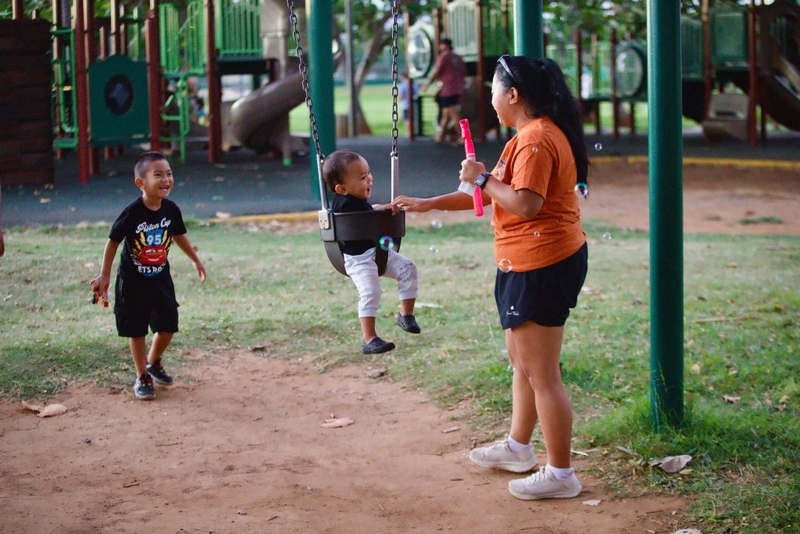
Both mothers said they also enjoyed bringing their kids to the Hui Aloha Playground at Keōpūolani Park in Kahului, which has separate play areas for older and younger children. However, that playground has fewer swings and much less shade.
“Keōpūolani is obviously a really nice one," Laloulu said, "but you have to go there early in the morning or right before sunset because of how hot it is.”
Laloulu — whose four children are between the ages of 1 and 14 — also appreciated that there was so much room around the playground at Kalama Park for her older kids to run around, and she could still keep an eye on them while playing with her youngest. Both Laloulu and Helgi said they wished more playgrounds on Maui catered to children under the age of 3.
“It's really good for all ages here,” Laloulu said. “There are always so many things going on.”
Lynus Yadao said the swings were also his one-and-a-half-year-old daughter’s favorite playground activity. While there are a few playgrounds closer to where Yaddao’s family lives in Central Maui, they rarely visit them.
“This is definitely one of the bigger ones,” he said.
Yadao looked over his shoulder and nodded at the unobstructed view of the Pacific Ocean, adding, “And we like to come here to watch the sunset on this side.”
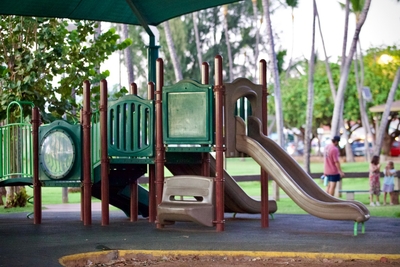
On the Big Island, the playground at Harold H. Higashihara Park, about 20 minutes south of Kailua-Kona, is the kind of place people make special trips to visit. Giant monkeypod and kukui nut trees shade two conjoined playgrounds for both younger and older kids, a swingset, and a fort-like wooden play structure and multi-story slide. A giant whale sculpture makes for good climbing, and the playground is adorned with art and educational panels about Hawaiian language and culture.
This playground is one of thousands designed decades ago by the company Leathers & Associates. The company, founded by Robert Leathers, would solicit ideas from children, complete a design and then leave it to thousands of community volunteers to build the final product. Products of this playbook spanned the country.
Because it's also located at a higher elevation than the other two playgrounds in town, families go out of their way in hopes of keeping cool.
On a recent Wednesday, Riana Espino drove 30 minutes from the hot, dry northern side of Kailua-Kona to bring her daughters there. Her kids love the slide so much, she said, the playground was a factor for her family when they decided to move to the Big Island from Kailua on Oʻahu recently. Her kids used to love playing at their school playground on weekends, but then the school put up a fence and blocked weekend access.
"It was a community-funded space, so that was so frustrating," Espino said.
Katie Burgess, who recently moved with her family from Hilo, spoke fondly of the playground at the Panaewa Zoo, Anuenue Playground in Waimea, and the new one at the pit stop off Saddle Road, but she bemoaned the large swaths of the island with no real option for kids.
"You could say we have a playground desert on this island," she said. "There's just a real lack of spaces for local people."
The playground at Pualani Park down the hill has a tiny shade structure, but it's well trafficked by families who live in the nearby subdivisions. So much so that it has fallen into disrepair recently, said Burgess, but Mayor Kimo Alameda told a group of parents recently improvements are on the way.
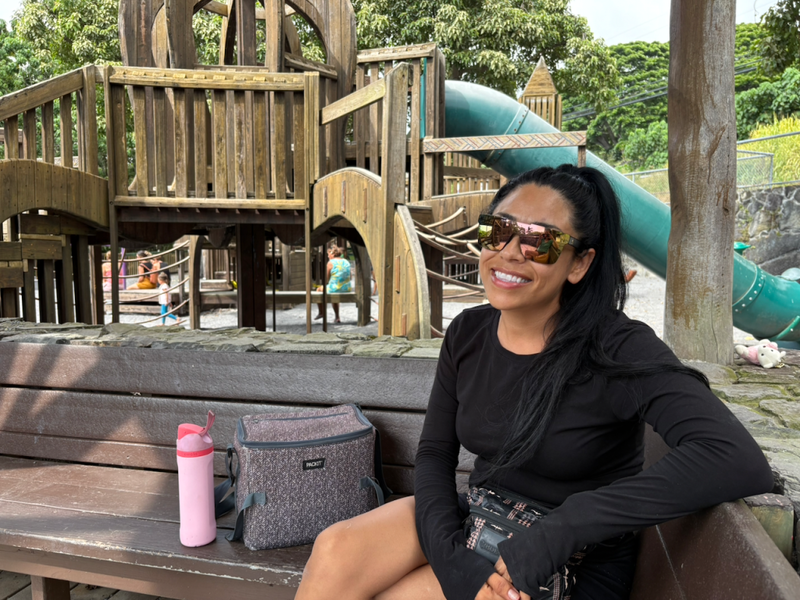
Juanita Toci's 4-year-old twins attend the Head Start program a few minutes from Higashihara Park. For that reason they've become regulars, even though they have a park near their home in Captain Cook. The whole family likes it, she said from under a shaded collection of benches. But she wants to see better drinking fountains and a potential splash park, especially after this El Niño summer.
"We get in the car and they’re grimy and hot," she added. "I bring two water bottles, and they're always empty by the time we leave."
Safety was another important factor, all three mothers agreed. They typically avoid the playground at Old Airport Park because a number of unhoused people live nearby.
On Kauaʻi, Samuel Moua, who was recently visiting from Oregon with his family of five, followed two of his daughters — ages 6 and 16 months — under an artificial cave and through wooden walkways at Kamalani Playground at Lydgate Park.
“This is probably one of the best parks I’ve been to in a while,” he said.
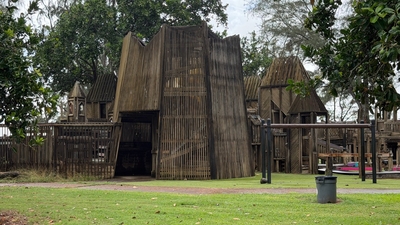
The playground is another product of Leathers & Associates. The general manager of The Friends of Kamalani Park & Lydgate Park, Tommy Noyes, said it was built as a way to strengthen the community after 1992's Hurricane ʻIniki.
Moua particularly enjoyed the amount of shade the playground provides. It surrounds a 25-foot-tall tree and has pavilions and walkways of varying heights that help keep him and his daughters cool in the hot afternoon sun. The largest slide, roughly 15 feet tall, is entirely covered by a wooden tower and lets out onto padded, artificial grass.
There’s also plenty of wooden nooks and crannies. One contains a glockenspiel that he taps with a provided mallet.
Other playgrounds his family has visited during their trip, such as the one at Poʻipū Beach Park, were too hot. At Poʻipū, he's glad he slid down the slide before his daughters so they didn’t get burned. Other kids didn’t start playing on the equipment until the sun started to go down — he assumes because of the heat.
Designing For Maximum Fun
Around the corner from Oʻahu's Victoria Ward Park is Kolowalu Park, where its designer Danielle Sagum said the name of the game is inclusivity. That concept is often conflated with accessibility – which more narrowly means whether someone can physically get to a space – but she said the two words have slightly different meanings.
“Inclusion considers, obviously, the access to the playground,” she said. “But then, well, what do they do when they get there?”
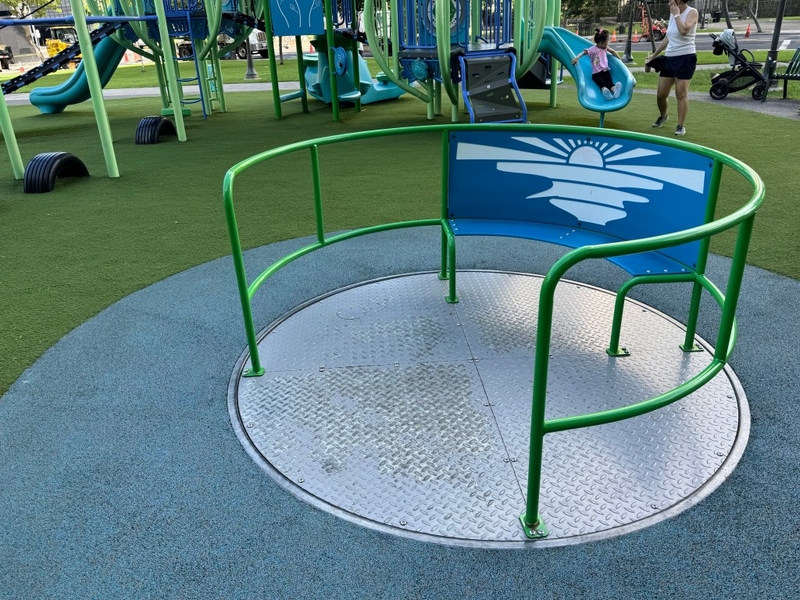
Sagum said it’s important that designs consider children with cognitive differences who might feel overstimulated and need a place to retreat to.“Jump-in points” give them the option to gradually enter a play area as they grow more comfortable and confident before joining the main action. “Cozy spots” allow them to escape the bustle without leaving the entire play space.
Sagum’s designs won all three of Honolulu’s playground contracts. The first, at ʻĀina Haina’s Nehu Neighborhood Park, is set to open on Friday while other projects at Ala Moana’s Sheridan Community Park and Waiʻanae’s Kaupuni Neighborhood Park should be done by the end of this year or early next year.
The idea for all three is to incorporate place-based themes to promote a local sense of pride and ownership: a fishpond theme for Nehu; a Hawaiian values garden theme for urban Sheridan, which lost its old playground after someone set it on fire last year; and a mauka-to-makai theme for Kaupuni with an ʻuala (sweet potato) patch and a kalo patch.

Rather than put out a call for the cheapest bid, Honolulu’s new playground procurement model allows officials to choose the design they like most after giving bidders a specific budget. It’s not the fastest way to build playgrounds, especially since custom parts will need to be manufactured and then shipped over – an already achingly long process when replacements are needed. But Serota, the parks spokesperson, framed the tradeoff as “quality over quantity.”
Kauaʻi County joined the same procurement system in 2023, according to spokesperson Alden Alayvilla. Kauaʻi mostly uses it for replacing smaller parts, but it can also support larger larger projects such as the Līhuʻe Inclusive Playground, he said. Maui County has not used the agreement to build build or repair any playgrounds, that county's parks director Patrick McCall said in a written statement.
It’s easy to think of a playground as another amenity checkbox, Sagum said, but the features that go in have very real consequences for how kids develop.
“There’s a huge life lesson in something as simple as monkey bars,” she said, which help keiki develop upper body strength and teach them how to conquer their fears.
Swings are similar, she said, in that they provide children with a unique and playful way to develop their senses of spatial awareness and depth perception. On Oʻahu, the playgrounds at Nehu and Kaupuni will also have swings, adding two new options – including the first on the Westside – to the island's pitiful count.
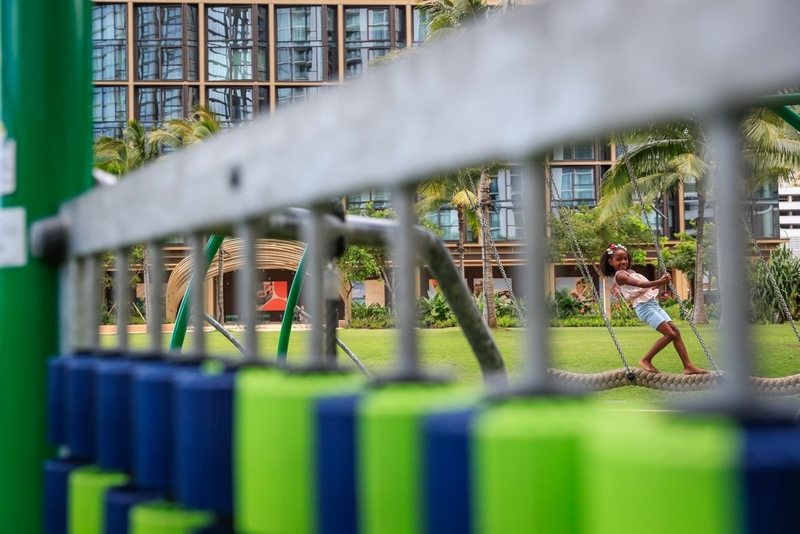
Honolulu parks Director Thielen said there’s a reason for swings' rarity: Modern safety standards require fall-safe surfaces under swings. And the bigger the swing, the bigger the cushion has to be. That space requirement makes it difficult to choose swings out of a suite of options that could fit into the same-sized play space, Sagum said.
Still, they’re the most popular playground equipment across all ages, according to the 2023 National Study of Playgrounds, which includes observations from 100 playgrounds in the United States and United Kingdom.
“When you’re considering designing for all ages and all abilities,” Sagum said, “swings are one of the most inclusive experiences.”
Crucial too, the study says, is that designers make the area comfortable with shade, seating, bathrooms and water.
“The more comfortable I am,” Sagum said, “the longer the kids get to stay and enjoy.”
Honolulu, HI