School board members can be deposed for removing library books, federal court rules
Oct 19, 2026 | 6:38 pm ET
Description
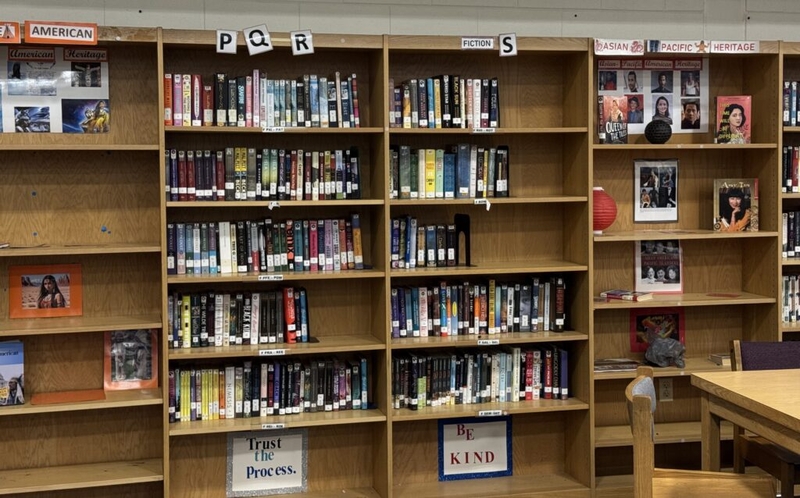
Books in a Florida high school library. (Photo by Jay Waagmeester/Florida Phoenix)
A years-long legal battle over book removals in Escambia County has a new chapter. A federal appeals court ruled school members may be deposed about why they removed library books and classroom material.
The lawsuit was brought by book publishers, parents, and the PEN American Center in 2023 after Escambia County officials voted to remove, at the request of a teacher and the superintendent, library books deemed to have “‘extreme sexual content,’ ‘LGBTQ agenda,’ ‘race-baiting,’ ‘graphic rape scenes,’ and ‘language,’” the suit explains.
School board members claimed legislative privilege to avoid depositions. The appeals court agreed with the trial judge: Board members acted as administrators and not legislators when removing books and do not enjoy legislative privilege in this case.
Three judges of the U.S. Court of Appeals for the 11th Circuit oversaw the appeal. Two agreed with the district court — Jill Pryor and Andrew Brasher. Chief Justice William Pryor dissented.
Brasher, writing for the majority, wrote that the school board’s decisions on the books resembled “nothing about” “what a legislator does i.e., the ‘proposal, formulation, and passage of legislation.’”
“We have explained an act is ‘more apt to be administrative in nature’ if ‘the facts utilized in making a decision are specific, rather than general, in nature,’” Brasher wrote, referencing 11th Circuit precedents.
First, an internal committee advised keeping the books, while an appeal to the school board ended with the books being removed, Brasher wrote.
“Our decision today is a narrow one. We do not address whether other privileges or discovery rules may warrant quashing these subpoenas, curtailing the depositions, or the like,” Brasher continued.
“Nor do we suggest that every decision to stock or remove a book is administrative in nature. Legislative privilege serves important interests in preserving legislative independence and protecting legislators from compelled inquiry into legitimate legislative acts. Those interests warrant robust protection.”
But he added: “Our dissenting colleague’s independent research may have been comprehensive. But we respectfully suggest that his resort to unraised arguments about far-flung authorities merely underscores that this Court’s precedents (which we have obviously addressed in depth) do not support his position,” Brasher wrote.
Pryor had cited, in the majority’s words, “an obviously distinguishable 1880 decision from California.”
“But the majority prefers to base its decision on our recent precedents about disparate contexts like personnel and zoning decisions that look nothing like an elected school board having to decide a political issue like removing a controversial book from school libraries,” Pryor wrote.
Pryor viewed the board’s vote as “of a public character” in setting “a prospective and generally applicable Board policy.”
“Because the members of the Escambia County School Board exercise discretion over a matter of public policy when voting to remove books from school libraries, the majority wrongly strips them of their privilege to avoid testifying about those votes. In doing so, it ignores the common law that the Supreme Court has explained defines the privilege. It misreads our precedents too,” Pryor wrote.
Had the board members acted on their own initiative, as opposed to reacting to parental and superintendent actions, Pryor argued, the majority would have views that as legislative, not administrative.
Backstory
Last year, Chief Justice Allen Winsor of the U.S. District Court in Tallahassee sided with the county, saying the school district had not violated students’ First Amendment rights in keeping from them a book about two male penguins raising a chick together.
Escambia County’s library policy has accumulated a long legal history, including disagreements about whether a 7-year-old student should be deposed. The district argued the student should be, and he was deposed.
Judge: Escambia County did not violate First Amendment by removing same-sex penguin book
In August 2025, a federal judge in Orlando ruled the state law banning school library books was “overbroad and unconstitutional.” That case was appealed to the 11th Circuit. Oral arguments were held in April.
Meanwhile, Henry Mack, Florida’s education commissioner, who started in that position this summer, sent a memo telling all districts “to identify deficiencies in how some districts are discharging those duties” of reviewing instructional and library materials. The duties are prescribed by the 2023 law.
“Districts must follow Florida law and State Board of Education rules by providing only materials that are age- and developmentally appropriate. Unfortunately, parents continue to find a shocking amount of material that fails that test. Again, that is unacceptable,” Mack wrote.
“Several districts, including Clay, Escambia, and Nassau, have already removed or discontinued substantial numbers of titles following review. Delaying until a district becomes the subject of the next public controversy is not an acceptable approach,” Mack added, adding that he holds authority to investigate noncompliance with the law.
Tallahassee, FL