Dallas man who died in Laredo ICE facility was lawful permanent resident
Oct 19, 2026 | 6:57 pm ET
Description
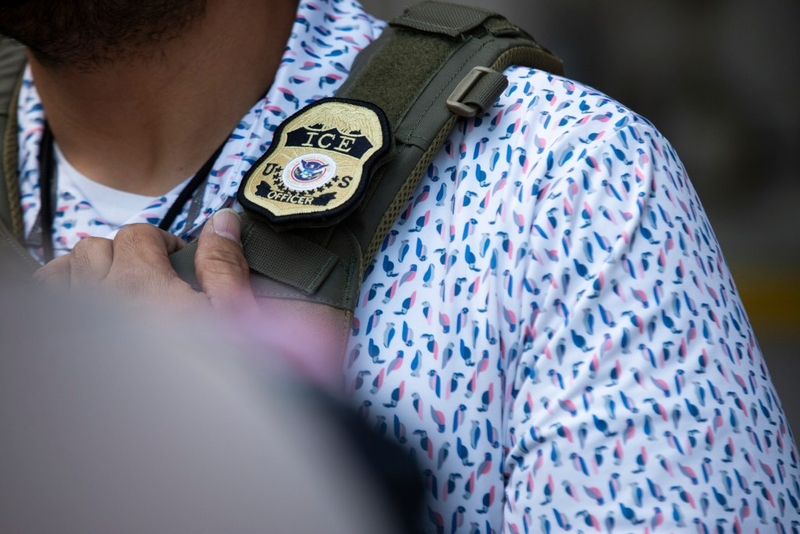
A U.S. Immigration and Customs Enforcement agent’s badge is seen in front of the J.J. Pickle Federal Building in Austin on April 1, 2025. (Eddie Gaspar/The Texas Tribune)
The 56-year-old Mexican man who died Saturday while in U.S. Immigration and Customs Enforcement custody was a lawful permanent resident in the country, the agency said in a statement a day after The Texas Tribune reported about his death.
Emiliano Andrade-Covarrubias, 56, was found unconscious in his bed at the Rio Grande Processing Center on Saturday morning. ICE said staff performed chest compressions and called emergency services, but he was declared dead about 20 minutes after being found unresponsive. He had been in immigration detention since June.
ICE on Monday said Andrade-Covarrubias’ cause of death is still unknown, as the autopsy was still pending with the Webb County Medical Examiner. The agency also said he received proper medical care and was seen by medical professionals.
In the statement, ICE said Andrade-Covarrubias was returning to Texas from Mexico at a port of entry in Laredo when immigration officers detained him on June 26. ICE added that he was detained because officers believed he obtained his legal status in the U.S. fraudulently because he failed to disclose a 2004 arrest for theft during the review process.
The agency was also seeking to deport him, saying that he was in removal proceedings before an immigration judge. Andrade-Covarrubias was supposed to appear at an immigration court hearing on Nov. 2, according to online records.
Andrade-Covarrubias’ daughter, Estefani Andrade, told the Tribune that her father did bring up his criminal record during the application process — and that immigration officials approved his green card application.
Andrade-Covarrubias had lived for decades in Dallas, where he raised three children who were all born in the U.S. He painted apartments and townhomes for a living, and his daughter said he was planning to return to Mexico. He traveled to Mexico often because he was building a house there, she added.
Her dad had a heart condition, she said, along with diabetes and high blood pressure. He had medicine with him when he was detained, but she said staff at the center wouldn’t “give him his medications.”
When he said he felt sick and had a cough, she said her family was especially worried because he was hospitalized for COVID-19 in 2021 and the illness took a lasting toll on his health. He sought help from the facility’s medical staff, but he told her that “they would just ignore him.”
She said her dad told her that medical staff at the center brushed off his concerns, even when he told them he was having trouble breathing and felt tightness in his chest.
U.S. Rep. Henry Cuellar, D-Laredo, told the Tribune that he inspected the detention facility on Sunday and asked staff about the facility’s medical procedures, but they could not provide specific details about Andrade-Covarrubias’ case because his death was still under investigation. The Democrat said he has sent ICE written questions to get more information on the case.
“Any death in federal custody is a serious matter, and we need to know what happened,” Cuellar said in a Monday statement.
Andrade-Covarrubias is the seventh person to die while detained by ICE in Texas this year — the first being Geraldo Lunas Campos, whose death was ruled a homicide by the El Paso Medical Examiner’s office in January.
Andrade-Covarrubias is also the second to die in an ICE facility in Laredo this year. Felix Alcorta-Rodriguez, a 63-year-old Mexican who was being held at Webb County Detention Center, died on June 19 after being found unresponsive, according to the agency.
In June, the U.S. Supreme Court ruled that U.S. Customs and Border Protection officers at ports of entry were allowed to prevent people with legal permanent residency — commonly known as green card holders — from reentering the U.S. if they had any history of criminal arrests or convictions.
In an opinion written by Justice Clarence Thomas, the Supreme Court ruled in a 6-3 vote that immigration officials at ports of entry don’t need “clear and convincing evidence that a lawful permanent resident has committed a crime involving moral turpitude.” Immigration officers would be allowed to detain the person from reentering the country, but an immigration judge would have the final say on whether that person would be stripped of their green card and ordered deported.
Justice Ketanji Brown Jackson dissented, writing that the court’s opinion undermines “the benefits and security that come with having a green card.” She also wrote that she is worried the court “handed the Government a massive blank check” to put lawful permanent residents in “immigration limbo.”

Austin, TX