Washington panel eyes ways to ease hurdles to rebuilding homes destroyed by wildfires
Oct 19, 2026 | 6:46 pm ET
Description
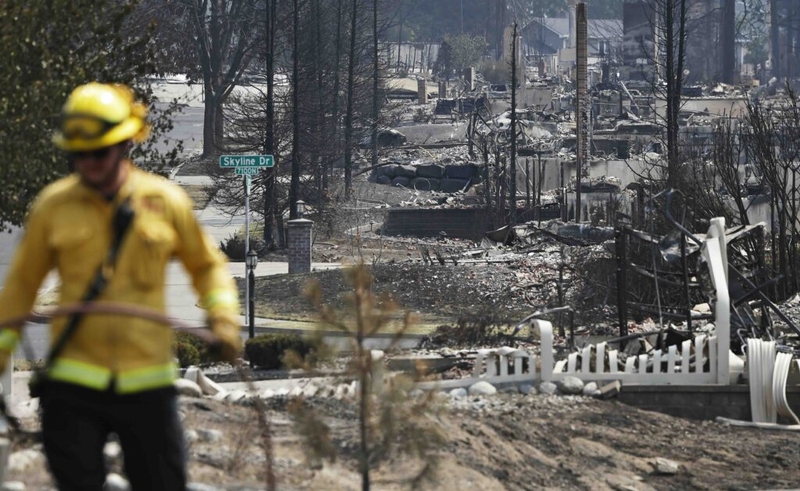
A Cal Fire firefighter works amid the remains of homes destroyed in the Old Trails Fire on Aug. 6, 2026 in Spokane, Washington. (Photo by Mario Tama/Getty Images)
Under pressure from Gov. Bob Ferguson, the Washington state Building Code Council is wrestling with how far it can bend residential energy codes to speed up rebuilding homes destroyed by wildfires this summer.
Ferguson issued an emergency proclamation in August directing the council to identify state laws, rules or code requirements “that may be waived or suspended” if enforcing them strictly would hinder replacement of nearly 700 homes lost in blazes, most in the vicinity of Spokane in eastern Washington.
Earlier this month, the governor asked the council to adopt an emergency rule allowing owners of homes built before 2015 to rebuild in line with less restrictive residential energy codes adopted in 2015. For homes constructed after 2015, the governor is pushing for owners to be able to rebuild to the energy code that was in effect when their residence was first constructed.
“Newer building codes can increase construction costs and create delays as builders, designers and permitting staff adapt to new requirements,” he wrote in his Oct. 8 letter. “For homeowners rebuilding after a wildfire, those added costs and delays can be significant barriers to returning home and can prolong displacement and increase recovery costs.”
On Friday, Oct. 16, in their first meeting since receiving the letter, council members said they want to support the community’s recovery but flagged several concerns and challenges. After two hours, there appeared to be a path that would provide homeowners an option without ceding ground on existing standards. The full council could act by the end of the month after the approach is scrutinized by a subcommittee.
Some members are concerned about the precedent. Any change of building code standards through code waivers can have broad impacts and unintended consequences, they said.
There are statutory realities: an emergency rule to allow use of the older codes would only last 120 days and could expire before many owners are ready to rebuild.
There are political realities: Controversial code changes drawn up since 2015 are geared to get new homes built with electric heat pumps rather than natural gas, an idea widely disfavored on the east side of the state. In Friday’s meeting, several people expressed concern that homeowners would be deterred from rebuilding if required to install a heat pump.
Pam Stone, Ferguson’s senior housing adviser, told the council the intent is to provide flexibility for those who owned the home at the time of the wildfire. If the properties are sold, the new owners would need to comply with the most current codes.
“This is targeted relief. This is not a rollback,” she said. “Time matters just as much as cost. We fear that if we don’t take swift action, which is what we hope the council will do, we are going to lose some deeply important members of our community.”
Washington’s building code contains energy efficiency requirements for residential and commercial construction. It establishes a scoring system used in the approval of building permits based on the size of a home and construction options.
In recent years, Washington has pushed to wean the state off its dependence on natural gas to heat homes. Changes drawn up in 2023 offer builders greater incentives in the permitting process for choosing electric heat pumps — which provide both heating and cooling in the same unit — instead of natural gas furnaces. The appliances are more energy efficient and result in less pollution.
Rep. Suzanne Schmidt, R-Spokane Valley, and Sen. Shelly Short, R-Addy, sent a letter to the council strongly endorsing the governor’s request.
Schmidt told the council on Friday that most of the roughly 700 structures destroyed were built 40 to 60 years ago. Building codes concerning safety and energy efficiency have been updated multiple times since then so any homes that are rebuilt will be better from an environmental standpoint under the 2015 or 2018 codes.
“We’re still improving on what existed prior to the fires,” she said.
Charting a path
Ferguson’s August proclamation required the Building Code Council to submit a report within 30 days assessing potential options.
What the council turned in Sept. 9 expressed little interest in what the governor is now seeking.
“While the State Building Code Council considered blanket code rollback and more targeted relief, it does not yet support waiver of a specific current code provision for wildfire recovery,” reads the opening line of the central conclusion.
The council pointed out that providing relief in this situation far exceeds suspending or waiving a single building code.
“The near-term universe of current-owner total-loss rebuilds is only a subset of all affected properties,” the report reads. “Partial-loss repair, local permitting practice, insurance, financing, debris removal, utilities, and contractor availability, may affect more households than a broad new construction code waiver.”
Complicating the process is that the council is in the final weeks of formally adopting its 2024 standards that would take effect in May 2027. Members generally don’t want to see the timetable disrupted.
One option outlined Friday will get more study in the coming days.
It would involve rule-making to amend current standards to give owners of older homes flexibility when complying with the energy codes. Secondly, new provisions would be tacked into the 2024 codes giving cities and counties the ability to deal directly with owners seeking to rebuild. It would allow local governments to be more surgical with how the property owners’ needs can be addressed.
The council is on course to adopt those 2024 codes in December, which means any new language would need to receive a public hearing and council vote very soon.
“I am interested in finding a permanent pathway that allows for this to be available for users that are affected by this disaster,” said Dustin Curb, the council’s managing director. “I also think that this is a good opportunity for the council to envision ways to have something memorialized for future disasters that may come down the line.”
The council is aiming to take action on an approach by the end of the month.
Olympia, WA