Louisiana laws to protect domestic abuse survivors only go so far
Oct 19, 2026 | 11:09 am ET
Description
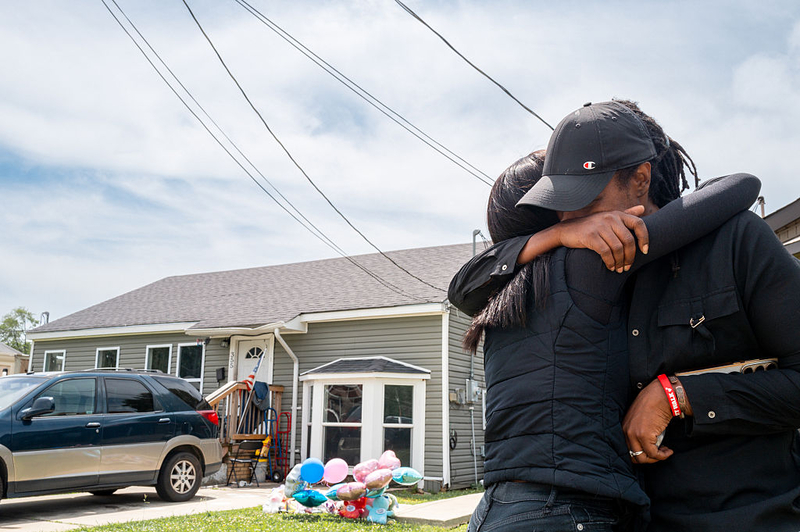
People grieve in front of the home where a shooting spree occurred on April 20, 2026 in Shreveport's Cedar Grove neighborhood. Eight children were killed and two women were wounded at two homes during a domestic violence incident in the early morning hours on April 19, according to local authorities. (Photo by Brandon Bell/Getty Images)
Director Deeyah Khan had been fighting violence against women for 15 years when she made the 2022 documentary “Behind the Rage: America’s Domestic Violence.”
“There is a greater consequence in the United States for killing a bald eagle than there is for assaulting your wife,” says an interviewee in the film.
In Louisiana, a first conviction for domestic abuse battery carries a fine of $300 to $1,000 and 30 days to six months of jail time. Under federal law, killing a bald eagle can result in a fine of up to $100,000 and a year in prison for a first offense.
Charles, one of the men Khan interviewed for her documentary, said he once went to jail for domestic violence twice in one night. Between the two arrests, he found the woman and beat her for calling the police.
When asked whether the women he abused got restraining orders, he said, “Restraining order ain’t nothing but a piece of paper. That ain’t gonna stop me from doing nothing. It ain’t over till I say it’s over.”
A restraining order and firearms restrictions are legal boundaries available to survivors of domestic abuse, but they are not sufficient when an abuser is determined to punish, control, stalk or kill their victim.
Under Louisiana law, a person subject to certain qualified protective orders is prohibited from possessing firearms or carrying concealed weapons when a court finds they represent a credible threat. Since 2018, courts have been required to order some abusers to surrender guns they already own.
A restraining order relies on a chain of people and institutions — judges, clerks, police, prosecutors, service providers and often the victim — to work effectively. When that chain fails, or when the abuser takes offense at the court order because it challenges their authority, the paper meant to protect the victim can become evidence of danger rather than a guarantee of safety.
In Louisiana, Gwen’s Law allows a judge to hold a person charged with domestic abuse battery, stalking or a protective order violation without bail for 48 to 72 hours. The law weighs warning signs such as threats and strangulation, but it also has weaknesses. The bail hearing Gwen’s Law once required has been optional since 2015, and a judge may order a jail hold but isn’t required.
Protection also weakens before the bail hearing. A temporary restraining order issued in Louisiana without notice is generally set for a hearing within 21 days. The state’s firearm-prohibition statute does not include a temporary restraining order, which gives the perpetrator time and leverage to do harm.
Women are killed with and without guns. In 2024, according to the Violence Policy Center, firearms were used in 63.4% of killings of women by men. This means that more than one-third involved another weapon or method.
The central issue is not merely what weapon an abuser can access but whether he is using what Rutgers University scholar Evan Stark calls coercive control: a pattern of violence, intimidation, isolation and control used to dominate a partner.
Loyola University New Orleans criminologist Rae Taylor’s research points to the same root: sexual proprietariness, a man’s sense that a woman belongs to him. A woman is not made safe simply because one weapon is removed from her home if the system does not address the person who believes he has the right to control her body, movement, relationships and future.
Although Louisiana has a preferred risk tool that predicts whether an abuser will assault again, there is an additional tool that exists. The Lethality Assessment Program screens women at the scene and connects high-risk victims with an advocate on the spot.
An Oklahoma study reported promising results from the program. In a state health department report published in February, Louisiana’s Domestic Abuse Fatality Review Panel recommended that officers use both tools.
Louisiana must measure a victim’s safety against the full pattern of abuse, including coercive control and lethal violence committed without a firearm. We continue to try to protect abuse survivors one weapon at a time while the danger remains the same.
Restraining orders are not enough as long as we continue to measure the danger by the gun in the house instead of the man who believes it isn’t over until he says it’s over.
Baton Rouge, LA