More ballot drop boxes, please
Oct 19, 2026 | 12:58 pm ET
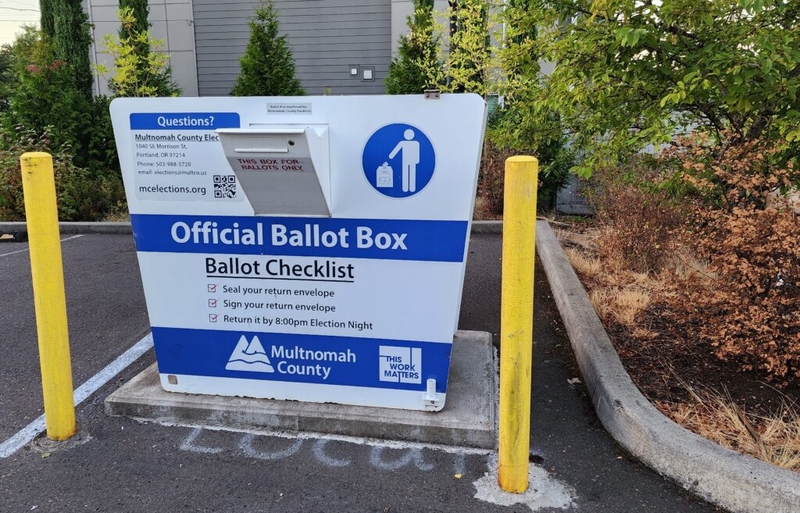
Description
In 1998, Oregon voters essentially voted against an attempt to make it more difficult to get ballot measures approved. (Photo by Lynne Terry/Oregon Capital Chronicle)
Oregon famously allows people to place their completed ballots in the mail for dispatch to the county elections office. It’s safe and it works.
If you want to be really super-rigorous about security, the platinum standard a small but determined group of Oregonians hold to is to take your completed ballot to the county clerk’s office and submit it there. Ballot security in that case is about as perfect as it gets.
The gold standard, which is very nearly as good, is to do what I do: Drop them in the nearest ballot box, which for significant numbers of people is within walking distance of their residence (as it is for me) or workplace. Ballots can be delivered to any official drop box by 8 p.m. on Election Day.”
The ballot box system is so sturdy and reliable that the best single improvement Oregon could make in it, would be to expand it.
Ballot drop boxes (outside of polling places) once were rare nationally but now are found across much of the country. As of early this year, 15 states (including Oregon) required by state law provision of the boxes, another 14 permit them and 11 states (mostly southern and including Texas but also South Dakota) actually ban them. In most states, they’re a well-established part of election life.
Most states, including Oregon, require strong security measures, often including video or personal monitoring and heavy box construction that also blocks efforts to set fires in them.
Oregon law and rules cover much of this, along with their location. Rules from the secretary of state’s office specify at least one “dropsite” at the county elections office, and at least two for every county-wide election; and at least one for every 30,000 registered voters; and at least one “within 4 miles of the main campus of each public university or community college.”
The office recommends counties consider population concentration, geography, security and available funding when determining locations.
There is a small amount of flexibility and vagueness in this.
A large majority are outdoors, available for 24-hour use, for example. But some are located inside government buildings and available only during office hours.
This plays out differently in various counties. Baker County, with about 16,700 people, has five drop boxes: one at the Baker County election office, one at a Baker City community center, and the others at city halls in Halfway, Huntington and Richland. Voters in Haines, Sumpter and Unity face longer drives.
Benton County, with nearly 100,000 people, has 14 boxes, all but three in Corvallis.
Clackamas County has a big population but no single dominant city, so the 26 boxes there are as you might expect spread around, in Boring, Canby, Colton, Damascus, Estacada, Gladstone, Happy Valley, Welches, Lake Oswego, Milwaukie, Molalla, Oregon City, Sandy, West Linn and Wilsonville.
The number of boxes and their location doesn’t follow a straight proportional line, though.
Multnomah County has close to twice the population of Clackamas, but only a few more boxes (32). And Washington County, which has a population almost 50% larger than Clackamas, has fewer (21) drop-offs.
On the other side of the picture are the counties which have large geographic areas but small populations, and few communities.
The extreme case is Grant County, which reports just two boxes for a geographically large county, and both of those are at the same address, at the county courthouse in Canyon City (one box inside, and one outside). That means no boxes for John Day, Prairie City, Seneca, Dayville, Mountain Vernon and Greenhorn, all (except John Day) a significant driving distance from Canyon City.
Another county, Gilliam, also has just two boxes (at Arlington and Condon). And five others (Crook, Curry, Hood River, Lake, and Wallowa) have just three.
The county with the largest land area, Harney, has four boxes, two in Burns, one in adjacent Hines, and one in more remote Crane.
Here again, the population and land areas aren’t easy predictors of box availability. Some small area and population counties have more ballot drops, such as Tillamook (9) and Union (8).
There are understandable limits to the numbers and spread of drop boxes. They are crafted for security, and are not cheap. And in smaller communities there are limited numbers of places where they can be situated to keep them secure.
But these limitations shouldn’t be too much of an obstacle to keep Oregon officials from reviewing whether voters all over the state have the access to them they should have need.
At the moment, the answer to that question seems to be, no.
Salem, OR