Dems have a great issue to run on: the credibility gap
Oct 19, 2026 | 7:00 am ET
Description
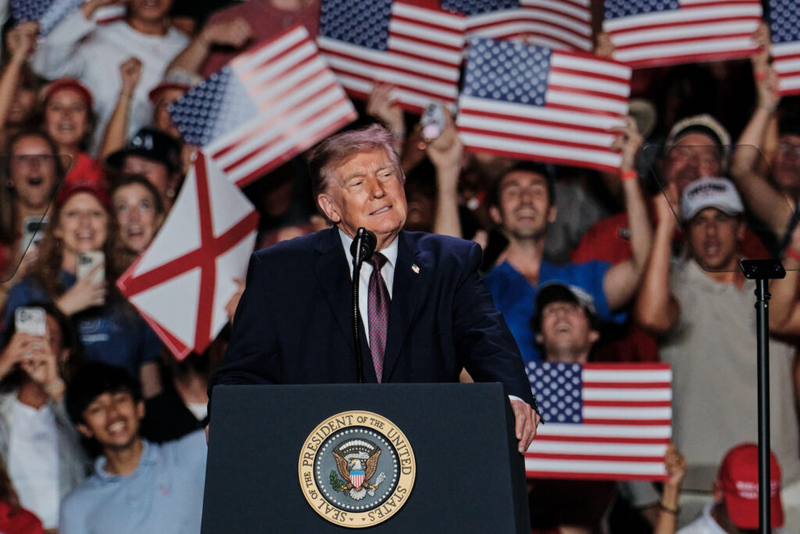
President Donald Trump speaks at the Mitchell Center at the University of South Alabama in Mobile, Alabama on Oct. 2, 2026, as he campaigns in GOP-leaning states ahead of the midterms. (Photo by Dan Anderson/Alabama Reflector)
We were told Trump’s mass deportation project would target the “worst of the worst.” We watched with our own eyes as our neighbors and family members were kidnapped off the streets and our fellow Minnesotans killed.
The videos contradicting the Trump administration’s lies about its killings of Renee Good and Alex Pretti were seen by as many as 80% of us. At the very least, Minnesota Republicans, who often cheered on the immigration crackdown, are complicit in the damage done by Trump’s massive dishonesty.
The result is a “credibility gap,” and it may be one of the better tools available to Minnesota Democrats to blunt well-funded Republican efforts to make the 2026 election about the safety net fraud that occurred under this Democratic-Farmer-Labor governor.
Hammering the credibility gap answers a question I’ve been thinking about for some time. How do we — as communicators, candidates, voters, Americans, Minnesotans — respond to a political party that has made industrial-scale lying its central tool of governing?
I lump President Trump and the Republican Party together here, as one inseparable entity. The president made it clear at the unusual midterm convention his party held in Dallas when he said, “I’m asking you to pretend that I’m on the ballot. I’m on the ballot just one more time.” The Republican brand owns the omnipresent lies and naked corruption of the Trump administration.
The problem is making that count for something, given our fragmented media landscape and the goldfish-level attention span of the American mass public.
Fact-checking hasn’t done the job. During the first Trump presidency the Washington Post did yeoman’s work, documenting over 30,000 lies. Yet he is back in the Oval Office.
Lies are easy. Truth is hard, rarely explainable in a soundbite. Because lies appeal to strong emotions like fear and hatred, it’s hard to extricate lies once they have lodged themselves in the public imagination.
Calling out even the worst liars can sound more like whining about the refs. You most often get drawn into an argument where neither side wins. These aren’t new problems, but social media and the growing capture of mass media channels by right-leaning billionaires has only made them worse.
The credibility gap is a way around a lot of those obstacles. It doesn’t get bogged down in argument. It’s an idea, like the ones I’ve used for years in my advertising job to build or repair brands. It’s uncomplicated. Easy to understand, remember and share. It creates emotional engagement.
It would have added thematic staying power to the recent reverse-gotcha moment when Sen. Amy Klobuchar, the Minnesota Democratic candidate for governor, deftly skewered her Republican colleague Sen. Eric Schmitt for mixing up the Atlanta Hawks and University of Iowa Hawkeyes basketball teams in his embarrassing attempt to label former special counsel Jack Smith a perjurer.
Or, the MAGA influencers’ ridiculous story about Texas U.S. Senate candidate James Talarico checking into an Ohio mental health facility.
Although the Schmitt and Talarico episodes have launched 1,000 funny memes, the credibility gap speaks to a real concern.
Sarah Longwell, the former Republican strategist who’s spent years using focus groups to listen deeply to voters, describes trust as the central issue in politics right now in her new book, “How to Eat an Elephant: One Voter at a Time.” In a recent piece adapted from the book for her publication The Bulwark she writes, “It’s a phrase I hear constantly, across different focus groups, different years, different demographics: ‘I don’t know what to believe anymore.’”
That distrust is everywhere. In their latest “Trust Barometer” survey the communications firm Edelman sums up the current moment by saying, “distrust is the default instinct.”
The credibility gap intrigues me because it’s an idea a political party can use to put themselves on the right side of that distrust by being the first mover with its messaging. For example, simply pointing out to voters, “When a party is lying to you, they aren’t listening to you.”
Brand strategies often work this way. The good ideas are broad and emotional. You own them by getting there first, then talking about them with some volume and consistency.
There is opportunity here for a Democratic Party sorely in need of repairs to its beaten-up brand. In part, because it’s hard to see it as an opportunity for Donald Trump’s Republican Party. The president’s ever-sinking approval ratings are often stated as a loss of trust on issues that have traditionally been Republican strengths.
The calculus here is simple. Politics is binary. Distrust is growing everywhere, but most significantly for the president and his party. If Democrats succeed in talking about the credibility gap, it strengthens their branding by weakening the other brand.
All of this would be especially salient here in Minnesota, where the scars are still fresh from the administration’s lies during Operation Metro Surge. We were once again reminded just how real the credibility gap is and how much damage has been done by administration lies when the Good family filed suit on Oct. 1 against the federal government and a number of Trump officials over her killing. Attorney Benjamin Berkman cited an 1871 law passed to fight the Ku Klux Klan at his press conference announcing the suit, describing ICE activities in Minnesota as a similar conspiracy to the Klan’s violent regime.
“One hundred fifty-five years later, armed men went in disguise on Portland Avenue. They went as part of campaign to terrorize people based on the way they looked — and now Renee Good is dead.”

Saint Paul, MN