Michigan spends billions chasing jobs. There’s a better way
Oct 19, 2026 | 8:00 am ET
Description
Michigan Economic Development Corporation in Lansing. | Photo by Jon King/Michigan Advance
Regardless of who wins the Michigan governor’s race next month, the state’s approach to economic development is likely to undergo sweeping change.
Republican candidate John James says he will completely overhaul the troubled Michigan Economic Development Corp., the state’s quasi-public development agency, and initially focus it on retaining existing businesses.
Democratic candidate Jocelyn Benson says she’ll fire MEDC President and CEO Quentin Messer Jr. and replace him with a “seasoned administrator,” possibly from the business community.
Benson says she might also create a separate agency focusing on the needs of small and micro businesses.
The MEDC has been mired in controversy over the alleged theft and misuse of a $20 million grant by former board member Fay Beydon that led to state Attorney General Dana Nessel charging her with 16 felonies.
Declining tax revenues from Native American casinos recently led the MEDC to lay off about 15% of its staff.
And there have long been complaints that MEDC’s business attraction spending isn’t delivering promised jobs.
Tim Bartik, senior economist at the W.E. Upjohn Center for Employment Research in Kalamazoo and an expert on business attraction incentives, agrees with the gubernatorial candidates that Michigan must radically change its economic development course if it is to become a more prosperous state.
His exhaustive,186-page new study on business attraction incentives found that the $95 billion a year states spend on these giveaways doesn’t move the needle much on boosting per capita income, a basic measure of a state’s economic wellbeing. Those incentives include cash payments, tax credits and other forms of cash-based incentives.
Michigan, for example, has fallen into the bottom-tier of states in per capita income over the past 30 years despite spending tens of billions of dollars trying to get new businesses to invest here and create jobs.
Bartik’s report, which received financial support from the Rockefeller Foundation, recommends the state slash expenditures on cash-based incentives and redirect the money to three areas: customized services for businesses, targeted incentives to distressed areas and housing construction.
His economic modeling, which included examination of cash-incentive programs in Michigan, California, North Carolina, Tennessee and Texas, found that every $1 spent on business attraction incentives delivered $1.75 in overall economic benefit and 17 cents in new tax revenues.
Adopting Bartik’s recommendations could balloon a long-term economic benefit of between $10 and $28 for every dollar spent and between $1 and $3 in new tax revenues, his study found.
“We must do a lot more than subsidize a few mega projects” that often don’t pay off, Bartik told me.
Businesses value customized services, job training and infrastructure assistance, Bartik said, but less than 18 cents of every incentive dollar go to providing those services.
“That ratio is backwards,” he said in the report. “A small, but specific, incentive, tailored to a business’s unique needs, can provide an outsized benefit.”
Targeting incentives to those communities most in need, places like Flint, Benton Harbor and northern Michigan can put more jobless people living in those areas to work, making the whole state more attractive to business investment.
Giving incentives to businesses to locate in wealthier communities where unemployment is low means many of the new jobs will go to people living outside those markets.
That means the employment status of those living inside the labor market doesn’t change much, “and neither does the state’s fiscal return,” Bartik said.
And if the state wants more jobs, it needs more housing. States should pair business incentives with zoning and permitting reform and focus on funding housing projects in areas already committed to housing policy reform, Bartik’s study says.
A well-designed economic development strategy incorporating Bartik’s recommendations can raise residents’ per capita income by 5% and boost state and local tax revenues by 4% over 20 years, the study claims.
Traditional economic development policies boost per capita incomes by less than half a percent and cut state and local tax revenues by 3 percent, the study found.
Bartik said he’s under no illusion that policymakers will completely shift away from offering businesses cash, tax abatements and other goodies to invest in their states.
Governors score political points by announcing they’ve landed big projects promising thousands of new jobs.
And getting businesses to invest in distressed areas with a low quality of life and unskilled labor will likely be difficult.
But Bartik believes there could be a big payoff for Michigan if it would allocate more of its economic development dollars and business assistance to places that need them.
“Let’s take it one step at a time and see how things work out,” he said.
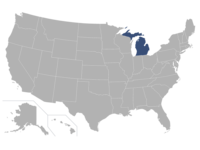
Lansing, MI