How much PFAS is in Minnesota fish? We often have no idea.
Oct 19, 2026 | 10:18 am ET
Description
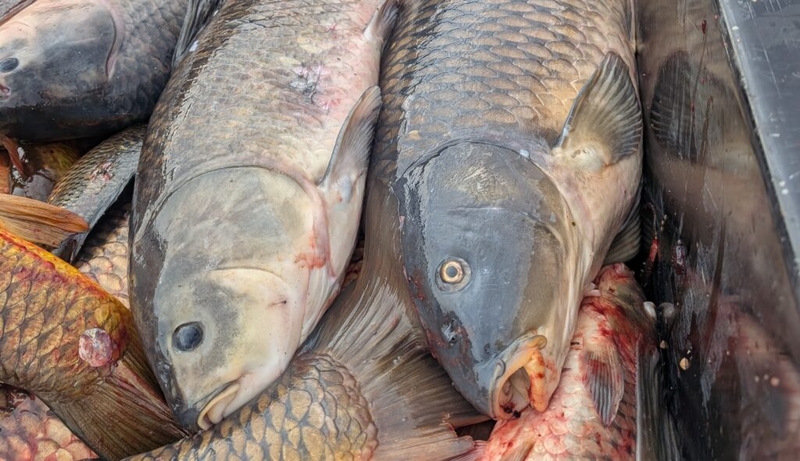
A citizen has found that government agencies are far behind when it comes to analyzing PFAS contamination in the fish in Minnesota waterways. Pictured here: Bigmouth buffalo, right and common carp. (Photo by Frank Bures/Minnesota Reformer)
Hundreds of Minnesota lakes, rivers and creeks lie downstream of industrial sites where well sampling shows significant groundwater contamination.
In most of them, state agencies have yet to sample fish — or at least publish the results of completed tests — for PFAS, the so-called forever chemicals associated with a slew of adverse human health impacts.
That’s according to a suburban Twin Cities resident’s analysis of publicly available data from three state agencies, the U.S. Environmental Protection Agency, and the U.S. Geological Survey.
The findings show nearly 1,000 lakes and about 4,200 river miles downstream of 93 named facilities where sample wells show concerning levels of PFAS contamination in groundwater. Most are closed landfills that operated during the mid- to late 20th century, when consumer and commercial products containing PFAS and other harmful chemicals were common and their impact less widely known or understood.
Last year, samples taken from at least 19 wells at the closed Gofer Landfill near Fairmont showed PFAS concentrations far in excess of human exposure thresholds set by the Minnesota Department of Health. One well had levels of PFOA — a PFAS chemical used in nonstick cookware and other common consumer products — 2.2 million times higher than the state health department’s benchmark for elevated lifetime cancer risk.
In 2021, the Minnesota Pollution Control Agency told the Minnesota Star Tribune that PFAS was leaching into Elm Creek, a Minnesota River tributary near Gofer Landfill. Five years later, public data show that the state has yet to publish fish testing results from Elm Creek or several named lakes in its watershed — nor from waters near Louisville Landfill, a Shakopee facility MPCA also flagged in 2021.
“These are two examples where they went out of their way to name those locations and there was no apparent follow-up,” said Beau Parrish, the Mendota Heights resident who compiled the data onto an interactive website in his spare time.
On the website and in an interview with the Reformer, Parrish stressed that the project does not accuse state health or environmental authorities of a coverup, draw conclusions about how PFAS spreads in surface and subsurface waters, or suggest that PFAS contamination is rampant in Minnesota’s fish population.
But the findings do show a yawning gap in testing that would take years to close at the current pace, Parrish said. State agencies and local authorities have monitored and mitigated PFAS in drinking water supplies for two decades across swathes of the east metro contaminated by PFAS from 3M industrial sites, but certain PFAS compounds can reach concentrations hundreds or thousands of times greater in fish tissue than in the water itself, he said.
“It’s the worst way you could consume (PFAS), in my opinion,” he said.
Staff from Minnesota’s Pollution Control Agency, Department of Health and Department of Natural Resources have analyzed fish from about 160 different waterbodies since 2021 through an interagency collaboration called the Fish Contaminant Monitoring Program, pollution control spokesperson Adam Olson told the Reformer in an email.
In 2024, the agencies ramped up testing thanks to a cash infusion from the state’s constitutionally protected clean water fund. They now have about $250,000 per year to monitor PFAS in fish. That’s enough for about 500 fish from 25 lakes or river segments, with priority going to “waters with known PFAS contamination risks, waters of Tribal significance, and popular fishing sites,” Olson said.
At that pace, it would take about 40 years to test the 997 lakes Parrish found to have no record of fish-tissue sampling for PFAS contamination. State health department data collected by Parrish shows fish in about 200 of those lakes were tested for other toxins, such as mercury, while about 800 have no record of fish-tissue testing for any contaminants.
“That is still a drop in the bucket,” Parrish said, of the added funding. The three agencies could clear the backlog much faster with a relatively modest investment: about $3 million per year for five years, he added.
Olson suggested the agencies may have a shortcut. This month, health and environmental officials from Minnesota, Wisconsin and Colorado published the results of a long-running joint study that found a clear correlation between surface-water and fish-tissue concentrations of PFOS, a common PFAS compound.
Using surface-water analysis as a “pre-screening tool” for fish-tissue test selection, as the researchers recommend, could be more cost-effective and humane than the status quo, Olson said.
“Surface water analysis is faster, cheaper and can be done at scale without the ecological impact of killing the equivalent number of fish,” he said.
It’s not clear whether accelerated testing would significantly change public understanding of PFAS risk in Minnesota fish. Closed landfills are only one potential source of PFAS contamination in surface or subsurface water, along with industrial activity, wastewater, stormwater, firefighting foam and more, Olson said.
“While it is a significant source, it’s impossible to say what percent of Minnesota’s known PFAS pollution has passed through landfills,” he said.
None of the 86 waterbodies for which the health department provides PFAS-related fish consumption guidelines are directly fed by water from closed landfill sites, and fish-tissue testing in lakes near closed landfills — including Mille Lacs Lake, one of the state’s richest fisheries — produced PFAS results too low to prompt waterbody-specific consumption guidelines, Olson added.
But those guidelines are not necessarily set in stone, Angela Preimesberger, fish consumption guidance program lead at the state health department, told the Reformer.
“PFAS science is a very active area of research,” Preimesberger said in an email. “(The) information we have today is based on our current understanding. As we learn more about PFAS in fish, MDH will update fish consumption guidance as needed.”

Saint Paul, MN