Open Studios fosters cultural community in New Haven
Oct 16, 2026 | 12:47 pm ET

Description
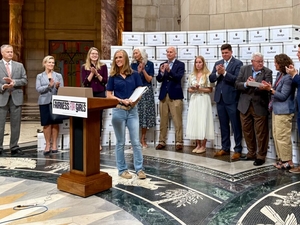
Photo courtesy of CT Mirror
Niko Scharer paused by a rack of finished pottery, lifting a small bowl off the shelf. She took a moment to marvel at the small, crackly finish that had formed in the firing process. Around her, the studio bustled with activity.
Nearby, potter Annie de Graff dipped a mug into a beige glaze, inspecting a thick drip that ran down one side. Susan Rogol settled into her nook, surrounded by small gem-colored bowls and vases. In the parking lot, Margaret Ulecka-Wilson had nearly finished loading pieces into a gas kiln that the group uses to fire its work outside.
All four — and particularly Scharer — are part of an artist-led, grassroots effort behind the fourth annual Open Studios New Haven, a celebration of artists and art making that unfolds across New Haven and West Haven for the month of October. In the final two weekends of the month, artists will open the doors to their studios, galleries, art buses, music incubators and community theaters, inviting people in to see a process that is often private.
“It feels like a party,” said Scharer, an artist at Erector Square Pottery and Ceramics who this year stepped up as a primary organizer of the event. “I love talking to people. I love showing them the process. People come into the studio, and they pick out things to talk about and look at that you would never expect. They share their own experiences working with clay. That’s what Open Studios is about. It’s about the people. ”
For many of the artists involved, the story of Open Studios begins well before its inception in the summer of 2023. From 2005 to 2020, the now-defunct organization Artspace New Haven ran a month-long festival called City-Wide Open Studios (CWOS), which stretched from the labyrinthine, former factory complex Erector Square to the city-owned Goffe Street Armory to studios and work-live spaces in the city’s Mill River District and Westville neighborhood.

In 2021, under a new executive director at Artspace, it became the Open Source Festival, a weeks-long fête that brought in skateboarding, multi-channel film and video, and storytelling alongside a weekend at Erector Square that was part of Artspace’s long-running tradition. Then in the early months of 2023, after the departure of its executive director, Artspace closed its brick-and-mortar storefront in downtown New Haven.
Around that time, a group of artists at Erector Square began working together to reimagine the festival. They were, remembered artist Martha Lewis, a rag-tag and dedicated band of artists and makers, who rebuilt the weekend’s infrastructure over a series of planning meetings. When Artspace had a closing sale, they bought old CWOS banners that had been in the building’s basement, and frankensteined them anew with paper guillotines and color-coded duct tape.
In October 2023, on the centennial anniversary of the building’s founding, over 150 artists welcomed visitors to the space. Over two days, roughly 1,500 people came out, according to artist and early organizer Eric March.
“It’s been a great bonding experience,” said Lewis, who has worked in studios at Erector Square for over a decade, and now curates a group show of Open Studios artists at New Haven’s Institute Library. “Especially at this moment in time, work that the artists of New Haven are doing as outreach. For people to see inside people’s studios … it really is a gift.”
Through the planning meetings, she’s gotten to know artists who may share the building, but are several floors away, behind a network of locked doors and steep stairwells. In her studio, which she has named “The Elaboratory,” Lewis can spend hours immersed in a single project, like her current series “Within Worlds.” The festival gives her an opportunity to emerge from her space, and see what her colleagues are working on.

Four years in, Scharer and fellow artists have helped coordinate 65 open studios and 42 guest artists for Erector Square alone, as well as pop-up events throughout the day like origami printing, family artmaking, and a “Wellness Concert” and instrument petting zoo from the youth-powered organization Music Haven.
Scharer said she is particularly excited about a scavenger hunt in which attendees can criss-cross Erector Square’s eight buildings, scurrying up and down stairways and filling out a “passport” of objects that they find along the way. In one studio in building six, for instance, there’s a small oil painting of a brown fox, installed to look like he’s chasing a bumblebee one canvas over.
In total, Schaerer said, the budget hovers around $8,000, an amount that comes from artist fees (it costs artists $25 to participate, or $60 if they are guests in the space), individual donations, and small fundraising events like raffles and tag sales. That money covers paying vendors and compensating collaborators.
She was quick to add that the work has very much been a group effort. Ioana Barac, of the Erector Square-based design firm Atelier Cue, put together a color-coded map meant to make the building seem less overwhelming. Glass artist Karen Hibbs organized a dinner for artists on Friday evening, so people have a chance to get to know each other before the event begins. Liese Klein, who runs New Haven Aikikai Aikido, put together the scavenger hunt. Maxim Schmidt, who is an artist and curator, came back onboard as the event’s volunteer coordinator.
Building Collaborative Community

Just days before the celebration formally began, several artists buzzed around their studios, moving tubes of paint and baubles of thread until the spaces were cleaner than they’d been in months. On the first floor of the complex’s building five, artist Leila Daw checked in on her rendering of the element earth, still drying after a coat of resin.
Daw, who has been working in her Erector Square studio for two decades, said she’s always excited for open studios weekend, and grateful to the organizers who have shepherded it through nearly half a decade of transition. In 2004, she moved into her current studio from a home studio in Branford, to work on a commission from Bradley Airport that now hangs in the space’s ticket lobby.
Her arrival coincided with the early years of Artspace’s CWOS, when curator Denise Markonish was still working with the organization (Markonish left New Haven in 2007 to work for Mass MoCA, where she was until last year). Those years were amazing, Daw remembered. But after the Covid-19 pandemic and a leadership transition at Artspace, “it was sort of a disaster,” she said.
Then several of her artistic colleagues scooped it up and began to reimagine it. Since that time, she said, she’s met artists who have been in the building for years, but have never had the chance to wander into her studio, or welcome her into theirs.
“We are in this big building complex and we don’t know each other,” she said. “We can’t really see each other, it’s [normally] not completely open. But Open Studios is this completely cooperative group effort.”
As she spoke, large-scale works turned the studio into a wash of blue and green, with pops of color that made their way across each canvas. Daw works in the style of Burmese shwe chi doe, or golden thread tapestry.

One building away and several flights upstairs, artists Laura Vasu, Shaily Menon and Mark Kidd stood in their shared studio, the space already pristine. The three, who work across wildly different styles, call themselves Beautiful Social Art Mechanics (BSAM), a nod to their shared time painting in a house on New Haven’s Mechanic Street. By day, all of them work in the sciences: Kidd runs a lab for Wren Laboratories in Branford, Menon is the dean of arts and sciences at the University of New Haven, and Vasu does purchasing for the biotech company Arvinas.
Twice a week, on Tuesday nights and Saturday mornings, they leave that work at the door, and meet in the studio to keep each other accountable as artists. It’s like exercise, said Kidd: if he doesn’t do it, he knows that his art muscles will atrophy . He’s not willing to do that again, after passing up art school when he was a young adult. Tuesday, he was true to his work, standing in the center of a bright studio, ready to get to work, just after 6 p.m.
For that reason, he and the other members of BSAM are especially excited to share their first open studios weekend with other artists in the building.
“We knew we wanted to come to Erector Square,” he said, framed by a dream-like portrait of a house on the water, the lake behind it stretching out towards the horizon line. “I hope it’s a stepping stone for us within the arts community and within ourselves.”
“For me, it’s like coming full circle,” added Menon, who has loved artmaking since she was a girl growing up in India, but ultimately chose to pursue the sciences. In the small studio, walls hung salon-style with art, she gestured to a painting of East Rock that she’s still working on, thick green foliage surrounding a glass-like Mill River as rock formations rose on one side.
“It’s a celebration,” she added. We’re coming at it as a year of us being together [in this space].”
Satellite Events Abound

during the reception for Devotional Alchemy at 63 Audubon in New Haven on Thursday, Oct. 15, 2026. The Connecticut Group Show is part of Open Studios New Haven, a month-long event featuring two dozen locations.
As Erector Square opens its doors, several satellite locations also plan to welcome artists and art enthusiasts both this weekend and next. They include, for instance, a fall festival from cARTie, a hands-on museum bus that travels to schools around the state; a guided tour of the Anita Louise House, a budding artists’ residency program from Lotta Studio founders Luke and Mustina Hanscom; and a smaller open studios showcase at the MarlinWorks Building.
Just over the city line in West Haven, lifelong artist Jenna González is preparing for a group show with a dozen artists. They include, for instance, sculptor Susan Clinard, cycling activist and collage artist Matthew Feiner, and guest artists including printmaker Shaunda Holloway and multi-media sculptor Linda Mickens.
In a phone call Wednesday, González called it a natural extension of her work to bring people together through the arts, which has in recent years stretched from Torrington to West Haven and back. For years, she ran the a mano gallery in Torrington, ultimately closing it after her mom’s health prompted her to move back to West Haven and take on a full time caregiving role.
When she arrived in West Haven four years ago, she was hungry for the same creative community she’d been able to cultivate in Torrington, and before that at the Star Pin building in Shelton, which for years doubled as a studio space for dozens of artists (the building suffered a large fire in 2020). When she arrived in West Haven, she rented a studio space at 14 Gilbert St., meeting other artists in the building.

In 2024, the arts advocacy platform ArtsWest CT named González West Haven’s artist-in-residence, giving her space to work in their basement offices on the city’s Main Street (despite the tiny space, “sculpture dried really well in there,” González said with a laugh). Through that program, González was able to spearhead the Shoreline Artist Collective (SLAC), which that fall held its first exhibition during the second annual artist-led open studios effort.
This show seeks to build on that momentum, she said. Earlier this year, SLAC dissolved, around the same time that she formally closed down her gallery in Torrington. González, who is not one to be easily discouraged, reached out to the Hurley Group, the property management company that runs 14 Gilbert St. A representative gave her access to keys and a 1500 square foot space for half the month, and the group show was born. That weekend takes place Oct. 24 and 25.
“The arts community has truly saved my life many times,” she said. “I always come back to it when I need it, and it’s always been there. When I come somewhere new, I seek it out, and if I can’t find it, I create it.”
She added that she sees the show, and West Haven’s formal and continued participation in Open Studios New Haven, as a way to give back to the community. As a kid, González was in and out of foster care, and faced homelessness for a period of time. It was someone who gave her access to artmaking that helped her move forward.
Years later, after raising a family as a single mother and surviving a stroke that left her with limited mobility, it’s still what keeps her going. One day a week, she still commutes back to Torrington, to run a support group as an art therapist.
“I think that Gilbert Street is an amazing opportunity for West Haven,” she said, crediting City Council Member Ruby Melton, long a champion of the arts, for talking with her about arts advocacy when she was struggling to find a community. “I think West Haven needs arts representation.”

Just a few miles away over the Hamden town border, artist Jacquelyn Gleisner and members of Quilt Club New Haven will present, “Quilts in the Covered Bridge,” with an installation on the bridge beside the Eli Whitney Museum & Workshop. This year, the works on display will include a project, commissioned by New Haven’s America 250 Commission, with images from city residents of the people or places that they most associate with New Haven.
In addition to many, many images of pizza — Gleisner sounded as though she was stifling a guffaw — people submitted drawings of everything from oysters to the futuristic, chrome-colored tunnel at New Haven Union Station, which may disappear as the Connecticut Department of Transportation implements a $402 million plan to update the station.
Earlier this year, club members scanned and then translated those drawings into vector files, which they used a Computer Numerical Control (CNC) machine to mill onto wooden blocks. This weekend, club members plan to ink those blocks, so that people who come by can make their own commemorative woodblock prints with them.
“I love bringing the quilts outside because it’s more or less forcing pedestrians to engage with them,” Gleisner said in a phone call Tuesday. She added that watching open studios come back to live has been “remarkable,” and despite some growing pains, “I do feel like artists are trying to band together to make the most of it.”

This year, the festival has also welcomed the performing arts, with a two-weekend preview of “Revolutionary Haven: Myths of America,” an original, still-evolving and site-specific work from members of A Broken Umbrella Theatre Company. Performing the work in an unused wing of Elm City Montessori School, over a dozen ensemble members plan to turn back the clock to 1776, exploring the American Revolution from multiple viewpoints.
For director Rachel Alderman, it feels like a homecoming — both in New Haven’s Westville neighborhood, where the company is based, and to open studios. Nine years ago, the company performed “Exchange,” a new work about the history of the District Telephone Company of New Haven, at three CWOS weekends.
In that work, which A Broken Umbrella premiered in the fall of 2017, ensemble members used a truck and trailer to create a mobile set, and toured it across three weekends of a then-vibrant CWOS festival. Then, for years, the company kept making work, and looking for ways to collaborate with other artistic organizations in the city.
Like Gleisner, Alderman said the project has been exciting because of the partnerships it has opened up, including with young people at Elm City Montessori and artists exhibiting their work across the city. With Wábi Gallery owner Kim Weston, for instance, set designer Mistina Hanscom has designed a room dedicated to Weston’s art, which centers her experience as a Black and Indigenous artist, mother, and member of the LGBTQ+ community.
“We’ve always been very close to the artist community in Westville and elsewhere, so this show is a great chance to illustrate that,” she said.
Open Studios New Haven takes place over the month of October, with locations across the city and into West Haven and Hamden. This weekend, Erector Square Open Studios takes place Oct. 17-18 at Erector Square, 315 Peck St. in the city’s Fair Haven neighborhood. Satellite events include open studios at the 83 Willow St. Marlinworks Building; “Quilts in the Covered Bridge” at 915 Whitney Ave. in Hamden; a museum bus festival at 650 Central Ave; and the first weekend of “Revolutionary Haven” at Elm City Montessori School at 495 Blake St. Next weekend, West Haven will open its studios at 14 Gilbert St. and Westville artists will have events throughout the neighborhood. Check out the full lineup here.
Hartford, CT