Nebraska Supreme Court upholds validity of Fairness for Girls ballot measure
Oct 16, 2026 | 11:03 am ET
Description
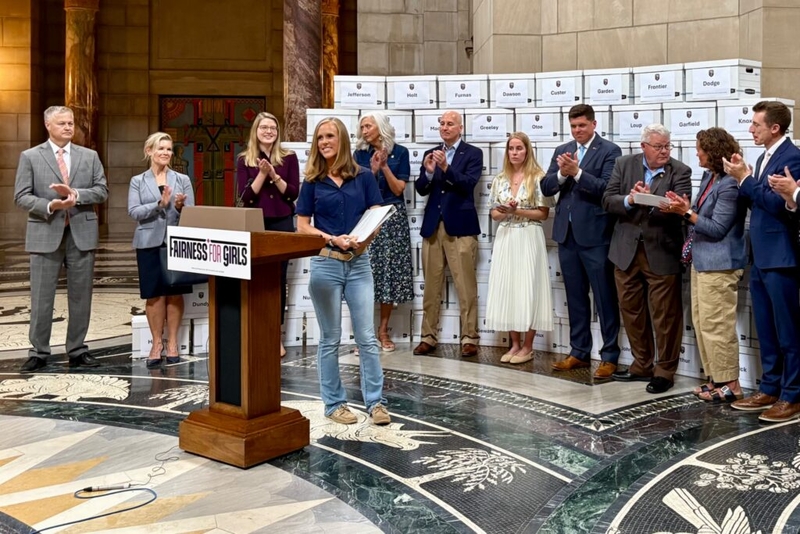
Former State Sen. Julie Slama of Dunbar leads a news conference for the Fairness for Girls campaign that seeks to constitutionally designate sex-separate athletics for K-12 and collegiate sports on June 30, 2026. (Photo courtesy of Julie Slama/Fairness for Girls)
LINCOLN — The Nebraska Supreme Court on Friday unanimously upheld the validity of a 2026 ballot measure seeking to cement sex-separate school sports requirements in the Nebraska Constitution.
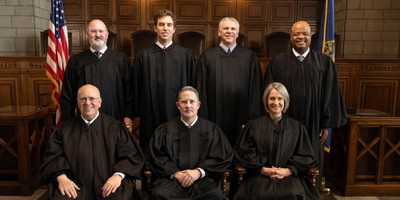
Justice Derek Vaughn of Omaha, in a 7-0 opinion, agreed with a lower district court’s ruling that the Fairness for Girls campaign had enough detail on its petition pages under state law.
“Section 32-1401 does not require an object statement to summarize all major provisions of an initiative,” Vaughn wrote.
Voters will see the item on their ballots as Initiative Measure 442. A hearing on the measure was held in Lincoln this week, and public hearings will be held in Kearney and Omaha next week.
The Fairness for Girls proposal would make permanent part of a 2025 state law requiring public K-12 schools, colleges and universities, and any private schools or colleges in the state playing against those schools, to designate sports and teams as male, female or coed. Male students couldn’t play on female-only teams.
The ballot measure would not define “sex” in the constitution. State law defines sex as whether someone “naturally has, had, will or would have, but for a congenital anomaly or intentional or unintentional disruption, the reproductive system that at some point produces, transports and utilizes” either eggs (female) or sperm (male) for fertilization.
A Lincoln voter, Cara Ullman, argued that the petitions lacked specificity in their “object statement,” so she signed to place the issue on the ballot without fully knowing what it would do.
Ullman’s attorney, Sydney Hayes, had argued before Lancaster County District Judge Lori Maret that if object statements could be so broad, it could be “open season for vague, incomplete and misleading” statements.
Lancaster County District Judge Lori Maret ruled against all of Ullman’s points. The Supreme Court noted that if a voter wanted to know exactly what a measure would do, they “need only flip over the page to read the proposed initiative’s full text.”
Lancaster County judge dismisses challenge to Nebraska K-12, collegiate sports ballot measure
Vaughn said the court could not read additional meaning into the law and that the court’s interpretation is supported not just by what’s in the law but also by what’s excluded.
For example, in Arizona, petitioners must describe the “principal provisions of the proposed measure” and a disclaimer that the description “may not include every provision contained in the measure,” Vaughn wrote.
The justices said a ballot measure’s object statement needs to say what type of measure it is.
“The language ‘legal effect of the filing of the petition’ contained in § 32-1401 does not require an initiative’s object statement to set forth every consequence that would result from the initiative measure should it be adopted by voters,” Vaughn wrote. “Instead, based on its plain language, it requires only that the object statement informs potential petition signers whether the legal effect of the petition is a referendum, enactment of a law or a constitutional amendment.”
Justice Jason Bergevin did not participate in the decision. Court of Appeals Judge PaTricia Freeman rounded out the court in his absence.
The general election is Nov. 3.
Lincoln, NE