Oklahoma state superintendent candidates seek more unified approach to education
Oct 16, 2026 | 11:24 am ET
Description
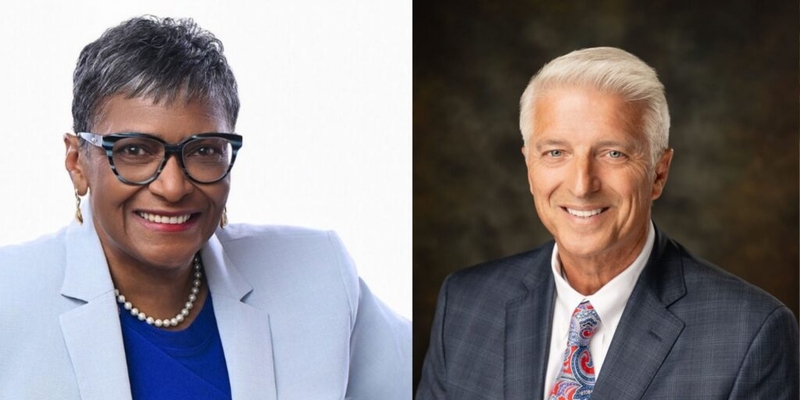
Democrat Jennettie Marshall, left, and Republican Robert Franklin, right, are running in the Nov. 3 general election for Oklahoma state superintendent. (Photos provided)
OKLAHOMA CITY — Two candidates hoping to lead a more collaborative Oklahoma State Department of Education are running for superintendent of public instruction.
Voters will choose between Republican Robert Franklin and Democrat Jennettie Marshall in the Nov. 3 general election. The winner will govern the state’s public schools system as the head of both the Education Department and the Oklahoma State Board of Education.
While Marshall touted her administrative experience in law enforcement and as a member of the Tulsa Board of Education, Franklin said his 45 years working as a teacher and leader in K-12 schools, CareerTech and higher education make him the most qualified candidate for the role.
Both candidates said they want to improve Oklahoma’s poor academic outcomes and support teachers rather than focus on political divisions.
“That seems to be something that we’re hand in hand on,” Franklin said. “So now, what’s the differentiating factor? To me, it goes down to the experience.”
Franklin, 66, of Sand Springs, said his top priority would be to unify school districts, higher education institutions, tribal nations and other key stakeholders to address Oklahoma’s teacher workforce shortage. Boosting the pipeline of future teachers with programs like Union High School’s educational leadership course could be scaled statewide, he said.

Oklahoma could keep teachers in the classroom with regionally competitive pay, he said, and by hiring more counselors and behavioral health specialists to help address classroom disruptions.
Franklin also proposed opening regional service centers at higher education campuses across the state where Education Department staff could bring professional development, particularly in early literacy and math, and other resources to nearby public schools.
Marshall, 68, of Tulsa, suggested hosting regional problem-solving sessions each month to more quickly address local concerns.
She said Oklahoma must do better than aim for the regional average in teacher pay. Respect for teachers’ professional skills must be restored, she said.
“In reality, what we see is teachers not being paid what they should be paid in the state, and we see teachers feeling devalued by the fact that they’re not able to teach because they are placed in the confines of cookie-cutter curriculums,” Marshall said.
The state superintendent has limited influence over teacher salaries, state funding levels for public schools and classroom lesson plans. But, both candidates said they hope to enact change by improving the Education Department’s relationships with districts and other state entities, which they said suffered during former Superintendent Ryan Walters’ turbulent tenure.
Walters, a Republican, resigned in September 2025 to lead a nonprofit. Neither he nor his governor-appointed successor, Superintendent Lindel Fields, filed to run this year for elected office.
The Education Department must hold districts accountable for their academic results, Marshall said, but the agency should offer help and resources rather than punishment. While Marshall served on the Tulsa school board, Walters threatened a state takeover of the district if it didn’t quickly improve its academic scores.
“When people are operating under a punitive umbrella, they’re less productive,” she said. “Rather than being focused on the business at hand, they are busy looking over their shoulders, seeing when the hammer’s going to fall. Who’s coming after me? What are they coming after me for next? And that’s where we were with Ryan Walters. We were in a very combative and volatile season, and that was statewide. Educators can’t teach while walking on eggshells.”
Providing schools with more immediate and usable state testing data could help drive academic improvement, Franklin said. He suggested changing Oklahoma’s method of state testing from once-a-year exams in the spring to benchmark assessments, which students would take incrementally throughout the school year.
Some states, such as Indiana, already have switched to benchmark-style tests to give schools and parents more up-to-date information on students’ academic progress. Walters called for a similar change shortly before he left office.
Unlike Walters, who claimed state testing could be overhauled in less than a year, Franklin said it’s “going to take us a while” to develop a plan and earn federal approval.
Many Oklahoma districts pay for benchmark assessments and deliver them internally to inform instructional decisions.
State test scores, on the other hand, typically aren’t revealed in Oklahoma until the following school year.
“That is nothing but a bureaucratic process that is supporting no one, and we’re spending millions doing it and making ourselves miserable all the month of April and May,” Franklin said.
Although she didn’t call for a new state testing system, Marshall echoed that education data is often provided and acted upon too late.
“If we have a teacher that’s not making the mark or we have a child that’s not making the mark, why are we waiting?” she said. “If something is not working to get that child across the finish line, change it then.”
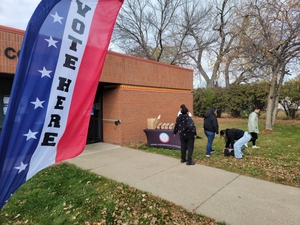
Early voting will take place Oct. 28-31. Polls will open on Election Day Nov. 3 from 7 a.m. to 7 p.m.
Oklahoma City, OK