If Wisconsin is in great financial shape, why can’t we afford to fund our schools?
Oct 16, 2026 | 4:00 am ET
Description
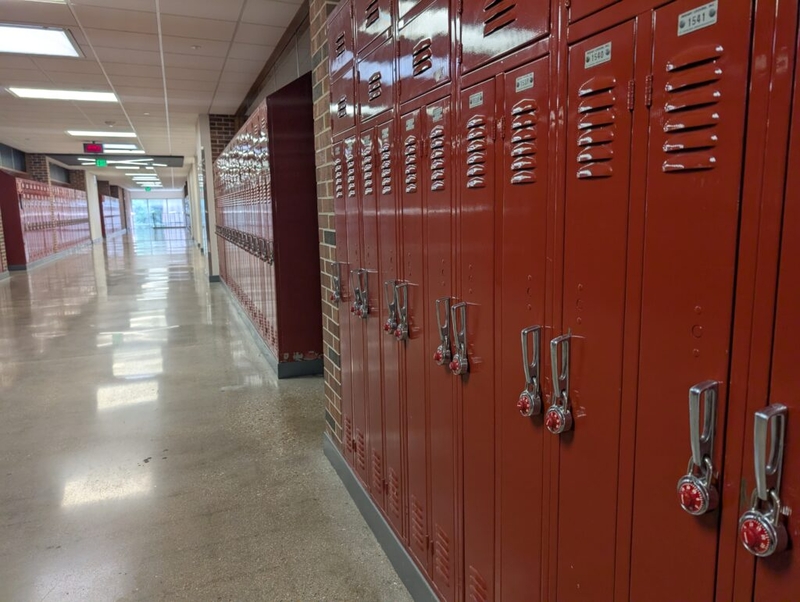
A hallway in La Follette High School in Madison. (Baylor Spears/Wisconsin Examiner)
It was a dreary, rainy Thursday morning when the state education department announced some depressing news: According to the final, official numbers, 62% of Wisconsin school districts will receive less money in state general aid this year than they did last year.
Schools are struggling because, for the third year in a row, the state budget put no new money into general school aid, the Department of Public Instruction pointed out in an Oct. 15 press release. That’s after more than 15 years during which per-pupil spending in Wisconsin schools has failed to keep pace with inflation. The latest school funding data arrived from DPI under the header: “Nearly two-thirds of districts will receive less aid due to flat state funding, antiquated funding formula,”
About an hour later, a press release from Gov. Tony Evers’ office cheerfully announced that Wisconsin has ended the fiscal year with a $3.3 billion budget balance and a record $2.1 billion in the state’s “rainy day” fund. The top line from the governor’s office message was upbeat: “Despite continued national economic turbulence, Wisconsin maintains strong fiscal position, reaching seven consecutive years of record-high General Fund balances during Gov. Evers’ tenure.”
These two announcements, although dramatically different in mood, are directly connected. The reason Wisconsin has a big budget surplus is largely because the state has abandoned its commitment to fund its public schools.
A slide presentation by Anne Chapman, research director for the Wisconsin Association of School Business Officials graphically illustrates the decline in per-pupil spending on Wisconsin public school students since the 2008-2009 school year. Using Legislative Fiscal Bureau data, Chapman shows the steadily widening gap between the money schools would have had each year if revenue had kept pace with inflation and what they actually had. This year the shortfall reached $3,571 per kid.
At the same time, schools have been carrying about $1.29 billion in special education costs that used to be paid for by the state.
Schools have never bounced back from the drastic cuts to education spending during the administration of former Gov. Scott Walker. But the current budget situation is unprecedented, Chapman says.
“The 2025-27 state budget provided no increase to general school aids. This was an extremely unusual policy choice, especially in light of the fact that the state had a $4.3 billion surplus going into the budget process,” she says. “The last instance of flat or negative general aids across both years of a biennial budget was the 2009-11 budget, at which time the state was facing a deficit.”
In other words, in a historic act of stinginess, the Legislature, while staring at a sizeable budget surplus, chose not to put a dime of it into public schools. That was a deliberate policy choice, not some sort of emergency measure taken under duress.
Wisconsin’s school funding formula is complicated — a mix of state and local funds divvied up based on school districts’ property wealth, enrollment numbers and spending patterns. Enrollment is figured out on a three-year rolling average, and different districts get different amounts of funding from the state — and some get none at all. When funding is flat, statewide, some districts get more and some get less. This is the “antiquated” system DPI referred to in its press release. It uses outdated metrics, and doesn’t account for the effects of high poverty or large numbers of English language learners.
State schools superintendent Jill Underly expanded on this in her State of Education speech in September: “The formula places value on the wrong things. It values enrollment, district spending, and property value, rather than student needs. It fails to ask the most essential question: how much does it actually cost to educate the students who live in a district so that they have an equal opportunity to succeed? A student’s opportunity for success should not depend on their zip code. If we are going to improve the academic outcomes for ALL students, then the funding formula must prioritize student need.”
Because of the complexity of school finance, and the patchwork of have and have-not districts, it’s hard to figure the exact amount Wisconsin has underfunded its schools since 2009, when overall per-pupil spending stopped keeping pace with inflation. But you can get a rough, back of the envelope estimate by taking DPI’s total enrollment number from 2025-26 — 781,367 students — and multiplying it by the Legislative Fiscal Bureau’s estimate of the shortfall in per-pupil spending that year compared with inflation, which was $3,468.60. The number you get is $2.7 billion in combined state aid and property tax levies. If the state returned to its much-discussed commitment to fund two-thirds of the cost of public schools, that would mean we’d have to allocate $1.8 billion of the current $3.3 billion surplus to make schools whole. Add to that the $1.29 billion in special ed costs the state has sloughed off on the schools, and it reaches $3 billion.
One of the main effects of the state deciding not to fund schools is that the burden has fallen instead on local property taxpayers, who are confronting another surge in referendum requests from their local school districts in the voting booth this fall.
Gov. Evers has proposed, by his own estimate in an address to the Wisconsin Public Education Network, $7 billion in new funding for schools that was rejected by the state Legislature over his two terms. He was bitterly disappointed when the state Senate rejected a $1.8 billion deal he struck with Republican legislative leaders that included some money for increased special education funding and property tax relief along with income tax cuts.
But in his latest message, the governor embraces the unspent money sitting in state coffers as “damn good news.”
“We’ve ended every fiscal year I’ve been governor with a positive balance,” he says. “We’ve shown that state government can work, and work better for the people we serve, and I’m incredibly proud of our efforts.”
Along with the surplus, the governor’s office celebrates the “largest balance in the ‘rainy day’ fund in state history” — at $2.1 billion, it’s six times larger than when Evers took office.
Meanwhile, schools are in worse and worse shape, and all over the state, people are struggling to keep up with the cost of housing as property taxes rise.
Whatever feeling of satisfaction there is in knowing the state has squirreled away a fat rainy day fund, when you look outside, it’s raining.
Madison, WI