RI Health and Human Services head to replace Roger Williams, Fatima hospitals CEO
Oct 15, 2026 | 2:06 pm ET
Description
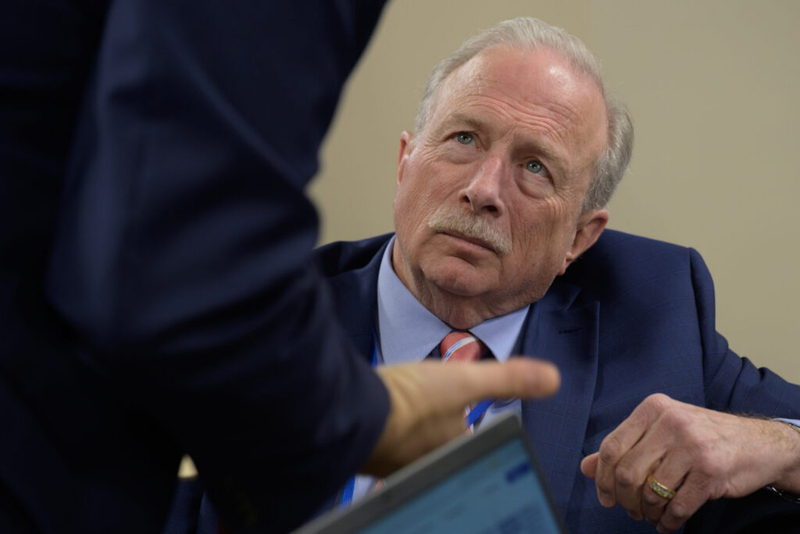
Rhode Island Health and Human Services Secretary Richard Charest is leaving state government to take a job as CEO of CharterCARE Health of Rhode Island, the local owners of Roger Williams Medical Center and Our Lady of Fatima Hospital. (Photo by Michael Salerno/Rhode Island Current)
In November, Rhode Island Health and Human Services Secretary Richard Charest’s covert courtship of another hospital buyer for Roger Williams Medical Center and Our Lady of Fatima Hospital drew a strong rebuke from the head of the nonprofit already approved to buy the hospitals.
Eleven months later, with the sale to The Centurion Foundation complete, Charest has been tapped to lead its Rhode Island hospitals operations.
CharterCARE Health of Rhode Island, Centurion’s local subsidiary, announced Wednesday that Charest will replace retiring CEO Jeffrey Liebman on Nov. 1. Charest submitted his resignation letter to Gov. Dan McKee the same day, according to the letter shared with Rhode Island Current.
Charest, 74, has worked for McKee’s administration since 2021, leading the Executive Office of Health and Human Services since 2023. He was appointed by CharterCARE’s 13-member board of directors, Ben Mingle, Centurion CEO and CharterCARE board president, said.
“Our Board felt that Rick’s experience and skill set made him uniquely qualified over other candidates to step right in and begin executing on our comprehensive strategic turnaround plan,” Mingle said in a statement.
Liebman has led CharterCARE since 2018, including through the sale to Centurion. The CharterCARE website lists him as a member of the board of directors, and it was unclear if he intends to remain on the board after he retires.
Otis Brown, a spokesperson for CharterCARE, did not respond to questions regarding the search process, including how many other candidates were considered by the board, or requests for a copy of Liebman’s resignation letter.
“I look forward to tackling the challenge of leading CharterCARE Health of Rhode Island,” Charest said in a statement. “We must deliver on the strategic turnaround plan to stabilize finances and strengthen operations of these essential safety-net hospitals. I commit my best efforts to CharterCARE’s board, providers, and employees to make this happen.”
Charest initially sought to retire from state government in July but then reversed course, agreeing to McKee’s request to stay in the $238,597 cabinet role and guide the massive state health and human service organization through massive federal policy and funding changes to Medicaid and the Supplemental Nutrition Assistance Program.
In his Oct. 14 resignation letter to McKee, Charest indicated he had previously planned to leave state office on Nov. 28. Now, his last day will be Oct. 31, Charest wrote.
McKee, who leaves office in January after losing his primary reelection bid to Democratic challenger Helena Buonanno Foulkes, did not immediately respond to requests for comment on Charest’s departure.
Strained relations
Charest’s 26-year career includes nine years as president and CEO of Landmark Medical Center in Woonsocket, including through its receivership and sale to Prime Healthcare in 2013.
Charest reached out to his former employer last year, with the blessing of McKee’s office, to see if they were interested in buying Roger Williams and Fatima hospitals. At the time, Centurion had already received conditional approval from state regulators to buy the facilities, but had not closed the deal, struggling to secure the investor-backed financing amid poor credit ratings. Meanwhile, then-owner Prospect Medical Holdings, in the midst of Chapter 11 bankruptcy proceedings, threatened to close the hospitals if the sale didn’t go through.
McKee’s office defended the secret outreach to Prime as a necessary backup plan if the sale to Centurion failed. But Mingle blasted state officials for undermining the deal already in place, while unionized healthcare workers at the hospitals staged a public press conference accusing the state of breaching contract and business law by reaching out to Prime.
In the end, Prime wasn’t interested, and with an $18 million boost of state reserve funds, Centurion closed the sale in March.
Yet the initial work to resuscitate the hospitals has not gone smoothly. Contract disputes with 1,200 unionized hospital workers are entering a seventh month, with the United Nurses and Allied Professionals set to issue a strike notice Friday if they can’t reach a deal, said Chris Callaci, general counsel.
Meanwhile, Rhode Island Attorney General Peter Neronha rejected the new owners’ turnaround plan — one of 85 conditions imposed by state regulators in their June 2024 approval — deeming it insufficient to keep the facilities operating beyond a few months. A revised plan submitted by the Sept. 15 deadline remains under review, said Tim Rondeau, a spokesperson for Neronha’s office.
And now, a leadership change might necessitate review by the state ethics panel, according to Neronha.
“We hope the Board has undertaken a diligent and thorough vetting process in selecting their next leader,” Neronha said in a statement. “We do note that given his current position at EOHHS there may be some ethical considerations that would be most appropriate for the ethics commission to address.”
Neronha did not specify what part of the state ethics code may be in question in Charest’s move from state government to private sector work.
Back through the revolving door
A potential problem for Charest’s hire: the revolving-door clause, which limits state officials and administrators from representing themselves before state agencies where they worked for at least one year after leaving the position.
“He pretty clearly would be prohibited from interaction with EOHHS for a period of one year,” said John Marion, executive director for Common Cause Rhode Island.
Separate provisions of the ethics code would ban Charest from using confidential information obtained in his government role to help his new employer financially.
In 2017, when former Senate President Teresa Paiva Weed stepped down from her paid, elected position in the General Assembly to take a job leading the Hospital Association of Rhode Island, she sought an ethics recommendation regarding the revolving door provision of state law.
The commission advised that Paiva Weed could not lobby on behalf of or otherwise represent the hospital trade group before the legislature for one year, though the ban did not apply to other branches of government.
Marion thought Charest should also seek an advisory opinion from the Ethics Commission for his pending job move.
“It always makes sense when somebody moves from government to an industry that they regulated while in government to seek an advisory opinion so they know the boundaries under the code of ethics,” Marion said.
The Ethics Commission has not received any requests for advisory opinions about Charest’s new job as of Thursday afternoon, Teodora Papa, a staff attorney, confirmed via email.
Brown, of CharterCARE, did not respond to requests for comment on concerns over ethical conflicts with Charest’s hire.
Callaci, who blasted Charest for interfering in the Centurion deal last year, was indifferent to the leadership change. He remained focused on the contract battle between union workers and CharterCARE executives — a negotiation that Charest will not be part of, Callaci confirmed.
In a separate email sent to CharterCARE employees and shared with Rhode Island Current, Mingle also specified that Charest’s appointment was not tied to his past relationship with Prime.
“I thought that was weird,” Callaci said.“But, as long as he’s not carrying Prime’s water, look, Rick has a long resume, I can’t challenge his qualifications.”
Callaci continued, “He’s going to be tested, just like Jeff was. Let’s see what the outcome is. We wish him well, we want the hospitals to succeed.”
Mingle acknowledged the “short-term cash flow pressures” facing the hospitals in the wake of the sale while noting that there has been “positive progress,” including in the contract negotiations.
“Volume has since been trending up, we have recruited several new physicians and specialists, implemented new programs and services, invested in equipment and our physical plants, all contributing to improved financial performance,” Mingle said in a statement. “Again, our Board is acutely aware of the critical role our hospitals play in our state’s health care system, and we are laser-focused on doing what is needed to preserve our mission and our community’s access to quality health care.”

Providence, RI