ADPH encourages vaccination after measles case; no new cases immediately reported
Oct 15, 2026 | 11:54 am ET
Description
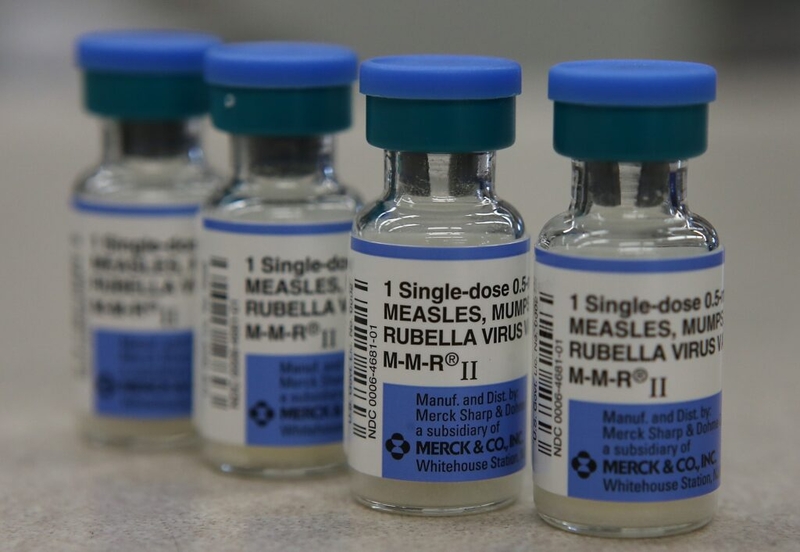
Vials of measles, mumps and rubella vaccine are displayed on a counter at a Walgreens Pharmacy on Jan. 26, 2015 in Mill Valley, California. Alabama public health officials said Thursday there are no new cases of measles after an Alabamian tested positive for the disease on Tuesday, and strongly encouraged vaccination. (Photo by Illustration Justin Sullivan/Getty Images)
Public health officials said Thursday there have been no new reported cases of measles after announcing a positive test in north Alabama earlier this week, but strongly encouraged vaccination as cases of the disease mount nationwide.
The Alabama Department of Public Health (ADPH) was not able to share many details of the positive test in north Alabama on Tuesday, but clarified Thursday the individual is an adult Alabamian who contracted the disease from a trip to South America. The department did not have any vaccination records for the individual.
The department said on Tuesday that the individual was out in public from Oct. 3 to 5 in the Bailey Cove area of Huntsville at a Subway and Publix.
“We are conducting epidemiologic surveillance. We are continuing to inform the public. We are informing physicians, emergency rooms, urgent cares about surveillance for measles,” Dr. Karen Landers, the chief medical officer for ADPH, said at a meeting of the ADPH board Thursday. “We will know if we have any additional spread of measles when we know.”
Landers, who was filling in for State Health Officer Dr. Scott Harris, said in an interview that the public is informed of a positive test “pretty immediately” after the lab report is verified.
“We verify our information, and we get our handout and our news release out immediately,” she said. “It’s our job to protect the citizens of Alabama, and secondly, we want to give people the information so that they can act accordingly for their own health and well-being.”
Symptoms of the disease can take seven to 14 days to present after infection, and can be particularly dangerous for infants and young children. Symptoms include a high fever, cough, runny nose, red, watery eyes and a rash.
According to CDC and ADPH guidance, children should get the first dose of the vaccine between 12 and 15 months, and the second dose between 4 and 6 years old before starting school. Adults should get one or two doses depending on individual risk factors, according to the department.
Landers said that people born prior to 1957 should be immune due to likely exposure to the contagious disease before the vaccine was developed in the mid-1960s, and that anyone uncertain of their vaccination status should check with their doctor.
“Be aware of this in terms of your own vaccination status, and if you are working in a high-risk situation such as a medical clinic or around patients that might be at higher risk to have severe infections,” Landers said. “I do want to remind people that this – other than persons that are severely immunocompromised – this is a very safe and effective vaccine.”
Alabamians who have received both doses of the vaccine do not need to revaccinate, Landers said. But she said additional doses are not harmful if an individual’s vaccination status is unknown.
Dr. Marquisha Jarmon, a Hoover-based pediatrician, said some of her patients’ parents do not vaccinate their children.
“Being in a pediatric practice, one of the things that I do talk to my parents about – because unfortunately, I do have patients who don’t vaccinate – I take care of other issues for them, but they have chosen not to vaccinate, or they do a delayed schedule,” she said. “One of the things I ask them not to do is that if they have signs of a rash or anything like that, not come to the clinic, and we do a lot of telemedicine for those things. Do you offer a PCR test that we can send to the patient that they can possibly do at home and send out?”
The measles test, known as a RT-PCR test, is a swab in the nose or mouth, according to the U.S. Centers for Disease Control and Prevention (CDC). Landers said there is not a take-home option. She recommended Jarmon send her patients to either a private or ADPH laboratory.
As of Friday, the U.S. Centers for Disease Control and Prevention confirmed 4,080 cases reported by 47 states of the highly contagious virus. In 2025, there were 2,289 cases reported by 45 states. There are currently outbreaks in Pennsylvania, Utah, Maryland, Delaware and Wisconsin.
One Alabamian has tested positive for the disease this year, but they were out-of-state and posed no threat of an outbreak to Alabama. There was one confirmed case of measles in Alabama in 2025: an unvaccinated child in the northern part of the state who was under five years old. The child later recovered.
In Pennsylvania, there have been more than 1,200 cases, 225 hospitalizations and five associated deaths. There were three reported deaths in 2025 in the U.S., a 0.13% mortality rate. The CDC has confirmed two deaths so far in 2026, a 0.05% mortality rate.
“Continue to remind people to vaccinate. This is a safe, effective vaccine. And the way we’ve gotten by in Alabama is we generally have a very high vaccination rate,” Landers said. “But as Dr. Jarmon pointed out, that’s changing.”
According to the CDC, 94.3% of Alabama kindergarteners are vaccinated against the disease for the 2025-26 school year. In the 2024-25 school year, 95.2% of kindergarteners were vaccinated.
About 92.7% of Pennsylvania kindergarteners are vaccinated against the disease for the 2025-26 school year, according to the CDC. Herd immunity against the disease is reached at 95% vaccination.
Landers, who was a north Alabama-based pediatrician and infectious control physician before becoming chief medical officer, said in an interview that the only way to protect against measles is to get the measles, mumps and rubella (MMR) vaccine.
“It’s a generational vaccine. It’s probably been given to more people than just about any other vaccine because of the length of time, and there are not any studies that indicate that this vaccine causes side effects in people,” Landers said. “We absolutely need to inform ourselves, talk to our physicians, talk to our pharmacists, and be aware that this disease can be severe and deadly. We don’t want to see that happen in Alabama. We don’t want to see what happened in Pennsylvania happen in Alabama.”
Weida recommended Alabamians in high-exposure professions – like healthcare providers – ensure they are vaccinated.
“If we don’t know, then they should get at least a dose. And if they’re in healthcare, they need to get two doses,” Weida said.
Montgomery